
History
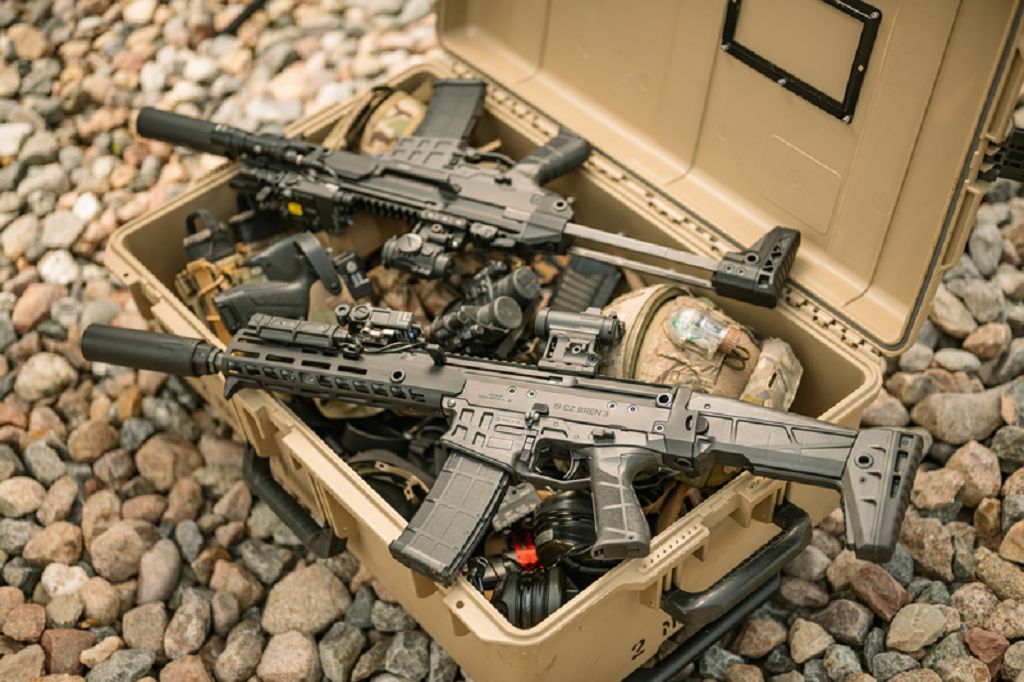
Česká zbrojovka (CZ) first presented the CZ BREN 3 assault rifle series to the international defence community at Eurosatory in Paris in June 2024. The third-generation BREN was developed with input from operational experience of earlier BREN rifles, including combat use in Ukraine.
Montenegro became the first country to adopt the CZ BREN 3. Representatives of the Montenegrin Ministry of Defence received the first shipment of a few hundred small arms, including BREN 3 assault rifles, in Podgorica on 7 October 2026 under an intergovernmental defence agreement signed on 19 May 2026. The full contract, valued at approximately €24.2 million, covers thousands of BREN 3 rifles from Colt CZ Group along with hundreds of pistols, sniper rifles, submachine guns, and various types of small-calibre ammunition, all planned for delivery by the end of 2026. The first shipment was flown to Montenegro aboard a Czech Air Force Embraer C-390 Millennium, which the Czech military had received on 6 October 2026; the BREN 3 cargo was the aircraft's first freight mission. The Czech Ministry of Defence stated that the two governments were already discussing a second intergovernmental agreement, with further negotiations expected in mid-October 2026.
Specifications
The CZ BREN 3 is a gas-operated rifle employing a short-stroke piston and multi-lug rotating bolt. It features a three-position adjustable gas regulator for suppressed, standard, and adverse-condition operation; M-LOK aluminium handguards; AR-style ambidextrous controls with a 45° safety/fire selector; interchangeable grip backstraps in two sizes; a non-reciprocating folding charging handle that also serves as a forward assist; and a bolt release located inside the trigger guard. The factory-set trigger has a 25 N pull weight with 7 mm of travel and 4 mm of reset. The rifle provides seven quick-detachment sling attachment points (two forward, five rear). The series passed NATO AC/225 D/14 endurance tests, including sand drag, icing, safety drop, salt-water immersion, and cook-off. Calibre conversion between 5.56×45 mm NATO and .300 AAC Blackout requires only a barrel and forend swap, with all internal components remaining in place.
The standard magazine holds 30 rounds and is STANAG (AR-15/M4) compatible. Depending on configuration, the rifle weighs between 3.0 and 3.6 kg without a magazine. The series comprises six models:
- CZ BREN 3 7" SR – .300 AAC Blackout, 180 mm barrel, 3.6 kg (with A-TEC A-Flow suppressor as standard), folding 4-position telescopic stock
- CZ BREN 3 9" – .300 AAC Blackout, 229 mm barrel, 3.1 kg, folding 4-position telescopic stock
- CZ BREN 3 7" PDW – 5.56×45 mm NATO, 180 mm barrel, 3.0 kg, PDW 1+3-position telescopic stock
- CZ BREN 3 11" – 5.56×45 mm NATO, 280 mm barrel, 3.1 kg (3.15 kg with optional rail handguard and folding steel sights)
- CZ BREN 3 14.5" – 5.56×45 mm NATO, 367 mm barrel, 3.3 kg (3.35 kg with optional rail handguard and folding steel sights)
- CZ BREN 3 16.5" – 5.56×45 mm NATO, 420 mm barrel, 3.4 kg (3.45 kg with optional rail handguard and folding steel sights)
All models use M-LOK handguard systems. Barrel twist rates are 1:5 in (4 grooves) for .300 Blackout models and 1:7 in (6 grooves) for 5.56×45 mm NATO models. Muzzle threads are 5/8-24 for .300 Blackout and 1/2-28 for 5.56×45 mm NATO. Typical factory-fitted accessories include the Spuhr RDF-20225K mount and the Aimpoint COMP M5 red-dot sight with Aimpoint 3-Mag 1 magnifier.
Operators
Montenegro is the first country to operate the CZ BREN 3. The broader CZ BREN platform (including earlier generations) is in service with the armed forces of more than twenty countries, including the Czech Republic, Argentina, Bosnia and Herzegovina, Cambodia, France, Hungary, Kenya, Moldova, Poland, Portugal, Romania, Rwanda, Ukraine, the United Kingdom, Zambia, Slovakia, Ghana, India, Indonesia, and Lebanon. BREN-series rifles have also been adopted by the French GIGN anti-terrorist unit.
 Argentina
 Armenia
 Australia
 Austria
 Austria-Hungary
 Belgium
 Brazil
 United Kingdom
 United States
 Brunei
 Bulgaria
 Canada
 Chile
 China
 Colonial America
 Colombia
 Confederate States
 Croatia
 Denmark
 Egypt
 Finland
 France
 Georgia
 Germany
 German Imperial
 Greece
 Holland
 Hungary
 India
 Indonesia
 Iran
 Iraq
 Ireland
 Israel
 Italy
 Japan
 Japan (1940)
 Jordan
 Kingdom of Italy
 Malaysia
 Mexico
 Myanmar
 Nazi Germany
 Netherlands
 New Zealand
 North Korea
 Norway
 Pakistan
 Peru
 Philippines
 Poland
 Portugal
 Prussia
 Romania

 Russia
 Saudi Arabia
 Serbia
 Singapore
 Slovakia
 Slovenia
 South Africa
 South Korea
 Soviet Union
 Spain
 Sweden
 Switzerland
 Syria
 Taiwan
 Thailand
 Turkey
 UAE
 Ukraine
 Vietnam
 Yugoslavia