
History
The iQPS QPS-SAR is a Japanese family of compact synthetic-aperture radar Earth-observation satellites. The system uses X-band radar to collect imagery during daylight or darkness and through cloud cover.
Institute for Q-shu Pioneers of Space, Inc. developed QPS-SAR as the basis of a planned 36-satellite commercial constellation. The completed constellation is intended to observe selected locations at average intervals of about ten minutes.
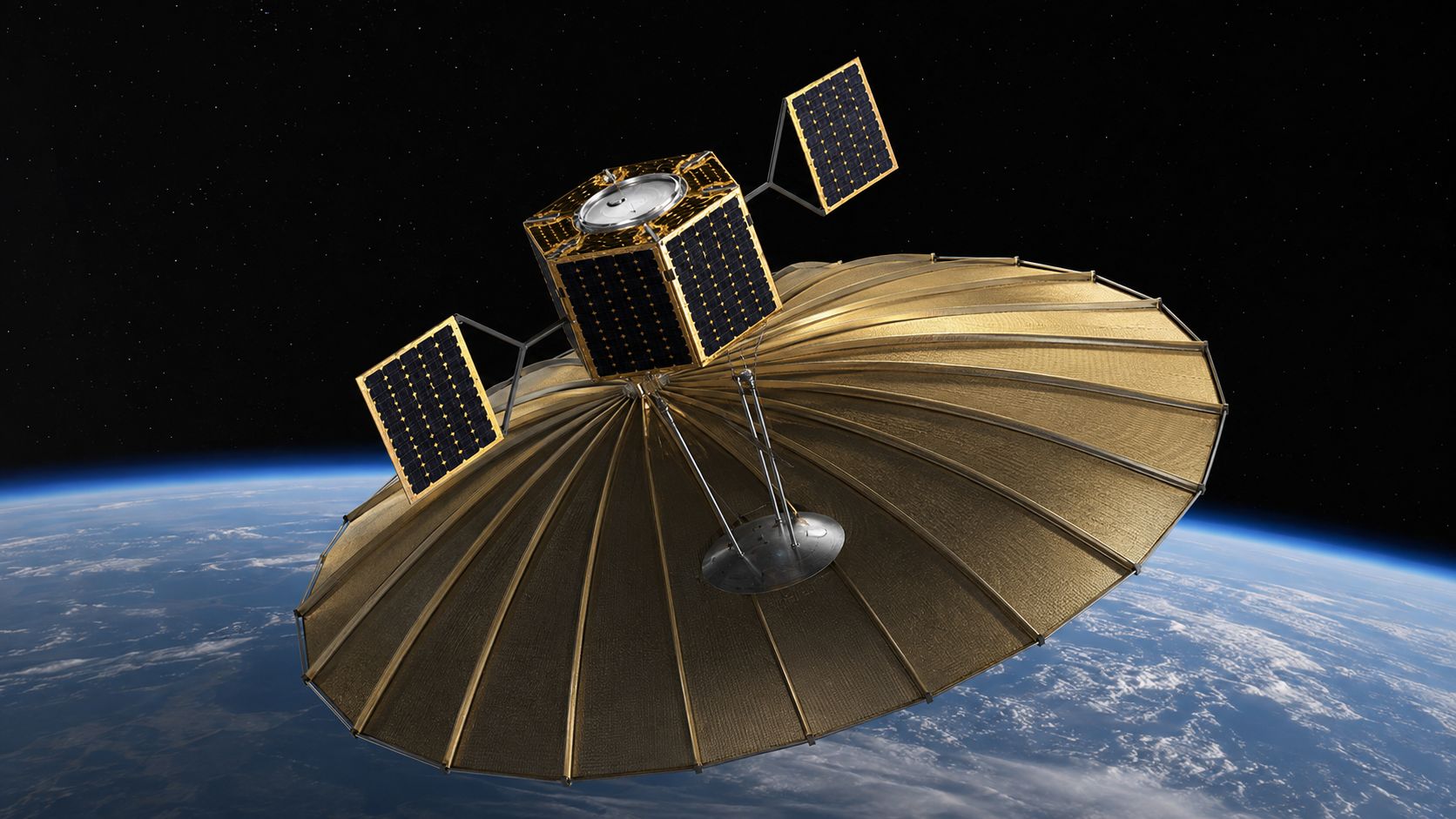
Each spacecraft has a mass of approximately 100 kg and carries a lightweight deployable antenna measuring 3.6 m in diameter. This design allows a relatively small satellite to produce sub-metre radar imagery.
Development
iQPS was founded in Fukuoka in 2005 by Tetsuo Yasaka, Noboru Sakurai and Kunihiro Funakoshi. The company grew from small-satellite research conducted at Kyushu University and was established to support a space industry in the Kyushu region. Its later business plan centered on a constellation of small radar-imaging satellites.
The first QPS-SAR spacecraft, QPS-SAR No.1 Izanagi, was launched by an Indian PSLV on 11 December 2019. Its antenna deployed in orbit five days later. Although the satellite reportedly demonstrated most of its functions, technical defects prevented it from providing the intended radar data.
QPS-SAR No.2 Izanami followed aboard a SpaceX Falcon 9 rideshare mission in January 2021. The satellite established communications, deployed its antenna and entered commissioning. In March 2021, iQPS announced the acquisition of its first radar imagery. By May, the company reported imagery with a resolution of 0.7 m over Japan.
QPS-SAR No.3 Amateru-I and No.4 Amateru-II represented an improved operational design. Both were launched aboard Japan's Epsilon-6 rocket on 12 October 2022, but the launch vehicle failed and the satellites did not reach orbit.
QPS-SAR No.6 Amateru-III was launched on SpaceX's Transporter-8 mission on 12 June 2023. Communications were established and its antenna was deployed on the day of launch. In July, iQPS reported imagery with a resolution of approximately 0.46 m. QPS-SAR No.5 Tsukuyomi-I was launched by a Rocket Lab Electron on 15 December 2023 after a change of launch provider.
Tsukuyomi-I returned its first stripmap images in January 2024. The images were collected through cloudy weather while the radar system was being calibrated at several power settings. In February, iQPS released spotlight images with a resolution of approximately 0.46 m. SpaceX subsequently launched QPS-SAR No.7 Tsukuyomi-II in April 2024 and No.8 Amateru-IV in August.
Rocket Lab began a series of dedicated Electron missions for iQPS with QPS-SAR No.9 Susanoo-I on 15 March 2025. QPS-SAR No.10 Wadatsumi-I followed on 17 May, and No.11 Yamatsumi-I was deployed on 11 June. QPS-SAR No.12 Kushinada-I, No.14 Yachihoko-I and No.15 Sukunami-I were also launched during 2025. A further Rocket Lab mission carrying an iQPS radar satellite launched on 6 August 2026 after an earlier attempt had been aborted more than a month before.
Launch records and spacecraft details are available from eoPortal, Gunter's Space Page and the iQPS satellite list. Rocket Lab's QPS-SAR mission press kit describes the dedicated Electron launch program.
Design
Spacecraft
QPS-SAR was designed to place a capable radar payload on a spacecraft with a mass of about 100 kg. The central feature is a patented spring-loaded antenna. It measures approximately 0.8 m in diameter and 0.15 m high when stowed, then unfolds into a seamless bowl approximately 3.6 m in diameter after orbital deployment.
The operational spacecraft introduced from QPS-SAR No.3 use an improved antenna design. They also have two deployable solar arrays, increased battery capacity and electric propulsion. The thrusters support orbit maintenance and controlled deorbiting at the end of a mission.
The spacecraft also carry a sensor developed by iQPS and IHI Corporation to study sub-millimetre orbital debris. Its array of electrically energized thin wires records impacts when debris cuts individual wires.
Radar payload
QPS-SAR is an active X-band imaging radar operating at 9.38 GHz. Unlike an optical camera, it transmits radio-frequency energy and measures the returned signal. It can therefore image the surface at night and through clouds, smoke or volcanic plumes. Intended applications include disaster assessment, infrastructure monitoring and observation of stationary and moving objects.
The radar operates in stripmap and spotlight modes. Stripmap mode covers a wider area and provides a nominal spatial resolution of 1.8 m. Spotlight mode concentrates observations on a smaller area and provides a resolution of approximately 0.46 to 0.47 m. The WMO OSCAR instrument record lists a 14 by 7 km stripmap scene and a 7 by 7 km spotlight scene.
The antenna can image in multiple directions, with viewing angles between 15 and 50 degrees off nadir. It supports HH or VV polarization, has an approximate bandwidth of 600 MHz and produces up to 2 kW of peak radiated power.
Onboard and ground processing
From QPS-SAR No.3 onward, the spacecraft incorporate the Fast L1 Processor, or FLIP. This onboard processing device was jointly developed by the Japan Aerospace Exploration Agency and Alouette Technology. It is intended to accelerate the preparation and distribution of radar data after an observation.
iQPS provides a ground console for selecting observation areas, submitting imaging tasks, accessing archived products and downloading data. The system also supports application programming interface integration. Available processing levels include complex radar data, amplitude products, ground-range-projected imagery and orthorectified imagery corrected with a digital elevation model.
Operational history
The constellation is operated by iQPS for commercial Earth observation. Its radar payload is suited to areas where darkness or poor weather limits conventional optical satellites. Demonstrated imagery has included urban areas, ports and regions obscured by clouds.
The operational satellites have been placed into several low Earth orbits rather than one common plane. QPS-SAR No.5 and several later Electron-launched spacecraft entered circular or near-circular orbits at approximately 575 to 585 km and an inclination near 42 degrees. Other spacecraft launched as rideshare payloads entered different inclinations and altitudes.
iQPS plans to expand the network to 36 satellites distributed among four orbital groups. The proposed completed constellation would provide an average ten-minute revisit interval for selected locations worldwide. This remains a planned constellation-level capability and does not describe the revisit performance of one satellite.
Variants
- QPS-SAR No.1 Izanagi: First prototype spacecraft, launched in 2019. Technical defects prevented delivery of the intended radar data.
- QPS-SAR No.2 Izanami: Second prototype, launched in January 2021. It returned the program's first radar imagery and demonstrated resolution of approximately 0.7 m.
- QPS-SAR No.3 and later: Improved operational design with a revised antenna, greater electrical power, deployable solar arrays, electric propulsion and FLIP onboard processing. No.3 and No.4 were lost in a launch failure, while later spacecraft reached orbit aboard Falcon 9 and Electron launch vehicles.
Operator
- Institute for Q-shu Pioneers of Space, Inc.: Japanese manufacturer, owner and commercial operator of the QPS-SAR constellation.
Specifications (QPS-SAR operational spacecraft)
General characteristics
- Type: Commercial synthetic-aperture radar Earth-observation satellite
- Mass: Approximately 100 kg
- Primary instrument: X-band synthetic-aperture radar
- Antenna diameter: 3.6 m when deployed
- Antenna mass: Approximately 10 kg
- Electrical power: Two deployable solar arrays with batteries
- Propulsion: Electric thrusters for orbit maintenance and deorbiting
Radar performance
- Frequency: 9.38 GHz
- Bandwidth: Approximately 600 MHz
- Peak radiated power: 2 kW
- Polarization: HH or VV
- Imaging modes: Stripmap and spotlight
- Stripmap resolution: 1.8 m nominal; 1.8 by 0.46 m in the WMO instrument record
- Stripmap scene: 14 by 7 km
- Spotlight resolution: Approximately 0.46 by 0.46 m
- Spotlight scene: 7 by 7 km
- Viewing geometry: Multiple directions, 15 to 50 degrees off nadir
 Argentina
 Armenia
 Australia
 Austria
 Austria-Hungary
 Belgium
 Brazil
 United Kingdom
 United States
 Brunei
 Bulgaria
 Canada
 Chile
Chile China
China Colonial America
 Colombia
 Confederate States
 Croatia
 Czech
Czech Denmark
 Egypt
Egypt Finland
 France
 Georgia
 Germany
 German Imperial
 Greece
 Holland
 Hungary
 India
India Indonesia
 Iran
Iran Iraq
Iraq Ireland
 Israel
 Italy
Italy Japan (1940)
 Jordan
 Kingdom of Italy
 Malaysia
 Mexico
 Myanmar
 Nazi Germany
 Netherlands
 New Zealand
 North Korea
 Norway
 Pakistan
 Peru
Peru Philippines
 Poland
 Portugal
 Prussia
 Romania
 Russia
 Saudi Arabia
 Serbia
 Singapore
 Slovakia
 Slovenia
 South Africa
 South Korea
 Soviet Union
 Spain
Spain Sweden
 Switzerland
 Syria
Syria Taiwan
 Thailand
 Turkey
 UAE
UAE Ukraine
 Vietnam
 Yugoslavia