
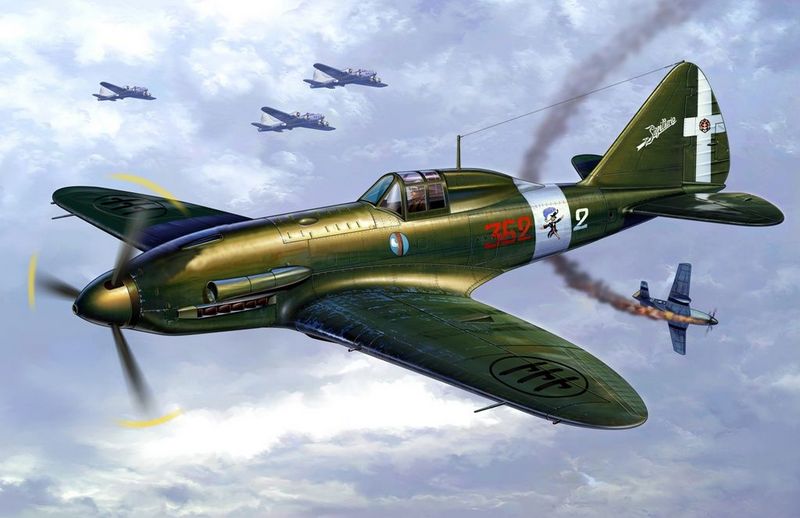
Regian re. History of Sagittarius (Archer) 2005
The pinnacle of Reggiane Re. The 2000 series of WWII fighters of Italian origin became the Re. 2005 Sagittarius ("Archer").
This form first flew on May 9, 1942, and was introduced in April-May 1943, culminating in the surrender of the Italian Air Force (Common Warring Forces and the Italian Social Republic) and the Luftwaffe. However, only 48 examples of this type were produced, severely limiting its contribution during the war.
The aircraft was highly regarded by its pilots and opponents alike, and was considered by many to be one of the best Italian fighters of the entire war.
During the development of the series, the aircraft used a variety of inline and radial engines, changing its profile. The original radial drive Re. Rejection by the Italian Air Force in 2000 (although adopted by Hungary and Sweden) led to the Re. 2001 design inspired by the German Diamler-Benz DB 601 inline engine. Upcoming Re.
2002 with Piaggio radial piston engine. There. In 2003, a "one-off", two-seat reconnaissance aircraft also had radial engines and the only prototype Re. 2004 fighter-bomber featured the Isotta Fraschini radial. The engine of choice for 2005 was the Fiat R.A.
1050 RC58 "Tifone" ("Typhoon"), a licensed German Daimler-Benz DB 605A-1 inline engine with 1,475 hp.
Re. In 2005, their design was further refined, including an improved landing gear and an improved chassis. The key change, however, was the use of an inline engine, which again changed Re. 2000 lines - especially the Re from the previous radial drive. 2002 brand.
The new aircraft's capabilities include a top speed of 390 mph, a cruising speed of 320 mph, a range of up to 610 miles, a service ceiling of 37,700 feet and a rate of climb approaching 3,900 feet per minute.
Armament consists of 2 x 12.7mm Breda SAFAT machine guns in the upper forward fuselage, fired synchronously through rotating propeller blades, and a 20mm MG-151 cannon fired through the propeller hub. Completing the weapon kit are 2 x 20mm MG 151 cannons mounted on the wings, one per wing. The 12.7mm machine gun was allowed to fire 350 rounds, while the hub gun was fired from a 150-round magazine.
The wing guns received 200 rounds per minute. The aircraft is also capable of strike operations, carrying up to 2,550 pounds of external material under the fuselage centerline hardpoints and under each wing. Throwing weapons can be replaced with throwing tanks for longer range.
Overall, re. In 2005, parts of a state-of-the-art fighter aircraft look. It has a sleek, long-nose design with the cockpit mounted amidships. The nose is nicely streamlined thanks to the use of an in-line engine. The system drives a three-bladed propeller unit with a large spinner in the middle.
The wings are mounted on both sides of the hull in front of the mid-hull. The tail is very traditional, with a vertical tail and low mounted horizontal plane. The landing gear has a trailing device and is retractable. The visibility of the cockpit was limited due to its positioning (and the bulge of the fuselage spine), but it was still usable in the heat of battle. Pilots and opponents alike appreciated the design for its good performance and powerful front armament.
Its qualities allowed it to take on the roles of fighter, fighter-bomber and interceptor at the same rate - limited only by small production numbers and Italy's position throughout the war, first as a member of the Axis powers and then as a member of the Allies supporters.
after a re. Commissioned in 2002, Re. Serial production was also accepted in 2005, starting in September 1942 and continuing until May of the following year.
Subsequent deliveries in 1943 brought total production to only the stipulated 48, some of which were available when the Italian Armistice ended in September 1943. These saw defence-oriented services through Naples, Roma and Sicily.
This re. Aircraft that were not destroyed by their pilots or lost to combat attrition in 2005 were either incorporated into the Italian warring forces, the Axis Air Service of the Italian Social Republic, or - like the 13 Re.
2005 copy - taken over by the Luftwaffe . By the end of 1944, further wear and tear led to some operations, and after hostilities ceased in 1945, the line was officially phased out - the aircraft never really achieved its full combat potential.
Specification
Basic
Production
Roles
- Fighter
- Intercept
- Ground Attack
Dimensions
28.64 feet (8.73 m)
36.09 ft (11 m)
10.33 ft (3.15 m)
Weight
2,600 kg
3,900 kg
Performance
Performance
391 mph (630 km/h; 340 knots)
37,730 ft (11,500 m; 7.15 mi)
609 miles (980 km; 529 nautical miles)
1,189 m/min (3,900 ft/min)
Armor
Default:
1 x 20mm MG 151 cannon firing through the propeller hub.
2 x 20 mm MG 151 wing cannons (one per wing)
2 x 12.7mm heavy Breda SAFAT machine guns in the hood.
1 x 2,200 lb bomb below the centerline of the hull
2 x 350 lb conventional drop bombs under the wings (one hardpoint per wing).
 Argentina
 Armenia
 Australia
 Austria
 Austria-Hungary
 Belgium
 Brazil
 United Kingdom
 United States
 Brunei
 Bulgaria
 Canada
 Chile
Chile China
China Colonial America
 Colombia
 Confederate States
 Croatia
 Czech
Czech Denmark
 Egypt
Egypt Finland
 France
 Georgia
 Germany
 German Imperial
 Greece
 Holland
 Hungary
 India
India Indonesia
 Iran
Iran Iraq
Iraq Ireland
 Israel
 Italy
Italy Japan
Japan Japan (1940)
 Jordan
 Malaysia
 Mexico
 Myanmar
 Nazi Germany
 Netherlands
 New Zealand
 North Korea
 Norway
 Pakistan
 Peru
Peru Philippines
 Poland
 Portugal
 Prussia
 Romania
 Russia
 Saudi Arabia
 Serbia
 Singapore
 Slovakia
 Slovenia
 South Africa
 South Korea
 Soviet Union
 Spain
Spain Sweden
 Switzerland
 Syria
Syria Taiwan
 Thailand
 Turkey
 UAE
UAE Ukraine
 Vietnam
 Yugoslavia