


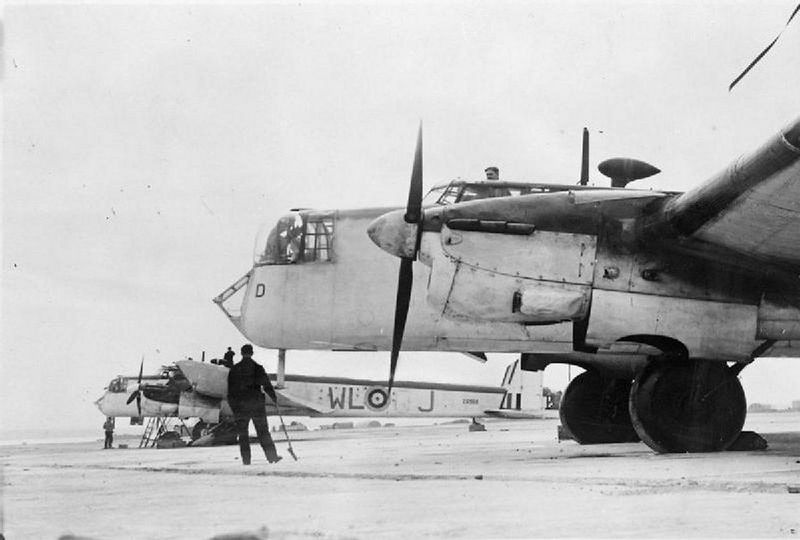


The Story of Armstrong Whitworth Whitley
The British Armstrong Whitworth Whitley continued the tradition of ugly but sturdy and reliable heavy bombers as the heavy bomber of choice early in the war and until 1942. The massive, unattractive design gave the RAF a versatile heavy hitter to smash the inner workings of the German war machine.
Although obsolete by the middle of the war, Wheatley would still fulfill the intended role of its design and provide the RAF with a much-needed offensive strike.
The Wheatley was originally a derivative of the AW 23 transport/bomber design, the first Wheatley prototype flew in 1936. Operating models in the form of the previous two brands - Mk I and Mk II - in 1937 initially ordered 80 aircraft (34 and 46 respectively). There are subtle differences between the two, but more notable is the use of different powerplants - the Tiger IX radial engine in the Mk I and the Tiger VIII radial engine in the Mk II.
By the time the aggression broke out, the Mk I would have almost completely eliminated Europe. The Mk III appeared shortly after the first batch and introduced a retractable ventral gun position. The Mk IV will be equipped with a different Rolls-Royce radial engine.
A sub-variant of the Mk IV will feature a reconfigured powered rear turret housing four 7.7mm machine guns. The final bomber variant of the Whitley series will have to wait until the Mk V model arrives, when the system will bear the brunt of advanced bombing raids on enemy territory.
Armstrong Whitworth Whitley's design was a basic twin-engine aircraft with a heavy bomber classification. One of the most noticeable features of the range is the interesting downward sloping format of the nose and cockpit sections, which itself contains a very pronounced protruding "chin" attachment.
Crew accommodation for a total of five people spread across various parts of the aircraft, crew systems or defensive weapons. Standard armament on the Mk V model consists of a 7.7mm machine gun in the nose gunner's position, supplemented by 4 x 7.7mm machine gun assemblies in a powered turret assembly at the rear of the aircraft.
The addition of Nash & Thompson products eliminates the retractable ventral gun position on earlier models. Internal bomb loads were limited to 7,000 pounds of various guns.
Whitley's, while noticeably lagging behind and vulnerable to an ever-improving enemy attacked day and night, slowly progressed as required by front-line combat capability until early to mid-1942though production continued until 1943, when Whitley changed Got to be more British through next-generation and better defenses by American bombers designed for long-range heavy strikes. Even so, Armstrong Whitworth Whitley would have been a great performer.
Specification
Basic
Production
Roles
- Ground Attack
Dimensions
21.11m
25.6m
4.57m
Weight
8,777 kg (19,350 lb)
33,501 lbs (15,196 kg)
Performance
Performance
230 mph (370 km/h; 200 knots)
26,001 ft (7,925 m; 4.92 mi)
1,501 miles (2,415 km; 1,304 nautical miles)
286 m/min
Armor
Default:
1 x 7.7mm machine gun in bow turret
4 x 7.7mm machine guns in the rear turret
There are as many as 7,000 pounds of bombs inside.
Changes
A.W. 23 - The transport design on which the Armstrong Whitworth Bomber/Whitley was based.
Mk I - Initial production version; powered by two 920 hp Armstrong Siddeley Tiger IX radials; 34 copies made.
Mk II - with Tiger VIII radial engine; 46 of these produced.
Mk III - equipped with Tiger VIII spokes; equipped with retractable ventral gun position; 60 produced.
Mk IV - Powered by 2 Rolls-Royce Merlin IV V-12 radial engines.
Mk IVA - with 1,145 hp Merlin X engine; with Nash and Thompson four-gun electric tail turret, no need for earlier retractable ventral mounts; 40 copies made.
Mk V - Main and final production model; elongated fuselage with straight wing leading edges; powered by Merlin X engines.
 Argentina
 Armenia
 Australia
 Austria
 Austria-Hungary
 Belgium
 Brazil
 United States
 Brunei
 Bulgaria
 Canada
 Chile
Chile China
China Colonial America
 Colombia
 Confederate States
 Croatia
 Czech
Czech Denmark
 Egypt
Egypt Finland
 France
 Georgia
 Germany
 German Imperial
 Greece
 Holland
 Hungary
 India
India Indonesia
 Iran
Iran Iraq
Iraq Ireland
 Israel
 Italy
Italy Japan
Japan Japan (1940)
 Jordan
 Kingdom of Italy
 Malaysia
 Mexico
 Myanmar
 Nazi Germany
 Netherlands
 New Zealand
 North Korea
 Norway
 Pakistan
 Peru
Peru Philippines
 Poland
 Portugal
 Prussia
 Romania
 Russia
 Saudi Arabia
 Serbia
 Singapore
 Slovakia
 Slovenia
 South Africa
 South Korea
 Soviet Union
 Spain
Spain Sweden
 Switzerland
 Syria
Syria Taiwan
 Thailand
 Turkey
 UAE
UAE Ukraine
 Vietnam
 Yugoslavia