
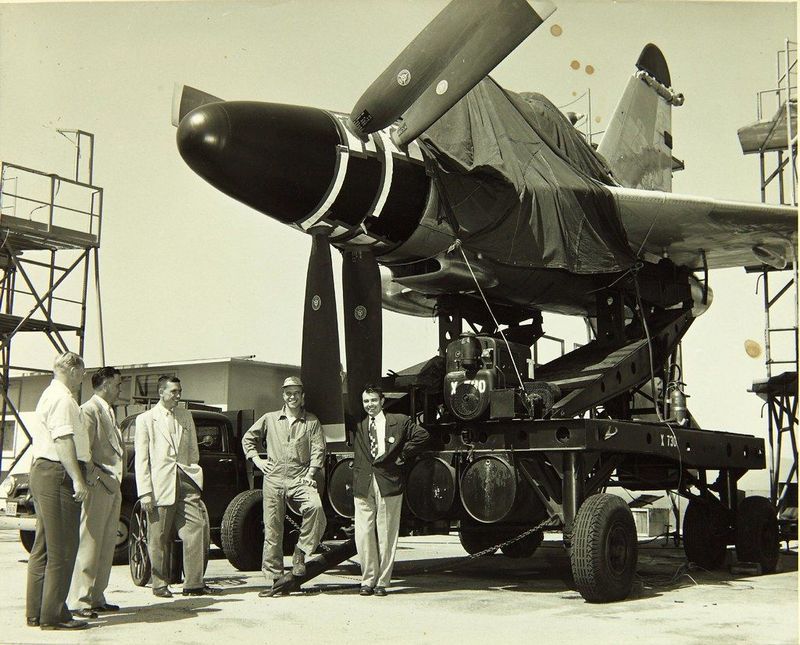


History
Both the CONVAIR XFY "Pogo" and the Lockheed XFV were developed in response to a 1950 United States Navy (USN) request to demonstrate the use of "tailstock" naval fighter jets in arming and protecting convoys as well as providing fast countermeasures against warships The defense ability of the reaction point is average. The plane is called a tail because of its vertical attitude when stationary, taking off or landing. In this way, the aircraft had a small and compact footprint on the decks of U.S. Navy ships in service at the time, and could be put into service for a short period of time. Several projects after World War II attempted the same end goal, including the SNECMA "Coleopter", which originated in France.
Finally, CONVAIR's work combines three aircraft with a flyable specimen. Likewise, Lockheed's filing can only claim that there is only one example of airworthiness between their two completed prototypes.
The CONVAIR file is called "XFY-1", also known as "Model 5". Like the Lockheed project, the CONVAIR aircraft uses conventional propulsion, retains isometric tails (ventral and dorsal, with all four wingtips covered by small rotating wheels), and has a pilot seated in the nose superior. By design, the XFY is equipped with a unique pilot ejection seat rotation system that allows the entire unit to tilt 45 degrees when the aircraft is in a vertical position, and change level when the aircraft is in level flight.
The ventral tail can also be jetted if an emergency landing of the aircraft is required. Unlike the XFV, the XFY's main-wing aircraft features a modified delta plan.
The US Navy ordered three prototypes from CONVAIR in March 1951.
Power for the design initially came from a 5,850 hp Allison YT-40-A engine, which was later switched to a still-in-development 6,966 hp XT40-A-16. This is the same plan as the rival Lockheed XFV.
The engine modification of the XFY will be used to drive 2 three-bladed propeller units in a contra-rotating manner in the nose.
The XFY is also intended to carry similar weapons to its rivals - 4 x 20mm guns mounted on bi-wingtip pods, or 48 x 2.75 inch airborne missiles in its place. Wingtip pods enabled the gun to fire large, wide rotating propeller blades.
A prototype completed its first tethered flight on April 19, 1954, and its first flight (vertical take-off and landing maneuver) on August 1, 1954 (Lockheed documents are "First flight" on June 16 of that year). On November 2, 1954, the aircraft completed its first transition from vertical takeoff to horizontal flighta goal that Lockheed failed to achieve.
The only airworthy XFY example was in the air for 60 hours before the US Navy terminated the VTOL program. The main disadvantage of the CONVAIR design is the lack of effective air braking when attempting to transition to a vertical landing, and the overall inherently difficult and dangerous landing maneuver that even requires a stable and experienced hand "on the stick".
Those factors aside, the aircraft's estimated performance will never be on par with the latest enemy fighters to come online. So the XFY's last flight was in November 1956, wrapping up several years of useful testing.
Like the Lockheed XFV, the CONVAIR XFY was preserved from scrap and is currently (2016) on display at the National Air and Space Museum in Maryland. Reported performance specs include a top speed of 475 mph, a range of up to 500 miles, a service ceiling of 37,500 feet and a climb rate of 9,980 feet per minute.
Specification
Basic
Production
Roles
- Fighter
- X-Plane / Development
Dimensions
32.15 ft (9.8 m)
27.56 ft (8.4 m)
22.90 ft (6.98 m)
Weight
5,060 kg
7,370 kg
Performance
Performance
475 mph (765 km/h; 413 knots)
37,533 ft (11,440 m; 7.11 mi)
500 miles (805 km; 435 nmi)
3,043 m/min (9,985 ft/min)
Armor
Suggested (default):
4 x 20mm cannons
Suggestion (optional):
48 x 70mm Mk 4 FFARs (Folding Fin Aero Rockets)
Changes
XFY - Base Product Name
XFY-1 - Prototype Designation
"Pogo" - Product Name
 Argentina
 Armenia
 Australia
 Austria
 Austria-Hungary
 Belgium
 Brazil
 United Kingdom
 Brunei
 Bulgaria
 Canada
 Chile
Chile China
China Colonial America
 Colombia
 Confederate States
 Croatia
 Czech
Czech Denmark
 Egypt
Egypt Finland
 France
 Georgia
 Germany
 German Imperial
 Greece
 Holland
 Hungary
 India
India Indonesia
 Iran
Iran Iraq
Iraq Ireland
 Israel
 Italy
Italy Japan
Japan Japan (1940)
 Jordan
 Kingdom of Italy
 Malaysia
 Mexico
 Myanmar
 Nazi Germany
 Netherlands
 New Zealand
 North Korea
 Norway
 Pakistan
 Peru
Peru Philippines
 Poland
 Portugal
 Prussia
 Romania
 Russia
 Saudi Arabia
 Serbia
 Singapore
 Slovakia
 Slovenia
 South Africa
 South Korea
 Soviet Union
 Spain
Spain Sweden
 Switzerland
 Syria
Syria Taiwan
 Thailand
 Turkey
 UAE
UAE Ukraine
 Vietnam
 Yugoslavia