

History
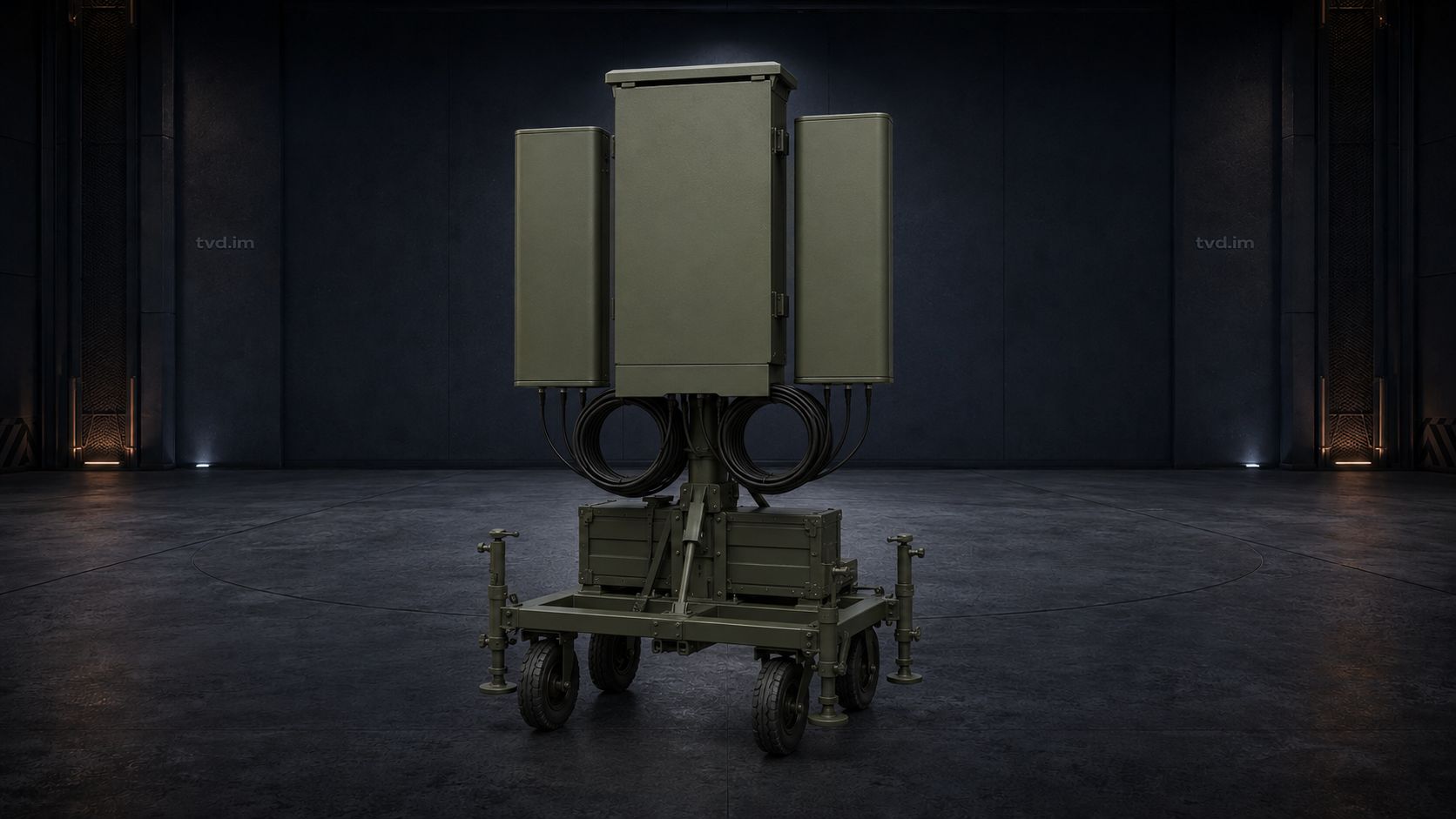
The Volna 3M is a Russian electronic-warfare system designed to disrupt satellite-navigation receivers. It has been identified on a Mi-8AMTSh transport and assault helicopter.
The system is intended primarily to interfere with the satellite navigation used by long-range unmanned aerial vehicles. Its reported functions include conventional jamming and the transmission of false navigation data.
Public reporting identified Volna 3M equipment on a Russian Mi-8AMTSh in July 2026. Installation on a helicopter gives the system an elevated and mobile platform, but the available information does not establish its production quantity or formal service status.
Design
Volna 3M operates in two frequency ranges: 1,144–1,312 MHz and 1,557–1,607 MHz. These bands cover signals used by the GPS, GLONASS, Galileo, and BeiDou satellite-navigation systems.
The equipment has three independent transmission channels. Each channel has a stated output of at least 180 W, while the stated combined output is at least 550 W. An active cooling system supports continuous operation at high output power.
Signal generation
The system reportedly generates BPSK, BOC, CBOC, and AltBOC modulations. These modulation formats allow it to imitate supported navigation signals as well as transmit interference. The spoofing function is intended to make a receiver accept false coordinates instead of merely losing its navigation fix.
Antennas
Each reported antenna contains one radiating element. The stated coverage pattern is 60 degrees vertically and 90 degrees horizontally. Publicly available information does not specify the complete antenna arrangement used on the Mi-8AMTSh installation.
Program status
Volna 3M has been photographed or reported aboard a Russian Mi-8AMTSh helicopter. This confirms the existence of an airborne installation, but the available evidence does not confirm how many systems have been produced or whether they have completed formal acceptance testing.
The manufacturer claims an effective range of up to 80 km against civilian GNSS receivers, up to 50 km against tactical receivers, and up to 20 km against receivers designed to resist interference. These figures are manufacturer claims and have not been independently demonstrated in the available material.
Specifications (Volna 3M)
General characteristics
- Type: Airborne electronic-warfare and satellite-navigation interference system
- Host platform identified: Mi-8AMTSh helicopter
- Navigation systems targeted: GPS, GLONASS, Galileo, and BeiDou
- Operating bands: 1,144–1,312 MHz and 1,557–1,607 MHz
- Independent channels: Three
- Output per channel: At least 180 W
- Combined output: At least 550 W
- Signal modulations: BPSK, BOC, CBOC, and AltBOC
- Cooling: Active cooling
Claimed effective range
- Civilian GNSS receivers: Up to 80 km
- Tactical GNSS receivers: Up to 50 km
- Interference-resistant GNSS receivers: Up to 20 km
Antenna characteristics
- Radiating elements: One per antenna
- Vertical coverage: 60 degrees
- Horizontal coverage: 90 degrees
 Argentina
 Armenia
 Australia
 Austria
 Austria-Hungary
 Belgium
 Brazil
 United Kingdom
 United States
 Brunei
 Bulgaria
 Canada
 Chile
Chile China
China Colonial America
 Colombia
 Confederate States
 Croatia
 Czech
Czech Denmark
 Egypt
Egypt Finland
 France
 Georgia
 Germany
 German Imperial
 Greece
 Holland
 Hungary
 India
India Indonesia
 Iran
Iran Iraq
Iraq Ireland
 Israel
 Italy
Italy Japan
Japan Japan (1940)
 Jordan
 Kingdom of Italy
 Malaysia
 Mexico
 Myanmar
 Nazi Germany
 Netherlands
 New Zealand
 North Korea
 Norway
 Pakistan
 Peru
Peru Philippines
 Poland
 Portugal
 Prussia
 Romania
 Saudi Arabia
 Serbia
 Singapore
 Slovakia
 Slovenia
 South Africa
 South Korea
 Soviet Union
 Spain
Spain Sweden
 Switzerland
 Syria
Syria Taiwan
 Thailand
 Turkey
 UAE
UAE Ukraine
 Vietnam
 Yugoslavia