
History
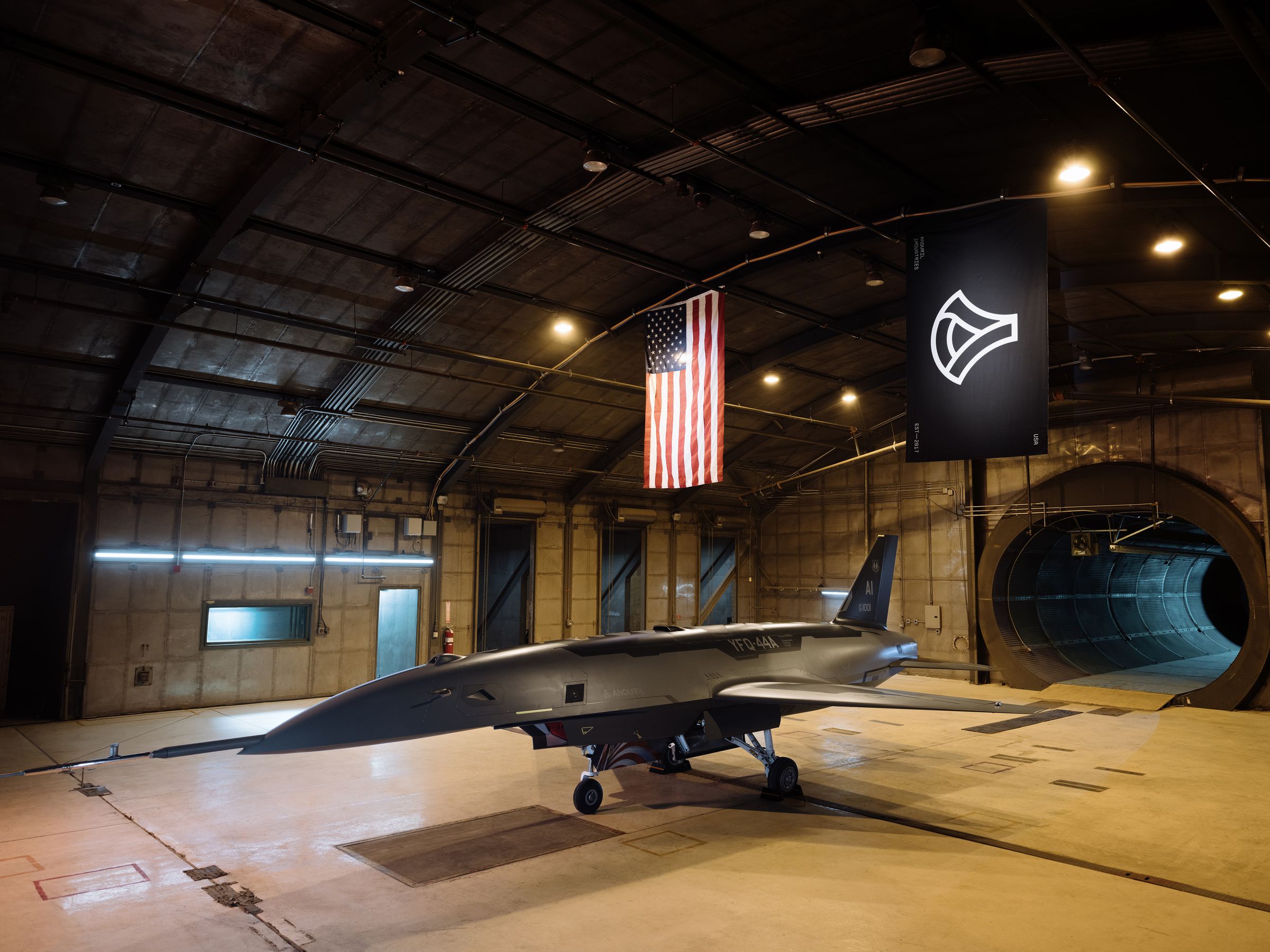
The Anduril YFQ-44A is an unmanned, semi-autonomous combat aircraft developed for Increment 1 of the U.S. Air Force Collaborative Combat Aircraft program. It is intended to support air-superiority missions alongside crewed fighters or operate independently under human supervision.
The aircraft evolved from the Fury unmanned aircraft designed by Blue Force Technologies. Anduril Industries acquired the company and redirected Fury from an adversary-training aircraft toward a modular combat aircraft.
The YFQ-44A entered flight testing in 2025. Testing during 2026 covered alternative mission-autonomy software, weapons integration, operations with crewed aircraft, and preparations for production.
Origins and selection
Blue Force Technologies began developing Fury in the late 2010s for the U.S. Air Force adversary air-training requirement. The concept was intended to imitate advanced hostile fighters while providing higher sortie rates than crewed adversary aircraft. Its proposed features included a single turbofan engine, low-observable airframe elements, and interchangeable mission payloads.
The Air Force Research Laboratory awarded Blue Force Technologies a Fury development contract in early 2022. The company also presented Fury as a possible platform for intelligence, surveillance, reconnaissance, and air-to-air missions.
Anduril Industries acquired Blue Force Technologies in September 2023. The new owner redirected Fury toward a multi-mission unmanned combat role as the U.S. Air Force developed its Collaborative Combat Aircraft requirement. CCA aircraft are intended to expand the sensors, weapons capacity, and operational reach of crewed combat aircraft while completing assigned tasks with a high degree of autonomy.
In April 2024, the Air Force selected Anduril and General Atomics to build competing Increment 1 prototypes. Anduril stated that the YFQ-44A reached its first flight 556 days after the clean-sheet development effort began. In March 2025, the Fury design received the FQ-44 designation, while the prototype became the YFQ-44A.
Flight testing
Anduril announced the beginning of YFQ-44A flight testing on 31 October 2025. According to the company, taxi and flight tests were semi-autonomous from the outset. The aircraft followed a mission plan, controlled its flight path and throttle, and returned to land under the supervision of an operator rather than continuous remote piloting. The Anduril flight-test announcement described the program as an evaluation of speed, maneuverability, autonomy, range, low observability, and weapons integration.
On 26 February 2026, Anduril reported that one YFQ-44A used two independent mission-autonomy systems during a single flight. Shield AI Hivemind controlled the aircraft through a series of test points before control transferred to Anduril Lattice for Mission Autonomy. Both systems were integrated through the Air Force Autonomy Government Reference Architecture. The dual-autonomy flight demonstrated that software from different suppliers could operate on the same aircraft.
Weapons testing followed in July 2026. Reports agree that the YFQ-44A completed a beyond-line-of-sight engagement against a simulated target using an AIM-120 air-to-air missile configuration. Available reports differ on whether the event used an inert AIM-120 round or a live AIM-120C missile. The Air Force emphasized that a human operator retained authority over weapon release.
From 21 July 2026, YFQ-44A aircraft participated in an Agile Combat Employment exercise at Creech Air Force Base, Nevada. The Collaborative Combat Aircraft Experimental Operations Unit conducted multiple sorties, integrated the aircraft with crewed platforms in local airspace, and simulated operational scenarios. The exercise was used to develop tactics, procedures, and requirements for future CCA employment.
Production
Anduril announced plans for its Arsenal-1 manufacturing complex in Pickaway County, Ohio, in January 2025. The facility is located near Rickenbacker International Airport and covers approximately 464,500 square metres (5 million square feet). Anduril identified the YFQ-44A as the first aircraft program scheduled to enter the factory.
The U.S. Air Force awarded Anduril an engineering, manufacturing, development, and production contract for the FQ-44A in June 2026. The number of aircraft covered by the contract was not disclosed.
The first Ohio-built YFQ-44A rolled off the Arsenal-1 production line on 27 July 2026. The line was reported to have capacity for as many as 150 aircraft per year, although Anduril had not announced its planned annual output. The Air Force was considering approximately 100 to 150 aircraft for the first CCA increment and had stated a longer-term objective of acquiring 1,000 Collaborative Combat Aircraft across the wider program. The production report did not specify how many would be Anduril aircraft.
Design
Airframe and propulsion
The YFQ-44A is a compact, unmanned, fighter-class aircraft powered by one turbofan engine. Fury was designed with low-observable airframe features, but detailed construction methods, materials, radar-signature figures, and engine specifications have not been released.
The aircraft uses external weapon stations rather than an identified internal weapons bay. Its design emphasizes uncomplicated manufacturing methods, established supply chains, and production equipment that does not require highly specialized tooling. Anduril developed a common production-software system called ArsenalOS to manage manufacturing processes.
Mission systems and autonomy
The YFQ-44A has open hardware and software architectures intended to accept different sensors, payloads, and mission-autonomy systems. The Autonomy Government Reference Architecture provides a common interface between the aircraft and autonomy software supplied by different companies.
Anduril describes the aircraft as semi-autonomous rather than remotely piloted. It can execute a prepared mission plan, control its flight path and throttle, and return for landing without a remote pilot continuously operating conventional flight controls. A human operator supervises the aircraft and retains command authority.
Test aircraft have operated with Anduril Lattice for Mission Autonomy and Shield AI Hivemind. The aircraft software also monitors vehicle health and supports maintenance and sustainment activities.
Sensors and armament
Published imagery and reporting identify a forward-looking infrared search-and-track sensor in a dorsal housing. The sensor is intended to support passive detection and tracking, although its model and performance have not been disclosed.
The YFQ-44A can carry external stores and has been tested with the AIM-120 Advanced Medium-Range Air-to-Air Missile. The final production weapons configuration has not been published. The U.S. Air Force has stated that Collaborative Combat Aircraft will not independently authorize weapon employment. Weapon release remains a human decision.
Program status
As of July 2026, multiple YFQ-44A aircraft were flying regularly in the development and evaluation program. Testing had included semi-autonomous flight, two interchangeable autonomy-software suites, weapons integration, beyond-line-of-sight engagement, multiple sorties, and coordination with crewed aircraft.
The aircraft remained in development and had not been described as operationally deployed. The June 2026 contract and the first Arsenal-1 aircraft marked the transition toward the FQ-44A production configuration. Public sources had not disclosed the contracted fleet size, delivery schedule, unit cost, or differences between the YFQ-44A prototype and FQ-44A production aircraft.
Variants
- Fury: Original Blue Force Technologies unmanned aircraft concept developed for adversary air training and later proposed for additional missions.
- YFQ-44A: Experimental Collaborative Combat Aircraft configuration selected for U.S. Air Force Increment 1 development and flight testing.
- FQ-44A: Production designation associated with the engineering, manufacturing, development, and production contract awarded in June 2026. Detailed configuration differences have not been disclosed.
Operators
- United States Air Force: Development and test operator through the Collaborative Combat Aircraft Experimental Operations Unit. The YFQ-44A was undergoing evaluation and was not yet described as operationally deployed as of July 2026.
Specifications (YFQ-44A)
The following publicly reported dimensions and performance figures are estimates. Detailed official specifications have not been released.
General characteristics
- Crew: Unmanned
- Length: Approximately 6.1 m (20 ft)
- Wingspan: Approximately 5.2 m (17 ft)
- Powerplant: One turbofan engine of undisclosed type
Performance
- Maximum speed: Reported estimate of Mach 0.95
- Service ceiling: Reported estimate of 15,200 m (50,000 ft)
Avionics and mission systems
- Mission autonomy: Compatible with Anduril Lattice for Mission Autonomy and Shield AI Hivemind during testing
- Integration architecture: Autonomy Government Reference Architecture
- Sensor: Reported forward-looking infrared search-and-track system
Armament
- Stations: External weapon stations
- Air-to-air weapons: AIM-120 missile configuration demonstrated during testing
 Argentina
 Armenia
 Australia
 Austria
 Austria-Hungary
 Belgium
 Brazil
 United Kingdom
 Brunei
 Bulgaria
 Canada
 Chile
Chile China
China Colonial America
 Colombia
 Confederate States
 Croatia
 Czech
Czech Denmark
 Egypt
Egypt Finland
 France
 Georgia
 Germany
 German Imperial
 Greece
 Holland
 Hungary
 India
India Indonesia
 Iran
Iran Iraq
Iraq Ireland
 Israel
 Italy
Italy Japan
Japan Japan (1940)
 Jordan
 Kingdom of Italy
 Malaysia
 Mexico
 Myanmar
 Nazi Germany
 Netherlands
 New Zealand
 North Korea
 Norway
 Pakistan
 Peru
Peru Philippines
 Poland
 Portugal
 Prussia
 Romania
 Russia
 Saudi Arabia
 Serbia
 Singapore
 Slovakia
 Slovenia
 South Africa
 South Korea
 Soviet Union
 Spain
Spain Sweden
 Switzerland
 Syria
Syria Taiwan
 Thailand
 Turkey
 UAE
UAE Ukraine
 Vietnam
 Yugoslavia