
History
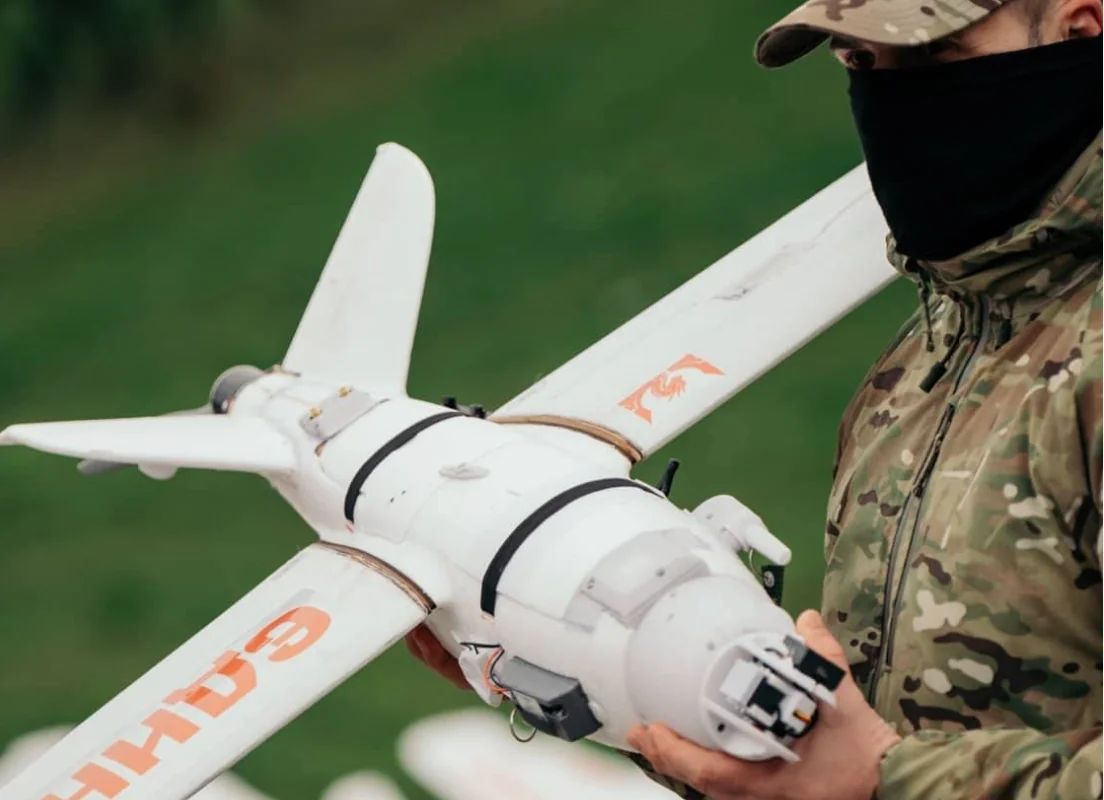
The Wovkulaka Spitfire is a Ukrainian unmanned aircraft designed to intercept hostile drones. It has been supplied to Ukrainian air-defense units for use against Russian reconnaissance UAVs.
In August 2026, a crew from the 18th Aviation Commandant's Office reported destroying a Russian Orlan-30 reconnaissance UAV with a Wovkulaka Spitfire at a distance of 110 km (68 mi). The target was intercepted over the sea, and the engagement was described as a record for the system's combat employment range.
The 18th Aviation Commandant's Office, part of Ukraine's Southern Air Command, received the system from the Serhiy Prytula Charity Foundation through the United Collection fundraising campaign. The record mission occurred within weeks of delivery and followed several months of crew training and regular exercises.
The original mission plan called for operation at a distance of 50–60 km (31–37 mi). After the tactical situation changed, the crew continued toward the target on a one-way flight. With no visual landmarks over the sea, the mission depended on accurate navigation and coordination between the pilot, navigator, and other crew members. Contemporary reports were published by The New Voice of Ukraine and Ukrmedia.
Design
The Wovkulaka Spitfire is a crew-operated interceptor UAV intended to engage hostile unmanned aircraft. Available operational accounts identify separate pilot and navigator roles, indicating that long-distance missions require coordinated flight control and navigation.
Published sources do not provide verified dimensions, mass, propulsion details, speed, endurance, sensor specifications, or information about the method used to destroy a target. The reported 110 km engagement represents a demonstrated combat employment distance under one-way mission conditions, rather than a published maximum range or combat radius.
Operational history
On 6 August 2026, the Serhiy Prytula Charity Foundation announced that an 18th Aviation Commandant's Office crew had intercepted an Orlan-30 at a reported distance of 110 km. The engagement took place over the sea. The Orlan-30 was being used as a Russian reconnaissance platform, a role that includes locating positions, supporting artillery fire, and supplying information for missile and drone attacks.
The foundation stated that Ukrainian interceptor drones were intended to push Russian reconnaissance aircraft farther away from the front. Greater stand-off distance can reduce the effectiveness of surveillance and complicate the transmission of targeting information.
The United Collection campaign had delivered 3,140 interceptor drones to 59 Ukrainian military units by the time of the announcement. The reported total included several systems, among them Wovkulaka Spitfire, Sting, Taras+, Blyskavka, and P1-Sun. The available reports do not identify how many Wovkulaka Spitfire systems were included in that total.
Operators
- Ukraine: The 18th Aviation Commandant's Office of the Southern Air Command operated the Wovkulaka Spitfire in combat by August 2026.
Specifications (Wovkulaka Spitfire)
General characteristics
- Type: Interceptor unmanned aerial vehicle
- Crew organization: Reported mission crew included a pilot and navigator
- Primary role: Interception of hostile unmanned aircraft
Demonstrated combat employment
- Reported engagement distance: 110 km (68 mi) during a one-way mission
- Reported target: Orlan-30 reconnaissance UAV
- Operational environment: Over the sea
- Record engagement date: 6 August 2026
 Argentina
 Armenia
 Australia
 Austria
 Austria-Hungary
 Belgium
 Brazil
 United Kingdom
 United States
 Brunei
 Bulgaria
 Canada
 Chile
Chile China
China Colonial America
 Colombia
 Confederate States
 Croatia
 Czech
Czech Denmark
 Egypt
Egypt Finland
 France
 Georgia
 Germany
 German Imperial
 Greece
 Holland
 Hungary
 India
India Indonesia
 Iran
Iran Iraq
Iraq Ireland
 Israel
 Italy
Italy Japan
Japan Japan (1940)
 Jordan
 Kingdom of Italy
 Malaysia
 Mexico
 Myanmar
 Nazi Germany
 Netherlands
 New Zealand
 North Korea
 Norway
 Pakistan
 Peru
Peru Philippines
 Poland
 Portugal
 Prussia
 Romania
 Russia
 Saudi Arabia
 Serbia
 Singapore
 Slovakia
 Slovenia
 South Africa
 South Korea
 Soviet Union
 Spain
Spain Sweden
 Switzerland
 Syria
Syria Taiwan
 Thailand
 Turkey
 UAE
UAE Vietnam
 Yugoslavia