
History
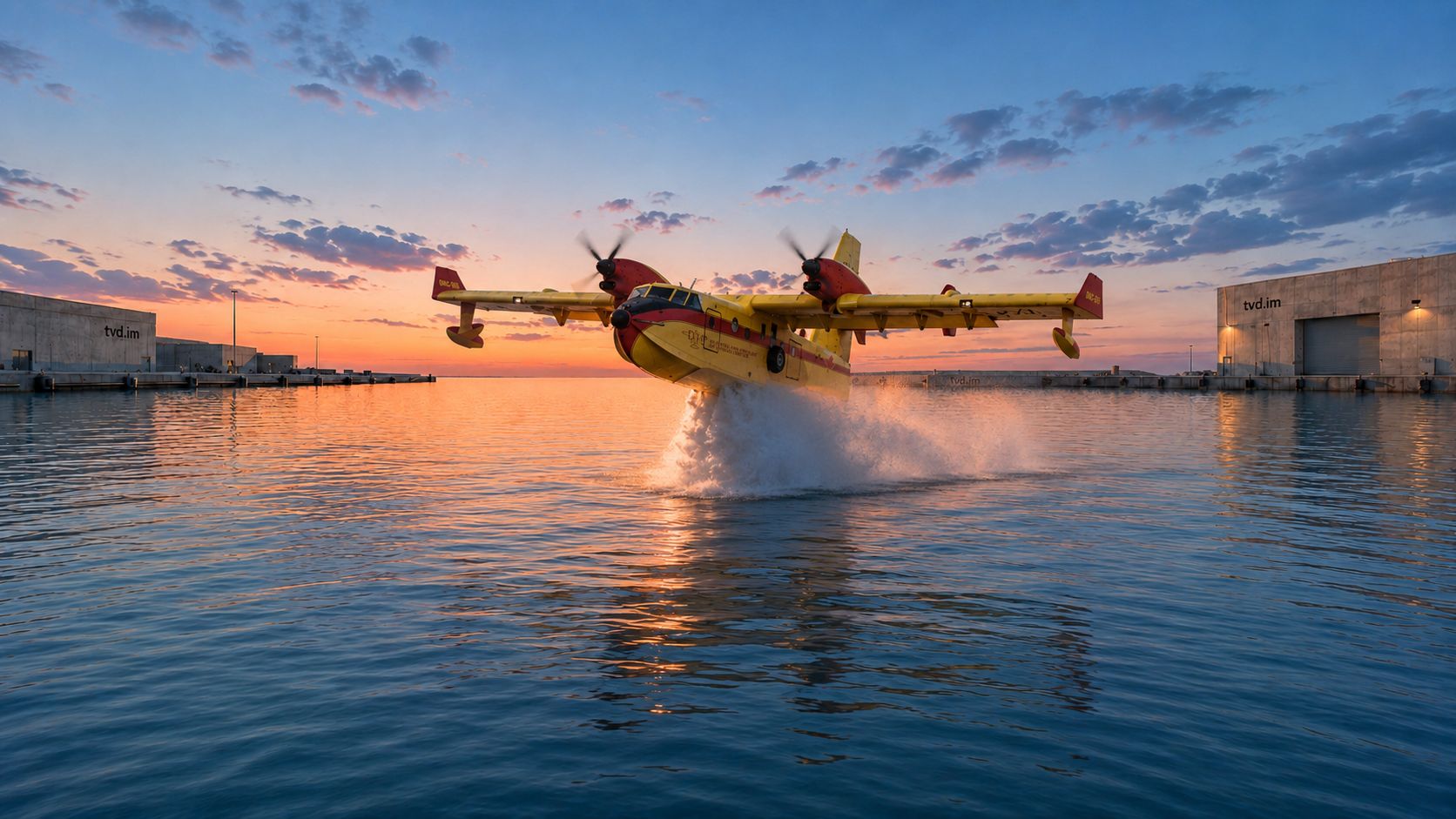
The De Havilland Canada DHC-515 Firefighter, also marketed as the Canadair 515, is a new-production amphibious firefighting aircraft developed in Canada. It is based on the operational design of the Canadair CL-415 but incorporates new materials, improved corrosion protection, and a modern flight deck.
The aircraft is designed to collect water directly from lakes, rivers, or the sea and deliver repeated drops without returning to an airfield for refilling. Its principal tank holds 6,137 litres of water, while a separate 680-litre tank carries foam concentrate.
The DHC-515 remained in production development as of 2026. Assembly of the first aircraft had begun, but the type had not entered operational service. Initial deliveries were planned for 2028.
Development
Bombardier ended production of the preceding CL-415 in 2015 after completing 95 aircraft. Viking Air acquired the CL-215 and CL-415 amphibious aircraft program in 2016 and began developing a modernized successor initially designated CL-515.
Indonesia announced an intended acquisition of six CL-515 aircraft in June 2019, including firefighting and multi-mission configurations. The supplied sources differ on the later status of this early commitment, so these aircraft cannot be treated as operational or confirmed deliveries.
De Havilland Aircraft of Canada officially launched the program under the DHC-515 designation on 31 March 2022. The launch followed expressions of interest from European governments seeking new amphibious firefighting aircraft for national fleets and the rescEU emergency-response reserve.
Component production began in British Columbia before final assembly was established in Calgary, Alberta. Assembly of major parts for the first DHC-515 was underway in March 2026. This represents the earliest supported year in which the first aircraft began taking physical form.
By August 2026, the production restart was supported by a European requirement for 22 aircraft and contracts from Canadian provinces. The first deliveries were scheduled for 2028. Consequently, the listed customers remain future recipients rather than operators of an aircraft already in service.
Design
Airframe
The DHC-515 is a high-wing amphibious aircraft with a boat-shaped fuselage and a twin-turboprop configuration derived from the CL-415. Its amphibious layout permits operations from conventional airfields and suitable bodies of water.
De Havilland Canada retained the basic dimensions and established operating characteristics of the CL-415 while introducing design changes intended to reduce maintenance demands. These changes include new materials and additional corrosion protection, an important consideration for an aircraft that may repeatedly operate in fresh water or seawater.
The wing has an area of 100.34 square metres and a span of 28.6 metres. Large wing and control surfaces support low-speed maneuvering during water collection and firefighting approaches. The aircraft has a published landing-configuration stall speed of 126 km/h.
Cockpit and avionics
The flight deck receives a complete avionics upgrade intended to meet current and future navigation requirements. The advanced display and avionics suite is designed to improve situational awareness and reduce pilot workload during low-altitude firefighting operations. The cockpit arrangement was evaluated through an avionics modernization program that could also be applied to existing CL-415 aircraft.
Firefighting system
The main water tank holds 6,137 litres. A separate 680-litre foam tank allows a foam concentrate to be mixed with the water when required. According to the manufacturer's DHC-515 overview, a full water load can be collected in approximately 12 seconds.
Water is taken aboard through scoops while the aircraft travels across the surface of a suitable body of water. This method permits several collection-and-drop cycles near a fire without landing at a ground base. De Havilland Canada states that the aircraft is intended to operate in waves up to 2 metres high, although actual operations remain dependent on local conditions and operating limitations.
The maximum touchdown weight before scooping is 16,783 kg. After collecting water, the maximum lift-off weight rises to 21,364 kg. The difference reflects the rapid addition of the firefighting load during the scooping run.
Powerplant and fuel
The design retains the CL-415 family's two Pratt & Whitney Canada PW123AF turboprop engines. Maximum usable fuel is 4,626 kg. At the published long-range cruise condition, average fuel consumption is 597 kg per hour.
Program status
The DHC-515 was not yet an operational aircraft in 2026. Production of the first examples was in progress, and delivery was planned to begin in 2028. European customers form the initial production group, while Canadian provincial governments have also placed or announced orders for delivery in later production batches.
The aircraft therefore has customers but no confirmed operators of delivered DHC-515 airframes. Existing CL-215 and CL-415 fleets operated by several countries are separate aircraft and should not be counted as DHC-515 operators.
Specifications (DHC-515 Firefighter)
The following values are published in the January 2025 De Havilland Canada specification sheet.
General characteristics
- Length: 19.8 m
- Height: 9.02 m
- Wingspan: 28.6 m
- Horizontal stabilizer span: 10.97 m
- Wing area: 100.34 m²
- Wheel track: 5.25 m
- Wheelbase: 7.22 m
- Propeller diameter: 3.97 m
- Operating empty weight: 12,995 kg
- Maximum usable fuel: 4,626 kg
- Maximum takeoff weight, utility category: 18,597 kg
- Maximum takeoff weight, restricted category: 19,890 kg
- Maximum takeoff weight from water: 17,170 kg
- Maximum landing weight on land or water: 16,783 kg
- Maximum touchdown weight before scooping: 16,783 kg
- Maximum lift-off weight after scooping: 21,364 kg
- Maximum zero-fuel weight, utility category: 16,511 kg
- Maximum zero-fuel weight, restricted category: 19,504 kg
- Water capacity: 6,137 litres
- Foam capacity: 680 litres
Performance
- Maximum cruise speed: 346 km/h
- Normal cruise speed: 333 km/h
- Long-range cruise speed: 259 km/h
- Stall speed in landing configuration: 126 km/h
- Average fuel consumption at long-range cruise: 597 kg/h
- Ferry range with maximum fuel: 2,333 km
- Takeoff distance from land: 783 m
- Takeoff distance from water: 814 m
- Landing distance on land: 674 m
- Landing distance on water: 665 m
- Full-load water scooping time: approximately 12 seconds
Related equipment
- Canadair CL-215: Earlier purpose-built amphibious firefighting aircraft from which the later Canadair family developed.
- Canadair CL-415: Immediate predecessor and principal design basis for the DHC-515.
- CL-415EAF: Enhanced Aerial Firefighter produced by converting existing CL-415 airframes rather than manufacturing new DHC-515 aircraft.
 Argentina
 Armenia
 Australia
 Austria
 Austria-Hungary
 Belgium
 Brazil
 United Kingdom
 United States
 Brunei
 Bulgaria
 Chile
Chile China
China Colonial America
 Colombia
 Confederate States
 Croatia
 Czech
Czech Denmark
 Egypt
Egypt Finland
 France
 Georgia
 Germany
 German Imperial
 Greece
 Holland
 Hungary
 India
India Indonesia
 Iran
Iran Iraq
Iraq Ireland
 Israel
 Italy
Italy Japan
Japan Japan (1940)
 Jordan
 Kingdom of Italy
 Malaysia
 Mexico
 Myanmar
 Nazi Germany
 Netherlands
 New Zealand
 North Korea
 Norway
 Pakistan
 Peru
Peru Philippines
 Poland
 Portugal
 Prussia
 Romania
 Russia
 Saudi Arabia
 Serbia
 Singapore
 Slovakia
 Slovenia
 South Africa
 South Korea
 Soviet Union
 Spain
Spain Sweden
 Switzerland
 Syria
Syria Taiwan
 Thailand
 Turkey
 UAE
UAE Ukraine
 Vietnam
 Yugoslavia