
History
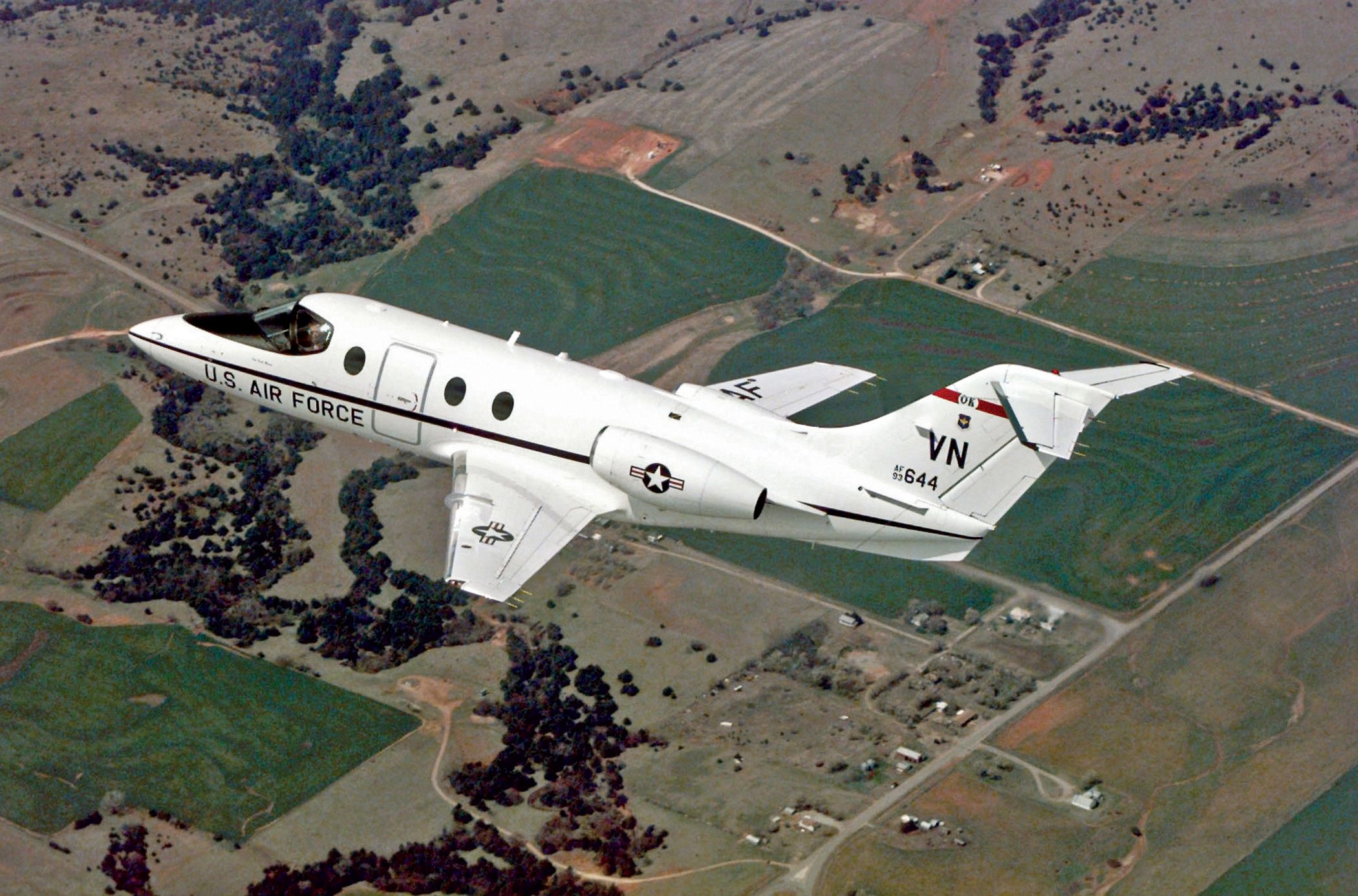
The Raytheon T-1A Jayhawk is a medium-range, twin-engine jet trainer developed for the United States Air Force. It prepared pilots for airlift, aerial-refuelling, reconnaissance, and other large multi-engine aircraft.
The aircraft is a military derivative of the Beechjet 400A business jet. Its side-by-side cockpit and flight characteristics provided training more representative of transport and tanker operations than the Northrop T-38 Talon previously used for this purpose.
The T-1A first flew on 5 July 1991. The first aircraft was delivered to Reese Air Force Base, Texas, in January 1992, and student training began in 1993.
Beech manufactured the aircraft while the company was owned by Raytheon. A total of 180 T-1 trainers were delivered between 1992 and 1997, while the United States Air Force reported a peak active inventory of 178 aircraft. The type entered service as part of specialized undergraduate pilot training, separating the mobility-aircraft training path from the fighter and bomber path that continued to use the T-38.
The T-1A also supported instructor-pilot, navigator, and combat-systems-officer training. Its assignments included Columbus Air Force Base in Mississippi, Laughlin Air Force Base in Texas, Vance Air Force Base in Oklahoma, Randolph Air Force Base in Texas, and Naval Air Station Pensacola in Florida.
Design
Airframe
The T-1A retains the swept-wing configuration and twin rear-mounted turbofan engines of the Beechjet 400A. Military changes include structural reinforcement for repeated training operations, increased resistance to bird strikes, strengthened landing gear for frequent touch-and-go landings, and an additional fuselage fuel tank.
The aircraft was designed for repeated operation at the low altitudes and high landing-cycle rates encountered during military pilot training. It carries no armament.
Cockpit and avionics
The cockpit accommodates two students seated side by side and an instructor. This arrangement supports cockpit resource management, crew coordination, navigation, and instrument procedures similar to those used in large multi-engine aircraft.
Installed equipment includes UHF and VHF radios, an inertial navigation system, TACAN tactical navigation equipment, an automatic direction finder, instrument landing and distance-measuring systems, weather radar, a radar altimeter, GPS, a ground-proximity warning system, and a traffic collision avoidance system. Combat-systems-officer training aircraft received additional student and instructor stations and equipment for simulated radar and warning-system training.
An Avionics Modernization Program replaced the original flight deck in 73 aircraft with a commercial glass cockpit. The program was completed in 2023.
Powerplant
Two Pratt & Whitney Canada JT15D-5B turbofan engines power the T-1A. Each engine produces 12.9 kN (2,900 lbf) of thrust.
Operational history
The T-1A served for more than three decades as the advanced trainer for pilots selected for mobility aircraft. It reduced the training burden on the T-38 fleet and introduced students to multi-crew procedures early in their careers.
The United States Air Force began reducing the fleet in fiscal year 2023 and continued the withdrawal from 2024. T-1A operations ended at Joint Base San Antonio-Randolph on 15 July 2024, at Laughlin Air Force Base on 17 December 2024, and at Naval Air Station Pensacola on 28 July 2025.
Only five flyable T-1As remained at Vance Air Force Base on 5 August 2026. A retirement ceremony and final departure for storage at Davis-Monthan Air Force Base were planned for 21 August 2026, with all remaining aircraft scheduled to leave service by the end of that month.
The Air Force does not plan to procure a direct replacement for the Jayhawk. It intends to redirect T-1A operating and sustainment funds toward the Boeing T-7A Red Hawk program and use revised training methods, including simulators, for mobility and combat-systems-officer instruction.
Variants
- T-1A: United States military trainer derived from the Beechjet 400A and powered by two JT15D-5B turbofans. A total of 180 aircraft were built.
- T-400: Related training version produced for the Japan Air Self-Defense Force. Thirteen aircraft were built with JT15D-5F turbofans.
Operators
- United States Air Force: Operated the T-1A for advanced pilot, instructor-pilot, navigator, and combat-systems-officer training. The final aircraft were scheduled for retirement in August 2026.
Specifications (T-1A)
General characteristics
- Crew: Three: two students and one instructor
- Length: 14.75 m (48 ft 5 in)
- Wingspan: 13.25 m (43 ft 6 in)
- Height: 4.24 m (13 ft 11 in)
- Maximum takeoff weight: 7,303 kg (16,100 lb)
- Powerplant: Two Pratt & Whitney Canada JT15D-5B turbofan engines
- Thrust: 12.9 kN (2,900 lbf) per engine
Performance
- Maximum speed: 866 km/h (538 mph; Mach 0.70)
- Range: 4,115 km (2,222 nmi)
- Service ceiling: 12,500 m (41,000 ft)
Armament
- Armament: None
Related equipment
- Beechjet 400A: Commercial business jet from which the T-1A was developed.
- Northrop T-38 Talon: Jet trainer formerly used for both fighter and multi-engine pilot training and retained for the fighter and bomber training path.
- Boeing T-7A Red Hawk: New fighter-training aircraft supported in part by funds redirected from T-1A operations, but not a direct Jayhawk replacement.
Technical characteristics and service background are documented in the United States Air Force fact sheet. Fleet modernization and retirement information is also summarized by Air & Space Forces Magazine.
 Argentina
 Armenia
 Australia
 Austria
 Austria-Hungary
 Belgium
 Brazil
 United Kingdom
 Brunei
 Bulgaria
 Canada
 Chile
Chile China
China Colonial America
 Colombia
 Confederate States
 Croatia
 Czech
Czech Denmark
 Egypt
Egypt Finland
 France
 Georgia
 Germany
 German Imperial
 Greece
 Holland
 Hungary
 India
India Indonesia
 Iran
Iran Iraq
Iraq Ireland
 Israel
 Italy
Italy Japan
Japan Japan (1940)
 Jordan
 Kingdom of Italy
 Malaysia
 Mexico
 Myanmar
 Nazi Germany
 Netherlands
 New Zealand
 North Korea
 Norway
 Pakistan
 Peru
Peru Philippines
 Poland
 Portugal
 Prussia
 Romania
 Russia
 Saudi Arabia
 Serbia
 Singapore
 Slovakia
 Slovenia
 South Africa
 South Korea
 Soviet Union
 Spain
Spain Sweden
 Switzerland
 Syria
Syria Taiwan
 Thailand
 Turkey
 UAE
UAE Ukraine
 Vietnam
 Yugoslavia