
History
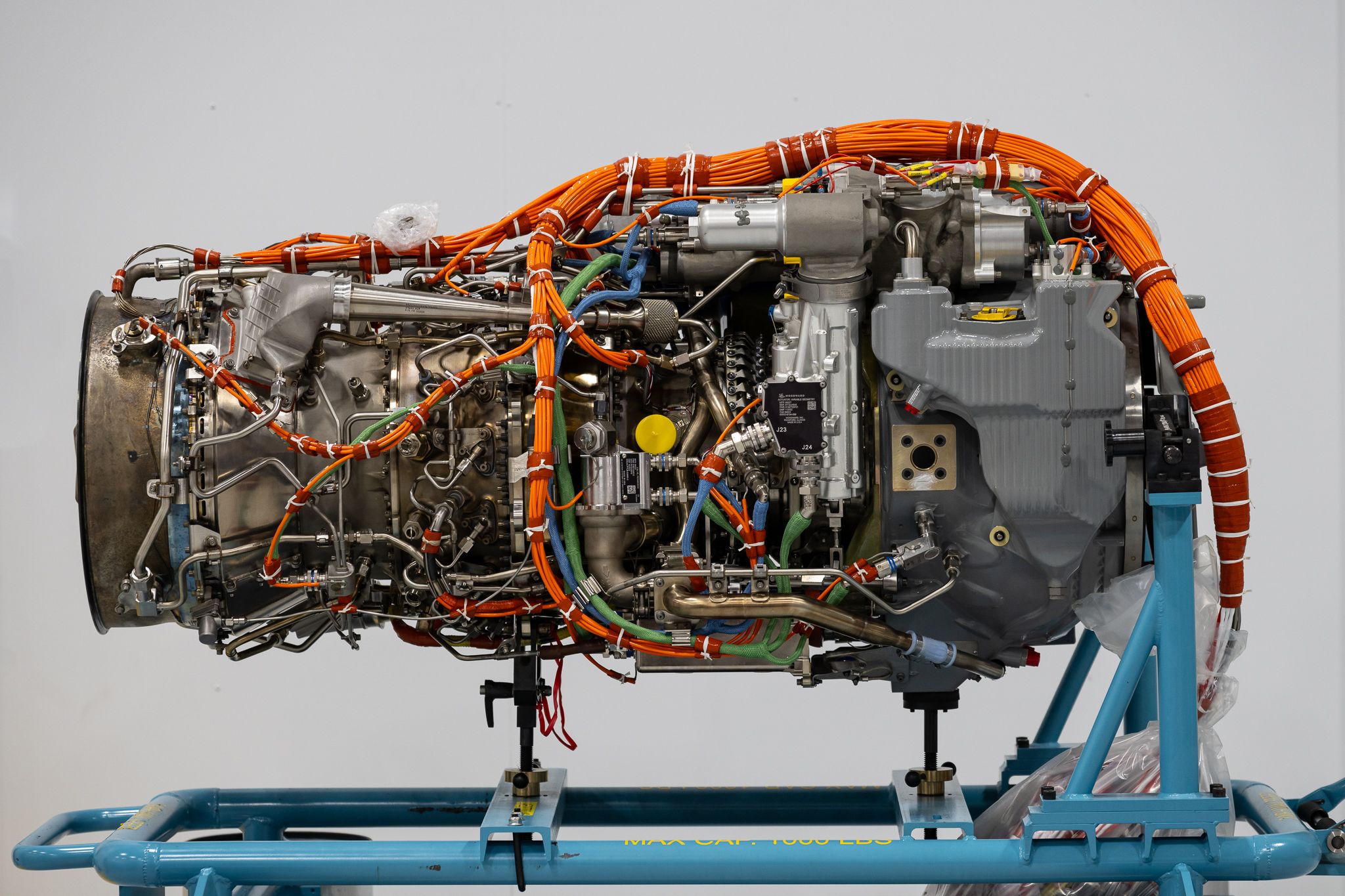
The GE Aerospace T901 is a 3,000 shp (2,240 kW) military turboshaft engine developed for the US Army's Improved Turbine Engine Program. It is intended to replace the GE T700 in the UH-60 Black Hawk and AH-64 Apache helicopter fleets.
The engine provides approximately 50% more power and 25% better specific fuel consumption than the T700. It was designed to restore payload, range, and high-altitude performance as the helicopters gained weight through successive equipment upgrades.
The T901 retains the installation envelope and modular architecture of the T700 while introducing ceramic matrix composites, additive manufacturing, improved cooling, sand-tolerant components, and an integrated engine health management system.
Development
GE began investing in T901-specific technologies in 2010. In 2016, the US Army awarded the company a $102 million contract for preliminary design work. Testing of a GE-funded prototype was completed in 2017. The engine competed against the Advanced Turbine Engine Company T900 for the Army requirement.
The US Army selected the T901 for the Improved Turbine Engine Program in February 2019. GE received a $517 million engineering and manufacturing development contract. The program initially covered the enduring UH-60 and AH-64 fleets and the Future Attack Reconnaissance Aircraft program.
The first engineering and manufacturing development engine began bench testing at GE's Lynn, Massachusetts, facility on 22 March 2022. This test phase concluded on 28 June after more than 100 hours of operation. The Army accepted T901 engines for the development program in 2023 and additional engines for UH-60 flight testing in 2024.
Ground runs in a UH-60M began in early 2025. Sikorsky conducted the first hover test of a T901-powered Black Hawk in May 2025. Later that year, the test aircraft reached almost 1,830 m (6,000 ft) and speeds above 160 kt (296 km/h), according to an account of the program's progress published by Aviation Tech Today.
Preliminary flight rating
The US Army granted the T901 a preliminary flight rating in August 2026. By this milestone, the engine had accumulated approximately 2,600 hours in test cells and more than 90 hours of aircraft testing on the ground and in flight. The T901-powered Black Hawk had reached 5,180 m (17,000 ft) and 160 kt (296 km/h).
The preliminary rating confirmed sufficient maturity for defined flight operations. It did not constitute full airworthiness qualification or a commitment to production.
Design
Architecture and integration
The T901 is a single-spool turboshaft with a free power turbine. Its axial and centrifugal compressor stages and high-pressure turbine stages share the core spool. The free power turbine transfers power through the output shaft to the helicopter transmission.
The engine is divided into cold-section, hot-section, power-turbine, and accessory modules. Sealed bearing sumps reduce contamination risks during field maintenance. The split compressor case permits access to compressor blades for inspection and limited repair without completely dismantling the engine.
The T901 was designed as a drop-in replacement for the T700. It uses the same principal dimensions, mounting locations, inlet and exhaust geometry, and major interfaces. This approach limits the scale of changes required to existing Black Hawk and Apache airframes. A detailed description of its modular layout was published by Key.Aero.
Materials and manufacturing
Ceramic matrix composite components are used in the hot section. These materials tolerate high temperatures with less cooling air than conventional metal parts, allowing more airflow to contribute to power production. Additively manufactured components reduce part counts, weight, and the number of joints in selected assemblies.
GE used three-dimensional aerodynamic design methods to improve component efficiency, pressure ratio, and stage loading. Advanced cooling features are intended to reduce metal temperatures, improve durability, and lower fuel consumption.
Sand protection
The engine incorporates a ruggedized compressor, erosion-control measures, adjusted cooling-hole dimensions, and an advanced inlet particle separator. The separator is intended to reduce sand ingestion and pressure loss, limit turbomachinery wear, and extend the interval between engine removals.
Engine health management
The engine health management system is integrated with the T901 rather than relying entirely on the host helicopter. It monitors engine condition, available power, recorded incidents, and the remaining life of monitored components. The system can generate maintenance alerts and transfer information to a ground station.
Its modular arrangement supports maintenance close to the aircraft. Individual modules can be removed, repaired, or replaced without routinely sending the complete engine to a depot. GE provides additional design information on its official T901 engine page.
Program status
As of August 2026, the T901 remained in development and qualification testing. Full airworthiness testing was scheduled to begin in October 2026 alongside continued UH-60M developmental flights. Planned evaluations included operations with heavy loads and in high-altitude and hot-weather conditions.
A central qualification objective is full engine performance at an altitude of 1,830 m (6,000 ft) and a temperature of 35°C (95°F). Flight testing was expected to conclude during the second half of 2027.
The Army had not committed to a production contract. In April 2026, it stated that certification would be completed before a procurement decision. Congress allocated a combined $238 million through two fiscal year 2026 spending measures to continue engineering and manufacturing development. A US Government Accountability Office assessment indicated that production for the Black Hawk might not begin before 2029.
The cancellation of the Future Attack Reconnaissance Aircraft program removed one planned application for the engine. A separate campaign would be required before the T901 could be installed in the Army's AH-64E fleet.
Intended applications
- Sikorsky UH-60M Black Hawk: Primary flight-test platform and intended enduring-fleet application.
- Sikorsky HH-60M Black Hawk: Included in the planned H-60M integration and test effort.
- Boeing AH-64E Apache: Intended T700 replacement, subject to a separate integration and qualification campaign.
- Bell 360 Invictus: Planned single-engine application under the subsequently cancelled Future Attack Reconnaissance Aircraft program.
- Sikorsky Raider X: Planned single-engine application under the subsequently cancelled Future Attack Reconnaissance Aircraft program.
Specifications (GE Aerospace T901)
General characteristics
- Type: Military turboshaft engine
- Architecture: Single-spool core with a free power turbine
- Length: Approximately 1,220 mm (48.2 in), based on published development estimates
- Diameter: Approximately 640-660 mm (25-26 in), based on published development estimates
- Modules: Cold section, hot section, power turbine, and accessory module
- Installation: T700-compatible mounts, inlet, exhaust, and principal interfaces
Performance
- Maximum power: Approximately 2,240 kW (3,000 shp)
- Power improvement: Approximately 50% compared with the T700 class it is intended to replace
- Specific fuel consumption improvement: Approximately 25% compared with the T700
- Published estimated specific fuel consumption: Less than 0.24 kg/kWh (0.4 lb/hp·h)
- High-hot qualification objective: Full performance at 1,830 m (6,000 ft) and 35°C (95°F)
Related equipment
- GE T700: The established turboshaft family that the T901 is intended to replace in US Army Black Hawk and Apache helicopters.
- ATEC T900: Competing engine proposed by the Advanced Turbine Engine Company during the Improved Turbine Engine Program selection.
 Argentina
 Armenia
 Australia
 Austria
 Austria-Hungary
 Belgium
 Brazil
 United Kingdom
 Brunei
 Bulgaria
 Canada
 Chile
Chile China
China Colonial America
 Colombia
 Confederate States
 Croatia
 Czech
Czech Denmark
 Egypt
Egypt Finland
 France
 Georgia
 Germany
 German Imperial
 Greece
 Holland
 Hungary
 India
India Indonesia
 Iran
Iran Iraq
Iraq Ireland
 Israel
 Italy
Italy Japan
Japan Japan (1940)
 Jordan
 Kingdom of Italy
 Malaysia
 Mexico
 Myanmar
 Nazi Germany
 Netherlands
 New Zealand
 North Korea
 Norway
 Pakistan
 Peru
Peru Philippines
 Poland
 Portugal
 Prussia
 Romania
 Russia
 Saudi Arabia
 Serbia
 Singapore
 Slovakia
 Slovenia
 South Africa
 South Korea
 Soviet Union
 Spain
Spain Sweden
 Switzerland
 Syria
Syria Taiwan
 Thailand
 Turkey
 UAE
UAE Ukraine
 Vietnam
 Yugoslavia