
History
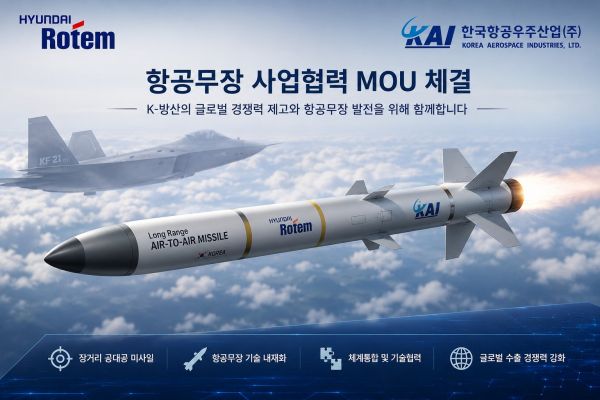
The Hyundai Rotem–KAI long-range air-to-air missile is an unnamed South Korean weapon under development for the KAI KF-21 Boramae fighter. It is intended to provide an indigenous beyond-visual-range air-combat capability.
Korea Aerospace Industries is responsible for aircraft-platform expertise and weapon integration, while Hyundai Rotem contributes experience in guided weapons and propulsion systems. The companies also plan to examine export packages combining aircraft and onboard weapons.
The project remains in development. No prototype, production missile, operational designation, or confirmed service-entry date has been announced.
South Korea approved a national long-range air-to-air missile effort in late 2025. According to AeroTime, the Agency for Defense Development leads the wider program, which is scheduled to run from 2026 through 2033. Its purpose is to reduce dependence on imported beyond-visual-range weapons, including the MBDA Meteor.
During February 2026, KAI signed separate agreements with Hanwha Aerospace and LIG Nex1 concerning domestically produced airborne weapons and joint export marketing for the KF-21 and FA-50. These agreements formed part of a broader effort to develop a South Korean aircraft-and-weapons ecosystem.
On 12 August 2026, Hyundai Rotem and KAI signed a memorandum of understanding at KAI's headquarters in Sacheon. The agreement covers cooperation on long-range air-to-air missiles, aircraft systems integration, business development, export marketing, and combined aircraft-and-weapon packages. The partnership was confirmed by reports from The Korea Times and UPI.
Design
Intended role
The missile is intended for long-range air-to-air engagements by the KF-21. In this role, it would supplement or eventually provide a domestic alternative to imported beyond-visual-range missiles. The KF-21's initial long-range air-to-air weapon is the MBDA Meteor.
Aircraft integration
KAI's role includes aircraft-platform development and systems integration. Hyundai Rotem's stated contribution centers on guided-weapon and propulsion capabilities. The available reports do not identify the planned seeker, guidance method, propulsion configuration, warhead, launch mass, dimensions, or carriage arrangement.
Reported performance objectives
One secondary report described the planned weapon as a Meteor-class missile with a range objective of approximately 200 km and a speed of Mach 4. These figures have not been confirmed in the other supplied reports and should be treated as reported program objectives rather than established specifications.
Program status
As of August 2026, the weapon is an active development program supported by a corporate cooperation agreement. The broader national effort is scheduled to continue through 2033. This date represents the planned end of the reported development period, not a confirmed operational introduction.
No missile designation, completed prototype, flight-test result, production order, inventory quantity, or operator has been disclosed. The Republic of Korea Air Force is the intended user of the KF-21, but the available evidence does not establish that it has formally accepted or ordered this missile.
Related equipment
- MBDA Meteor: The imported beyond-visual-range air-to-air missile selected as the KF-21's initial long-range weapon.
- South Korean short-range air-to-air missile: A separate domestic weapon under development as an alternative to the Diehl IRIS-T.
- KF-21 supersonic anti-ship missile study: A separate proposed air-launched weapon being studied for integration with the fighter.
 Argentina
 Armenia
 Australia
 Austria
 Austria-Hungary
 Belgium
 Brazil
 United Kingdom
 United States
 Brunei
 Bulgaria
 Canada
 Chile
Chile China
China Colonial America
 Colombia
 Confederate States
 Croatia
 Czech
Czech Denmark
 Egypt
Egypt Finland
 France
 Georgia
 Germany
 German Imperial
 Greece
 Holland
 Hungary
 India
India Indonesia
 Iran
Iran Iraq
Iraq Ireland
 Israel
 Italy
Italy Japan
Japan Japan (1940)
 Jordan
 Kingdom of Italy
 Malaysia
 Mexico
 Myanmar
 Nazi Germany
 Netherlands
 New Zealand
 North Korea
 Norway
 Pakistan
 Peru
Peru Philippines
 Poland
 Portugal
 Prussia
 Romania
 Russia
 Saudi Arabia
 Serbia
 Singapore
 Slovakia
 Slovenia
 South Africa
 Soviet Union
 Spain
Spain Sweden
 Switzerland
 Syria
Syria Taiwan
 Thailand
 Turkey
 UAE
UAE Ukraine
 Vietnam
 Yugoslavia