
History
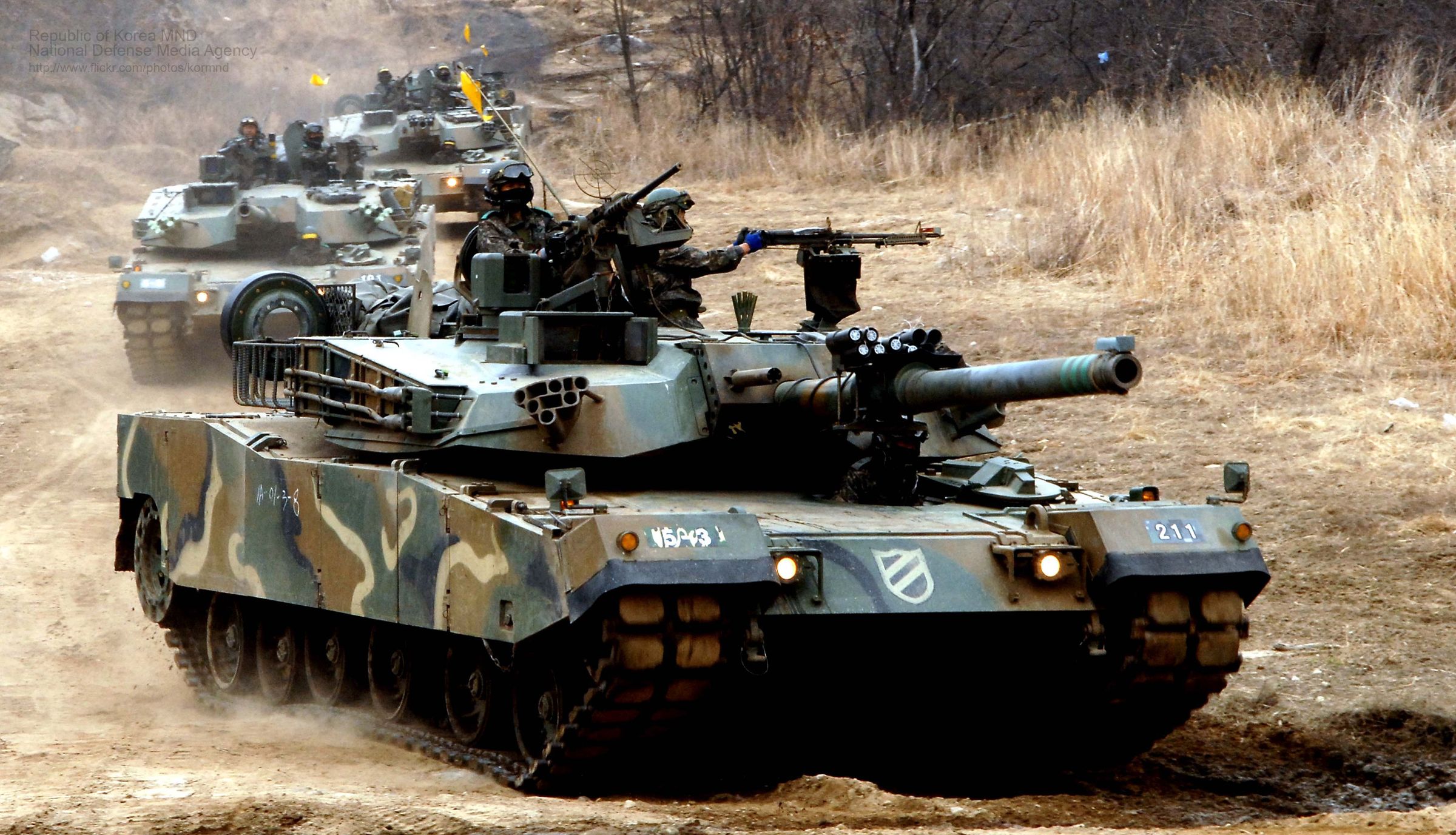
The Hyundai Rotem K1E1 is a modernized version of South Korea's K1 main battle tank. It retains the K1's 105 mm cannon and 1,200 hp diesel engine while adding digital battlefield systems, identification equipment, and external surveillance cameras.
The Republic of Korea Army began introducing the K1E1 upgrade in phases in 2014. The modernization extended the operational relevance of the original K1 design without converting it to the 120 mm armament used by the K1A1 and K1A2.
In August 2026, a K1E1 caught fire during live-fire training near the inter-Korean border. Its crew evacuated safely, and officials reported no casualties.
Development of the K1 family
South Korea began pursuing an indigenous tank during the 1970s as tensions with North Korea continued and Seoul sought to reduce its dependence on imported armored vehicles. The resulting Republic of Korea Indigenous Tank program, known as ROKIT, combined South Korean requirements and industrial participation with American design assistance.
Chrysler Defense was selected to design a tank adapted from technology associated with the American XM1 program. South Korean teams from the Agency for Defense Development and Hyundai participated in development and technology transfer. General Dynamics Land Systems continued the American work after acquiring Chrysler Defense in 1982.
The first XK1 prototype, PV-1, was completed in August 1983 as an automotive test vehicle with a non-functional turret. The PV-2 fire-control test vehicle followed in November 1983. Testing at Aberdeen Proving Ground exposed engine and mobility problems, including an engine fire in June 1984. The unreliable Continental AVCR-1790 diesel was subsequently replaced by the MTU MB 871 Ka-501, while the ZF LSG-3000 transmission was retained.
Development was completed in 1985 after testing continued in South Korea. Mass production began at Hyundai's Changwon plant in July 1987. A total of 1,027 K1 tanks were produced, establishing the type as a principal element of the Republic of Korea Army's armored force. A detailed account of the early program and prototype testing is available from MILMAG.
K1E1 modernization
The K1E1 program upgraded existing K1 tanks rather than producing an entirely new vehicle. Deliveries began in 2014 and proceeded in phases. The changes centered on digitalized core systems, improved battlefield information exchange, identification friend-or-foe equipment, and cameras that increased awareness around the vehicle.
Design
The K1E1 has a crew of four and a reported combat weight of approximately 51 metric tons. Its engine compartment is located at the rear of the hull. The vehicle uses a 1,200 hp diesel engine and can reach a reported maximum road speed of 65 km/h. Its operational range is approximately 500 km.
Digital systems and observation
A digital battlefield management system allows crews to exchange targeting and position information electronically. Identification friend-or-foe equipment helps crews distinguish allied vehicles from potential hostile targets. Cameras installed at the front and rear improve observation of the surrounding terrain and reduce blind areas close to the vehicle.
Armament
The K1E1 retains the original K1's 105 mm KM68A1 main gun. This distinguishes it from the K1A1 and K1A2, which use a larger 120 mm main gun. The available sources do not identify changes to the K1E1's secondary armament.
Operational history
On 6 August 2026, a Republic of Korea Army K1E1 assigned to the 5th Armored Brigade of the 5th Corps caught fire during live-fire training at the Seungjin Fire Training Field in Pocheon. The range is approximately 25 km south of the inter-Korean border.
The fire reportedly began in the rear engine compartment. The soldiers aboard the tank evacuated immediately, and no casualties were reported. Military and firefighting authorities opened an investigation into the cause and said that follow-up measures would depend on its findings. The initial reports did not establish whether the event resulted from an isolated failure, a maintenance issue, or a wider technical defect. The incident was reported by Yonhap News Agency and other South Korean media.
Variants
- K1: Original production main battle tank armed with a 105 mm gun. Mass production began in 1987.
- K1E1: Digital modernization of existing K1 tanks. It retains the 105 mm gun and entered phased introduction in 2014.
- K1A1 and K1A2: Related K1-family upgrades equipped with a 120 mm main gun.
Operators
- Republic of Korea Army: Operator of the K1E1, introduced through a phased modernization program beginning in 2014.
Specifications (K1E1)
General characteristics
- Type: Main battle tank
- Crew: Four
- Weight: Approximately 51 metric tons (56 short tons)
- Powerplant: 1,200 hp diesel engine
Performance
- Maximum road speed: 65 km/h (40 mph)
- Operational range: Approximately 500 km (310 mi)
Armament
- Main gun: 105 mm KM68A1 cannon
Equipment
- Battlefield systems: Digital battlefield management system
- Identification: Identification friend-or-foe equipment
- Observation: Front and rear surveillance cameras
 Argentina
 Armenia
 Australia
 Austria
 Austria-Hungary
 Belgium
 Brazil
 United Kingdom
 United States
 Brunei
 Bulgaria
 Canada
 Chile
Chile China
China Colonial America
 Colombia
 Confederate States
 Croatia
 Czech
Czech Denmark
 Egypt
Egypt Finland
 France
 Georgia
 Germany
 German Imperial
 Greece
 Holland
 Hungary
 India
India Indonesia
 Iran
Iran Iraq
Iraq Ireland
 Israel
 Italy
Italy Japan
Japan Japan (1940)
 Jordan
 Kingdom of Italy
 Malaysia
 Mexico
 Myanmar
 Nazi Germany
 Netherlands
 New Zealand
 North Korea
 Norway
 Pakistan
 Peru
Peru Philippines
 Poland
 Portugal
 Prussia
 Romania
 Russia
 Saudi Arabia
 Serbia
 Singapore
 Slovakia
 Slovenia
 South Africa
 Soviet Union
 Spain
Spain Sweden
 Switzerland
 Syria
Syria Taiwan
 Thailand
 Turkey
 UAE
UAE Ukraine
 Vietnam
 Yugoslavia