History
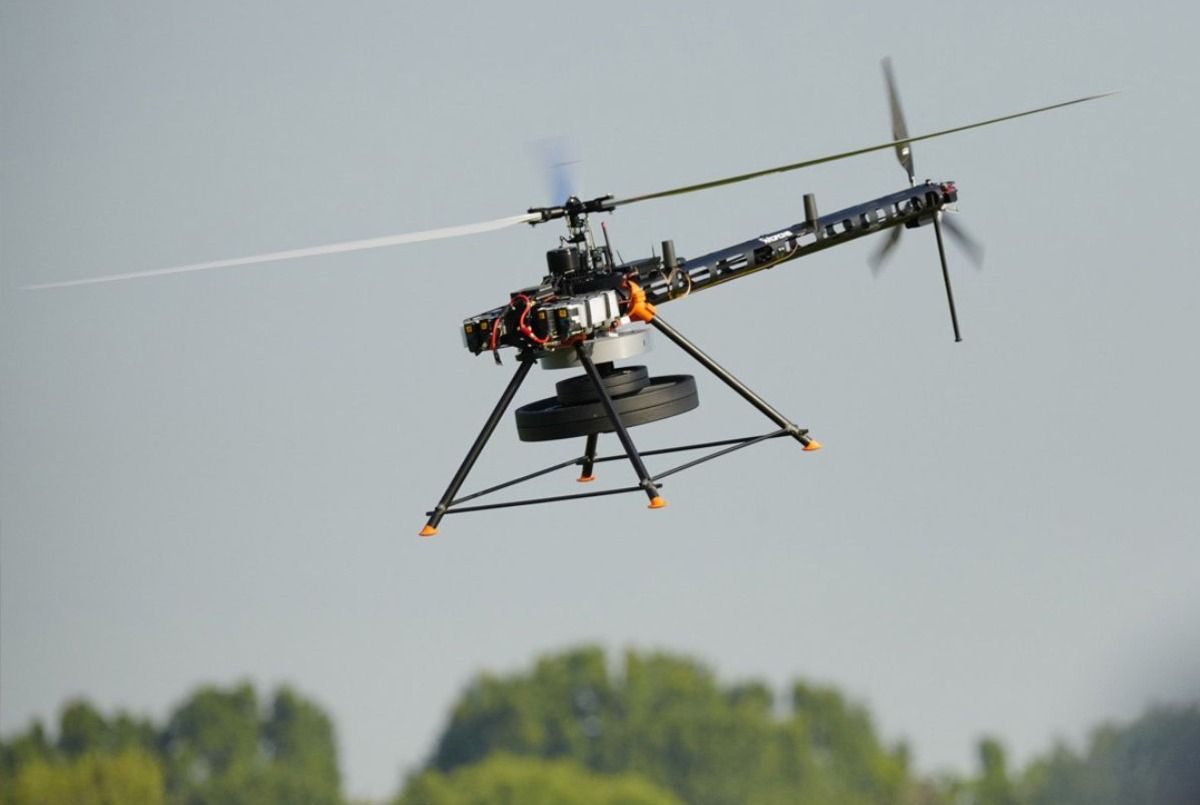
The Avidrone Katana is a single-main-rotor unmanned helicopter developed for heavy-payload flight. It gained attention in August 2026 after winning the Defense Advanced Research Projects Agency Lift Challenge in Dayton, Ohio.
During its winning flight, Katana carried a 51 kg (112.4 lb) payload while the aircraft itself weighed 13.3 kg (29.3 lb). This produced an officially reported payload-to-aircraft-weight ratio of 3.84:1.
Following the competition, Avidrone Aerospace announced that it would continue development of a commercialized Katana version intended for defense and industrial applications.
DARPA Lift Challenge
DARPA opened the Lift Challenge in November 2025 with a target payload-to-aircraft-weight ratio of 4:1. The competition was intended to encourage major improvements in the payload efficiency of small heavy-lift aircraft. The event took place from August 4 through August 9, 2026, at the National Museum of the U.S. Air Force in Dayton. According to the available reporting, 124 teams entered or were invited to the program, while 61 teams ultimately conducted flights during the seven-day event.
The flight task required competitors to complete a 9.3 km (5-nautical-mile) circuit within 30 minutes. Aircraft carried the competition payload on the outbound portion, released it, and returned without the load. Katana completed its winning run in 19 minutes and 17 seconds.
Katana achieved a 3.84:1 payload-to-aircraft-weight ratio by carrying 51 kg on a 13.3 kg aircraft. No competitor reached DARPA's 4:1 target. Avidrone nevertheless achieved the highest completed ratio and took first place. Because the target ratio was not reached, the prize was reduced from the maximum $2.5 million to $1.25 million. MTech Operations LLC placed second with a 3.64:1 ratio, while Xtreme Aerial Concepts placed third at 3.45:1. Contemporary reports of the result are available from Defence Blog and Whalesbook.
Post-competition development
After the Lift Challenge, Avidrone said interest in Katana had increased and announced continued development of a commercialized version for defense and industrial applications. The available sources do not identify a production designation, production schedule, customer, or service-entry date for this proposed version.
Design
Katana uses a conventional helicopter arrangement with one main rotor, a tail boom, and a tail rotor. Its configuration differs from the multirotor layouts common among many unmanned cargo aircraft and from several experimental airframes entered in the Lift Challenge.
Avidrone attributed the competition result to its experience with heavy-cargo aircraft together with proprietary autopilot and flight-control technologies. Secondary reporting on the competition described the Katana as battery-electric and identified battery modules, electric motors and speed controllers, carbon-fiber rotor blades, and GNSS antennas among components used on the aircraft. The available sources do not provide complete power ratings, battery capacity, rotor dimensions, flight-control architecture, or structural specifications.
The design demonstrated that a lightweight single-rotor aircraft could carry several times its own airframe weight over the Lift Challenge course. The competition result was a specific performance demonstration and does not by itself establish the payload, range, endurance, or operating limits of a future commercial version.
Program status
As of August 2026, Katana had completed the DARPA Lift Challenge and existed as a flying competition aircraft. Avidrone had announced plans to develop a commercialized derivative for defense and industrial use, but the available sources did not report production, operational deployment, or a confirmed operator.
Variants
- Katana competition aircraft: The single-rotor unmanned helicopter that won the 2026 DARPA Lift Challenge with a 3.84:1 payload-to-aircraft-weight ratio.
- Commercialized Katana version: A planned follow-on version announced by Avidrone after the competition for defense and industrial applications. No separate designation or detailed configuration has been reported.
Specifications (2026 DARPA Lift Challenge Katana)
General characteristics
- Configuration: Unmanned helicopter with a single main rotor, tail boom, and tail rotor
- Aircraft weight during winning run: 13.3 kg (29.3 lb)
- Payload during winning run: 51 kg (112.4 lb)
Performance
- Demonstrated payload-to-aircraft-weight ratio: 3.84:1
- Lift Challenge course distance: 9.3 km (5 nautical miles)
- Winning course time: 19 minutes 17 seconds
 Argentina
 Armenia
 Australia
 Austria
 Austria-Hungary
 Belgium
 Brazil
 United Kingdom
 United States
 Brunei
 Bulgaria
 Canada
 Chile
Chile China
China Colonial America
 Colombia
 Confederate States
 Croatia
 Czech
Czech Denmark
 Egypt
Egypt Finland
 France
 Georgia
 Germany
 German Imperial
 Greece
 Holland
 Hungary
 India
India Indonesia
 Iran
Iran Iraq
Iraq Ireland
 Israel
 Italy
Italy Japan
Japan Japan (1940)
 Jordan
 Kingdom of Italy
 Malaysia
 Mexico
 Myanmar
 Nazi Germany
 Netherlands
 New Zealand
 North Korea
 Norway
 Pakistan
 Peru
Peru Philippines
 Poland
 Portugal
 Prussia
 Romania
 Russia
 Saudi Arabia
 Serbia
 Singapore
 Slovakia
 Slovenia
 South Africa
 South Korea
 Soviet Union
 Spain
Spain Sweden
 Switzerland
 Syria
Syria Taiwan
 Thailand
 Turkey
 UAE
UAE Ukraine
 Vietnam
 Yugoslavia