
History
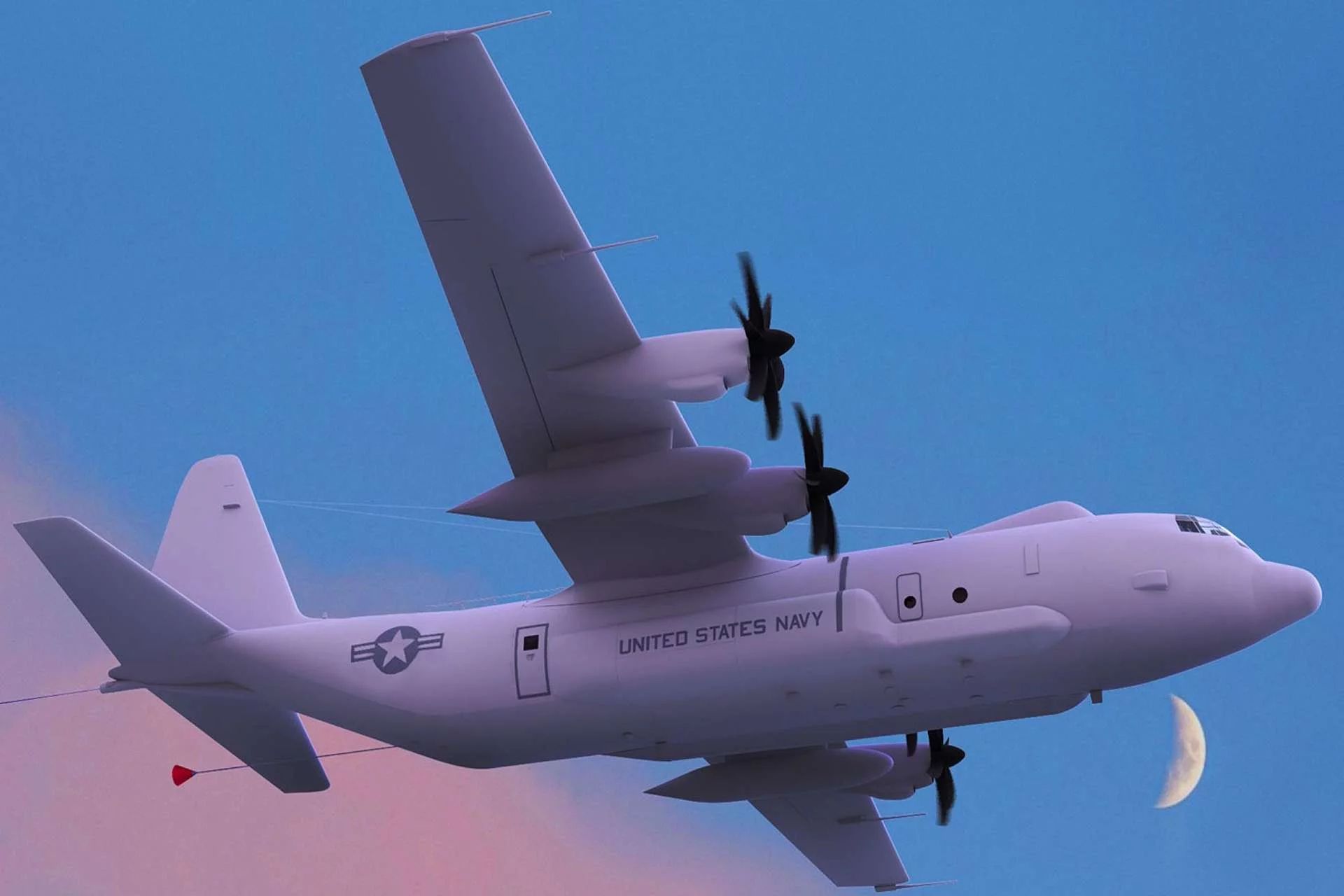
The Lockheed Martin E-130J Phoenix II is a U.S. Navy airborne strategic command, control and communications aircraft under development for the Take Charge and Move Out (TACAMO) mission. It is based on the C-130J-30 Super Hercules and is intended to replace the Navy's Boeing E-6B Mercury fleet in the mission of maintaining communications between national command authorities and ballistic-missile submarines.
The E-130J is planned as a TACAMO-only platform. Unlike the E-6B, it is not currently intended to perform the U.S. Air Force Airborne Command Post and Looking Glass mission associated with nuclear-capable bombers and land-based intercontinental ballistic missiles. Moving that function away from the Navy's replacement aircraft reduced the required mission scope and helped make a smaller C-130J-based platform practical.
The Navy plans a fleet of 31 E-130Js: six pre-production aircraft for development and 25 production aircraft. This is almost twice the 16 E-6Bs now serving in the Navy fleet and is intended to increase the number of airframes available for the survivable strategic communications mission.
Development
The Navy previously operated EC-130Q aircraft for TACAMO before the Boeing 707-based E-6A began entering service in 1989. The E-6 fleet was later converted to the E-6B standard, adding the Airborne Command Post mission. As the aging 707-based aircraft became more difficult to sustain, the Navy and Air Force examined replacement options for their strategic airborne command functions.
In December 2020, the Navy selected the C-130J-30 as the basis for its future TACAMO aircraft and awarded Lockheed Martin work associated with a testbed. The choice returned the mission to the C-130 family while taking advantage of a current-production airframe, a broad logistics base and the ability to use a wider range of airfields than the E-6B.
Three pre-production aircraft were funded in fiscal year 2023 for air-vehicle and mission-system testing. In October 2024, the U.S. Air Force approved the E-130J mission design series designation for the program, which had previously been known as E-XX. Northrop Grumman became the prime mission-system integrator, with the TACAMO equipment to be installed in government-furnished C-130J-30 airframes.
The first C-130J-30 airframe assigned for conversion into a pre-production E-130J was rolled out in 2025. The Navy later selected the common name Phoenix II. An Integrated Baseline Review was held from September 23 to 26, 2025 and formally closed on February 24, 2026 after the resulting actions were resolved.
A preliminary design review for the first test-aircraft configuration was held from March 31 to April 1, 2026. The April 2026 Modernized Selected Acquisition Report described the program as executing to its acquisition baseline and identified a total program of record of 31 aircraft. Aviation Week reported that the total consists of six developmental aircraft and 25 production aircraft.
The same acquisition report estimated a Program Acquisition Unit Cost of $732.8 million for the 31-aircraft program when research and development expenses are included. It estimated an Average Procurement Unit Cost of $360.9 million for the 25 production aircraft, excluding research and development. These figures were lower than the program's December 2024 baseline estimates.
Technical risk and schedule
The program has acknowledged technical and operational-availability risks. Government Accountability Office assessments cited the complexity of integrating specialized strategic communications equipment into the C-130J-30 and the possibility that non-standard components, security requirements and mission-system weight could create manufacturing and availability problems. Contractors have been working to reduce the weight of existing mission equipment and to address obsolescence, size, weight, power and cooling risks.
The Navy's low-rate production decision has been delayed as integration work matured. According to the 2026 program schedule reported by Aviation Week, a critical design review is planned for September 2027, a Milestone C production decision is expected in August 2029, and initial operational test and evaluation is scheduled to begin no earlier than 2033. The E-130J's initial operational capability date remains classified. The Navy has said that E-6Bs will be retired only as E-130Js enter service so that TACAMO coverage is maintained during the transition.
Design
The E-130J uses the four-engine turboprop C-130J-30 Super Hercules as its basic airframe. The C-130J-30 is longer than the standard-length C-130J and provides additional internal volume for crew stations and mission equipment. The E-130J configuration adds strategic communications systems, external antennas and other specialized equipment required for the TACAMO mission.
Airframe and basing
The C-130J-30 platform gives the E-130J different operating characteristics from the larger, jet-powered E-6B. It does not match the E-6B's basic speed and altitude performance, but it can operate from a larger number of air bases and smaller airfields. This can support dispersal and reduce dependence on a limited number of long, high-standard runways. The C-130J family also remains in production and is widely supported across the U.S. military.
The aircraft is expected to retain the C-130J family's ability to remain on station for extended periods and to use aerial refueling for longer missions. These characteristics are important for an aircraft intended to maintain continuous strategic communications during national emergencies.
Strategic communications systems
The TACAMO mission requires reliable communications with strategic forces under difficult conditions. Planned E-130J communications cover radio bands from very low frequency through advanced extremely high frequency and are intended to use multiple modulation, encryption and network methods. The very-low-frequency system is particularly important for sending messages to ballistic-missile submarines while they remain submerged.
The Phoenix II is planned to use a trailing-wire very-low-frequency antenna derived from the system carried by the E-6B. The existing E-6B can deploy an antenna about 8 km (5 mi) long, and the E-130J is intended to field a similar long-wire capability. Public concept images also show multiple external fairings and antenna installations associated with the mission system.
Because TACAMO is a nuclear command-and-control mission, the E-130J is planned with protection against nuclear electromagnetic pulse effects and with cybersecurity hardening. Program documentation also emphasizes strict technology-security, supply-chain and information-assurance controls because of the sensitivity of the aircraft's mission systems.
Mission scope
The E-130J is intended to relay Emergency Action Messages and other strategic communications between U.S. national command authorities and naval ballistic-missile forces. It is not currently planned to inherit the E-6B's Airborne Command Post and Looking Glass duties for U.S. Air Force bombers and silo-based intercontinental ballistic missiles. The Air Force is pursuing a separate Looking Glass-Next effort for that mission.
Program status
As of 2026, the E-130J Phoenix II remains in development and is not an operational aircraft. The Navy's program of record calls for six pre-production aircraft and 25 production aircraft. Strategic Communications Wing 1 at Tinker Air Force Base, Oklahoma, is the organization associated with the Navy's TACAMO force and is expected to transition from the E-6B to the E-130J as the new aircraft becomes available.
The larger planned fleet is intended to replace 16 E-6Bs while improving the number of available TACAMO airframes. The exact operational effect will depend on reliability, maintenance demands, training requirements and the outcome of integration testing. The Navy has identified operational availability as a program risk, with additional details classified.
Variants
- Pre-production E-130J: Development and test aircraft used for air-vehicle and mission-system integration. The Navy plans six pre-production examples in total.
- Production E-130J Phoenix II: Planned operational TACAMO configuration. The current program of record includes 25 production aircraft.
Specifications (E-130J Phoenix II)
General characteristics
- Base airframe: Lockheed Martin C-130J-30 Super Hercules.
- Length: approximately 29.8 m (97 ft 9 in).
- Wingspan: approximately 40.4 m (132 ft 7 in).
- Height: approximately 11.8 m (38 ft 10 in).
- Maximum takeoff weight: approximately 74,400 kg (164,000 lb).
- Powerplant: four Rolls-Royce AE 2100D3 turboprop engines.
- Power: approximately 3,500 kW (4,700 shp) per engine.
Performance
- Maximum speed: approximately 660 km/h (410 mph).
- Range: more than 3,700 km (2,000 nmi), depending on mission configuration and payload.
- Service ceiling: approximately 8,500 m (28,000 ft).
Mission equipment
- Primary role: survivable airborne strategic command, control and communications for the Navy's TACAMO mission.
- Submarine communications: planned very-low-frequency trailing-wire antenna system with a wire approximately 8 km (5 mi) long.
- Communications coverage: planned capability across radio bands from very low frequency through advanced extremely high frequency.
- Protection: planned nuclear electromagnetic-pulse and cybersecurity hardening.
- Armament: none specified; the aircraft is a communications and command platform rather than a weapons carrier.
Publicly reported E-130J dimensional and performance figures largely reflect its C-130J-30-derived airframe while the aircraft remains in development. Final mission-system weight, performance and configuration may change as integration and testing continue. A general technical summary is also available from the E-130J reference overview.
Related equipment
- Boeing E-6B Mercury: The E-130J's direct predecessor in the Navy TACAMO mission. The E-6B also performs the Airborne Command Post mission, which the E-130J is not currently planned to inherit.
- Lockheed EC-130Q: Earlier C-130-family TACAMO aircraft used by the Navy before the transition to the E-6.
- Lockheed Martin C-130J-30 Super Hercules: The production transport airframe from which the E-130J is being converted.
 Argentina
 Armenia
 Australia
 Austria
 Austria-Hungary
 Belgium
 Brazil
 United Kingdom
 Brunei
 Bulgaria
 Canada
 Chile
Chile China
China Colonial America
 Colombia
 Confederate States
 Croatia
 Czech
Czech Denmark
 Egypt
Egypt Finland
 France
 Georgia
 Germany
 German Imperial
 Greece
 Holland
 Hungary
 India
India Indonesia
 Iran
Iran Iraq
Iraq Ireland
 Israel
 Italy
Italy Japan
Japan Japan (1940)
 Jordan
 Kingdom of Italy
 Malaysia
 Mexico
 Myanmar
 Nazi Germany
 Netherlands
 New Zealand
 North Korea
 Norway
 Pakistan
 Peru
Peru Philippines
 Poland
 Portugal
 Prussia
 Romania
 Russia
 Saudi Arabia
 Serbia
 Singapore
 Slovakia
 Slovenia
 South Africa
 South Korea
 Soviet Union
 Spain
Spain Sweden
 Switzerland
 Syria
Syria Taiwan
 Thailand
 Turkey
 UAE
UAE Ukraine
 Vietnam
 Yugoslavia