
History
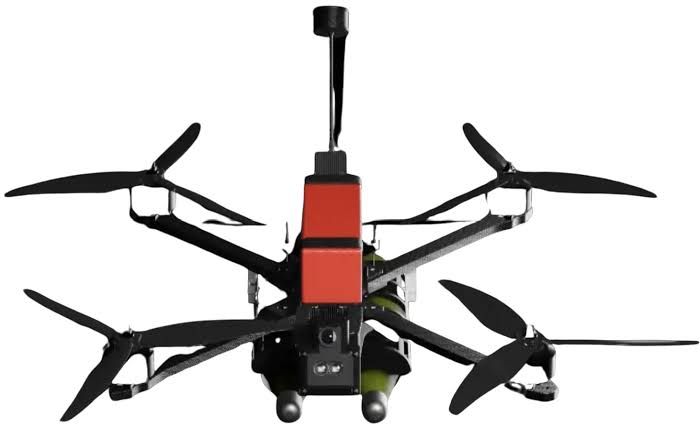
The North Weapon NWF10 is a Turkish 10-inch first-person-view (FPV) unmanned aerial vehicle intended for strike missions. North Weapon states that the NWF10 can fly at ranges of up to 30 km, reach speeds of up to 170 km/h, and carry a payload of more than 5 kg.
The NWF10 combines three electro-optical channels with an onboard computing board and computer-vision target tracking. According to the manufacturer, the operator selects a camera and a target, after which the system can acquire and follow the selected object during the terminal phase of the attack.
The model attracted wider attention in August 2026 after drones resembling the NWF10 were reported in the hands of the Tigray People's Liberation Front (TPLF) during renewed fighting in northern Ethiopia. The reported aircraft were identified by their distinctive three-camera arrangement and external similarity to the NWF10.
The available source does not establish when development, prototype construction, or production of the NWF10 began. It does establish that the model existed as physical equipment by 2026 through manufacturer specifications and reported battlefield use.
Design
The NWF10 is described as a 10-inch FPV drone. The available information focuses on its sensor package, onboard target-tracking functions, performance, and measures intended to improve resistance to electronic interference. Structural materials, propulsion details, battery configuration, and the specific type of carried payload are not stated.
Optical system and target tracking
The optical block contains three separate cameras. The thermal imager has a resolution of 384×288 pixels, a 25 Hz refresh rate, a 12 µm detector pitch, and a 9.1 mm lens. A daylight telephoto camera provides 1920×1080-pixel imagery with a 12 mm focal length. A separate wide-angle daylight camera uses a 3.9 mm lens and has a field of view of 72×45 degrees.
An onboard computing board supports the guidance and tracking system. North Weapon states that the operator chooses the required camera and selects a target. Computer vision then acquires the object and automatically maintains the track. The manufacturer claims that the system can follow targets moving at speeds of up to 80 km/h, detect a person at up to 500 m, detect a vehicle at up to 1,200 m, and track as many as 50 objects simultaneously.
Electronic-warfare resistance
The NWF10 is stated to use four antennas with horizontal and vertical polarization. The system can automatically switch among four operating frequencies. The manufacturer presents this arrangement as a measure intended to improve operation in an electronic-warfare environment, although the available source does not specify the frequencies or provide independent test results.
Operational history
In August 2026, a report citing Eritrean Post stated that TPLF forces had obtained Turkish-made North Weapon FPV drones and used them against the Ethiopian army during clashes in northern Ethiopia on 1–2 August. The aircraft shown in the report had the characteristic three-camera sensor arrangement and were described as externally similar to NWF10 drones. The identification should therefore be treated as reported rather than independently confirmed by the available evidence.
The route by which the drones reached TPLF forces was not established. The source noted that Turkey supported Ethiopia's central government and suggested that the drones might have been captured during fighting, but it did not confirm this explanation.
The reported use occurred after renewed tension following the 2020–2022 Tigray war and the Pretoria peace agreement of November 2022. Relations again deteriorated in 2025–2026, and clashes between Tigrayan and federal forces were reported in January and August 2026.
Operators
- Tigray People's Liberation Front (TPLF): Reported to have operated NWF10-type FPV drones against Ethiopian federal forces in August 2026. The quantity and method of acquisition were not established.
Specifications (NWF10)
General characteristics
- Type: 10-inch FPV strike UAV
- Payload: More than 5 kg
- Thermal camera: 384×288 pixels, 25 Hz, 12 µm detector pitch, 9.1 mm lens
- Daylight telephoto camera: 1920×1080 pixels, 12 mm focal length
- Wide-angle daylight camera: 3.9 mm lens, 72×45-degree field of view
- Target-tracking system: Onboard computer-vision guidance after operator target selection
- Antenna system: Four antennas with horizontal and vertical polarization and automatic switching among four operating frequencies
Performance
- Flight range: Up to 30 km
- Maximum speed: Up to 170 km/h
- Flight endurance: 15 minutes
- Maximum stated altitude: 5,000 m
- Maximum stated tracked-target speed: Up to 80 km/h
- Person detection range: Up to 500 m
- Vehicle detection range: Up to 1,200 m
- Simultaneously tracked objects: Up to 50
 Argentina
 Armenia
 Australia
 Austria
 Austria-Hungary
 Belgium
 Brazil
 United Kingdom
 United States
 Brunei
 Bulgaria
 Canada
 Chile
Chile China
China Colonial America
 Colombia
 Confederate States
 Croatia
 Czech
Czech Denmark
 Egypt
Egypt Finland
 France
 Georgia
 Germany
 German Imperial
 Greece
 Holland
 Hungary
 India
India Indonesia
 Iran
Iran Iraq
Iraq Ireland
 Israel
 Italy
Italy Japan
Japan Japan (1940)
 Jordan
 Kingdom of Italy
 Malaysia
 Mexico
 Myanmar
 Nazi Germany
 Netherlands
 New Zealand
 North Korea
 Norway
 Pakistan
 Peru
Peru Philippines
 Poland
 Portugal
 Prussia
 Romania
 Russia
 Saudi Arabia
 Serbia
 Singapore
 Slovakia
 Slovenia
 South Africa
 South Korea
 Soviet Union
 Spain
Spain Sweden
 Switzerland
 Syria
Syria Taiwan
 Thailand
 UAE
UAE Ukraine
 Vietnam
 Yugoslavia