
History
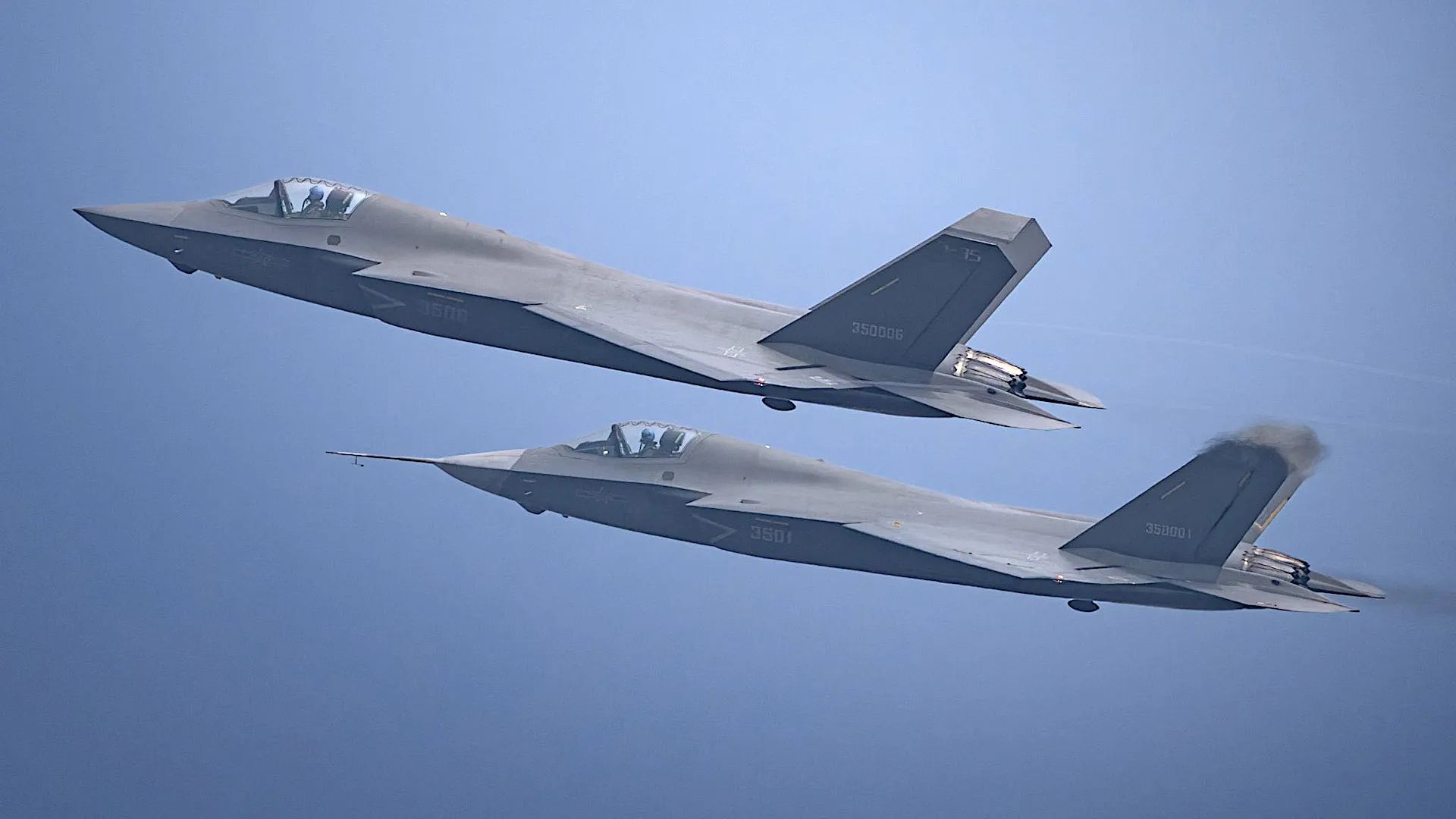
The Shenyang J-35 is a Chinese single-seat, twin-engine stealth multirole fighter developed by Shenyang Aircraft Corporation for carrier aviation. It evolved from the privately developed FC-31 demonstrator and was redesigned for operation from Chinese aircraft carriers.
The carrier-based J-35 made its first flight on 29 October 2021. Its naval configuration includes folding wings, a twin-wheel nose landing gear with a catapult launch bar, and equipment for arrested carrier landings. The aircraft later entered testing aboard the electromagnetic-catapult-equipped carrier Fujian.
By 2025, the J-35 had progressed from prototype testing to publicly demonstrated carrier operations and military service. Photographs published in August 2026 also showed a J-35 with an unusually reflective surface, creating renewed interest in the aircraft's low-observable materials and maritime coating technology.
Development from the FC-31
The J-35 lineage began with the Shenyang FC-31, an export-oriented stealth fighter demonstrator initially developed with company funding. The first FC-31 prototype flew on 31 October 2012. A substantially revised second prototype followed on 23 December 2016 with changes to the airframe, cockpit, control surfaces, engines and low-observable features.
Chinese military interest subsequently shifted the program toward a carrier fighter. A mock-up associated with the emerging naval design was observed on a Chinese carrier test facility in 2021. The redesigned carrier prototype flew on 29 October that year. Compared with the earlier FC-31, it incorporated folding wings, a catapult launch bar, a revised canopy and other changes required for naval operations. A detailed development chronology is also summarized by the J-35 reference history.
A further naval prototype, reported as aircraft 350003, appeared in July 2022 with People's Liberation Army Navy markings, refined surface treatments and modified engine exhausts. During 2023 and 2024, additional prototypes and full-size mock-ups were observed during flight and carrier compatibility testing.
Carrier testing and service introduction
China tested J-35 mock-ups and aircraft configurations with both its newer catapult-equipped carrier infrastructure and older ski-jump carrier decks. In 2024, a full-size J-35 mock-up was observed aboard Liaoning, supporting assessments that compatibility with more than one Chinese carrier configuration was being evaluated.
Testing with Fujian advanced during 2025. On 22 September 2025, the People's Liberation Army Navy publicly released imagery showing the J-35 completing electromagnetic catapult launches and arrested recoveries aboard Fujian. The service stated that the aircraft had been certified for catapult-assisted launch and recovery operations. Chinese state media had already displayed the J-35 and land-based J-35A as part of the country's military aircraft inventory during the September 2025 Victory Day parade.
Open-source reporting during 2025 and 2026 also indicated expansion of Shenyang's production infrastructure and increasing numbers of J-35-family airframes. Claims about exact production totals remain dependent on serial-number analysis and imagery rather than a complete official production record. One 2026 assessment of Shenyang's industrial expansion is available from Defence Security Asia.
Reflective surface observations in 2026
Photographs circulating in August 2026 showed a carrier-based J-35 with a bright silver or mirror-like appearance. The reflective finish attracted comparisons with experimental treatments previously flown on U.S. F-22A and F-35C aircraft. Chinese authorities did not publicly identify the material or explain its purpose.
The photographs alone do not establish that the J-35 was using a new radar-absorbent or multispectral stealth coating. Sun angle, viewing geometry, camera exposure and image processing can substantially change the apparent reflectivity of an aircraft surface. Other possibilities include a revised topcoat, a temporary protective layer, a manufacturing treatment or a durability experiment. A separate analysis of the photographs argues that lighting remains a plausible explanation and emphasizes the limited evidence available from imagery alone in the silver J-35 assessment.
A visually reflective surface does not by itself determine radar cross-section or infrared detectability. Radar interaction depends on airframe geometry, material conductivity, dielectric properties, coating thickness, frequency and viewing angle. Infrared signature also depends on temperature, emissivity, engine exhaust and aerodynamic heating. The observed surface therefore provides evidence of an unusual visible appearance, but not proof of improved radar or infrared stealth.
The issue is particularly relevant to carrier aviation because low-observable materials must tolerate salt, humidity, ultraviolet exposure, fuel and hydraulic contamination, thermal cycling and frequent deck handling. A durable coating that maintains signature performance while reducing maintenance requirements could improve aircraft availability, but no public evidence yet demonstrates that the reflective J-35 surface provides such an advantage. Technical possibilities and comparisons with American reflective-surface testing are discussed by Defence Security Asia.
Design
Airframe
The J-35 is a medium-size twin-engine aircraft with a blended fuselage, chiseled nose, side-mounted diverterless supersonic inlets, trapezoidal wings, all-moving horizontal tail surfaces and two outward-canted vertical stabilizers. Its overall layout retains the FC-31 lineage but incorporates extensive changes for military and carrier requirements.
Low-observable shaping includes aligned edges, internal weapon carriage, concealed engine faces behind curved inlet ducts and serrated or sawtooth treatment around selected doors and panels. The aircraft's actual radar cross-section has not been publicly established. An independent overview of the aircraft emphasizes that many detailed performance and stealth figures remain estimates rather than verified public data in the FC-31 and J-35 technical overview.
Carrier equipment
The naval J-35 uses a larger wing than the land-based J-35A and incorporates folding wing sections to reduce its footprint aboard ship. Its twin-wheel nose landing gear includes a catapult launch bar for carrier operations. The design also incorporates a tailhook for arrested recovery.
These features support operations from Fujian's electromagnetic catapult system. Testing with Liaoning mock-ups also indicates evaluation of the design for ski-jump carrier operations, although the degree to which operational J-35 units will routinely use older carriers is less clearly documented.
Cockpit and avionics
The J-35 family has been associated with an active electronically scanned array radar, a distributed optical aperture system and a chin-mounted electro-optical targeting system. Publicly available sources do not provide a complete independently verified configuration for production naval aircraft.
The naval J-35 reportedly uses an integrated center control stick, while related FC-31 and J-35A configurations have been shown with different cockpit controls. Large multifunction displays, a head-up display and helmet-mounted cueing have also been associated with the family. The aircraft is intended to exchange information with other platforms as part of networked air operations.
Propulsion
Powerplant development has changed repeatedly across the FC-31 and J-35 program. The original FC-31 used Russian RD-93 engines. Later demonstrators used Chinese WS-13-family engines. Early J-35 aircraft have been reported with the WS-21, also described as a development of the WS-13 family.
Later reporting identifies the WS-19 as the intended higher-performance powerplant for production aircraft. Public sources give different accounts of which engine standard is installed on particular J-35 airframes, and claims that the aircraft can supercruise with the WS-19 have not been publicly confirmed. For this reason, engine performance figures should be treated cautiously.
The aircraft also has a retractable aerial-refueling probe, allowing fuel transfer in flight.
Armament
The J-35 carries weapons internally to preserve its low-observable configuration. Sources describe six internal weapon stations in the main bay and additional external wing stations for missions where reduced radar signature is less important.
Reported air-to-air weapons include the PL-10 and PL-15 families, while longer-range weapons including the PL-21 have also been associated with the aircraft. The internal bay is also reported to accommodate precision-guided strike weapons. Exact operational load combinations have not been fully disclosed.
Operational history
The J-35's documented operational development centers on carrier integration. After its 2021 first flight, successive prototypes were used to refine naval features and low-observable configuration. Carrier compatibility work included shore-based facilities, deck mock-ups and eventually at-sea operations.
In 2025, J-35 aircraft were observed operating during Fujian trials. Publicly released footage in September showed electromagnetic catapult launches and arrested recoveries. The aircraft also appeared publicly with other Chinese fifth-generation fighters during the September 2025 military parade.
By 2026, open-source imagery indicated continued production and testing. The reflective J-35 photographed in August 2026 appears to have been a naval aircraft, but the purpose of its unusual surface remains unconfirmed.
Variants
- FC-31 31001: First flying demonstrator of the Shenyang stealth-fighter lineage. It first flew in October 2012 and was initially developed as an export-oriented company project.
- FC-31 31003: Heavily revised second demonstrator with altered aerodynamics, cockpit, engines and increased maximum takeoff weight.
- J-35: Carrier-based operational development with folding wings, twin-wheel nose gear, catapult launch equipment and arrested-landing capability. It is intended for People's Liberation Army Navy carrier aviation.
- J-35A: Land-based variant for the People's Liberation Army Air Force. It uses a smaller wing and single-wheel nose landing gear and omits the naval catapult arrangement.
- J-35AE: Export version derived from the land-based J-35A. It was publicly revealed in 2026.
Operators
- China: The People's Liberation Army Navy operates the carrier-based J-35. The related J-35A serves with the People's Liberation Army Air Force.
Pakistan has repeatedly been reported as a prospective customer for an export J-35-family aircraft. Reports have mentioned quantities of up to 40 aircraft, but the supplied sources also record conflicting official statements and do not establish confirmed delivery of operational aircraft. Pakistan is therefore not listed here as a current operator.
Specifications (J-35)
Public technical data for the operational J-35 remain limited, and several published figures originate from reporting around the wider FC-31 and J-35 development program. The values below are reported figures for the J-35 and should not be treated as complete officially verified specifications.
General characteristics
- Crew: 1
- Length: 17.3 m (56 ft 9 in)
- Wingspan: 11.5 m (37 ft 9 in)
- Height: 4.8 m (15 ft 9 in)
- Gross weight: 17,500 kg (38,581 lb)
- Maximum takeoff weight: 28,000 kg (61,729 lb)
- Fuel capacity: 7,200 kg (15,900 lb)
Performance
- Maximum speed: Reported as approximately Mach 1.8
- Combat radius: Reported as approximately 1,250 km (780 mi) on internal fuel
- Service ceiling: Reported as 16,000 m (52,000 ft)
- Load limits: Reported as +9/-3 g
Armament
- Internal stations: 6 reported weapon stations in the internal bay
- External stations: 6 reported wing stations
- Internal payload: Reported up to 2,000 kg (4,400 lb)
- External payload: Reported up to 6,000 kg (13,000 lb)
- Total weapons payload: Reported up to 8,000 kg (18,000 lb)
- Air-to-air weapons: PL-10 and PL-15 are reported for carriage; longer-range missile types have also been associated with the program.
- Strike weapons: Precision-guided bombs, land-attack, anti-radiation and anti-ship weapons have been reported as potential load options.
Avionics
- Radar: Active electronically scanned array radar; exact production configuration not publicly established
- Electro-optical systems: Distributed aperture system and chin-mounted electro-optical targeting system reported
Related equipment
- Shenyang FC-31: The demonstrator and development lineage from which the J-35 evolved.
- Shenyang J-35A: Land-based member of the same aircraft family for the People's Liberation Army Air Force.
- Chengdu J-20: China's larger fifth-generation fighter, operated alongside the J-35 family in the country's combat-aircraft inventory.
- Lockheed Martin F-35C: Carrier-capable stealth fighter of comparable general role; both aircraft have also attracted attention for reflective surface treatments used or observed during testing.
 Argentina
 Armenia
 Australia
 Austria
 Austria-Hungary
 Belgium
 Brazil
 United Kingdom
 United States
 Brunei
 Bulgaria
 Canada
 Chile
Chile Colonial America
 Colombia
 Confederate States
 Croatia
 Czech
Czech Denmark
 Egypt
Egypt Finland
 France
 Georgia
 Germany
 German Imperial
 Greece
 Holland
 Hungary
 India
India Indonesia
 Iran
Iran Iraq
Iraq Ireland
 Israel
 Italy
Italy Japan
Japan Japan (1940)
 Jordan
 Kingdom of Italy
 Malaysia
 Mexico
 Myanmar
 Nazi Germany
 Netherlands
 New Zealand
 North Korea
 Norway
 Pakistan
 Peru
Peru Philippines
 Poland
 Portugal
 Prussia
 Romania
 Russia
 Saudi Arabia
 Serbia
 Singapore
 Slovakia
 Slovenia
 South Africa
 South Korea
 Soviet Union
 Spain
Spain Sweden
 Switzerland
 Syria
Syria Taiwan
 Thailand
 Turkey
 UAE
UAE Ukraine
 Vietnam
 Yugoslavia