
History
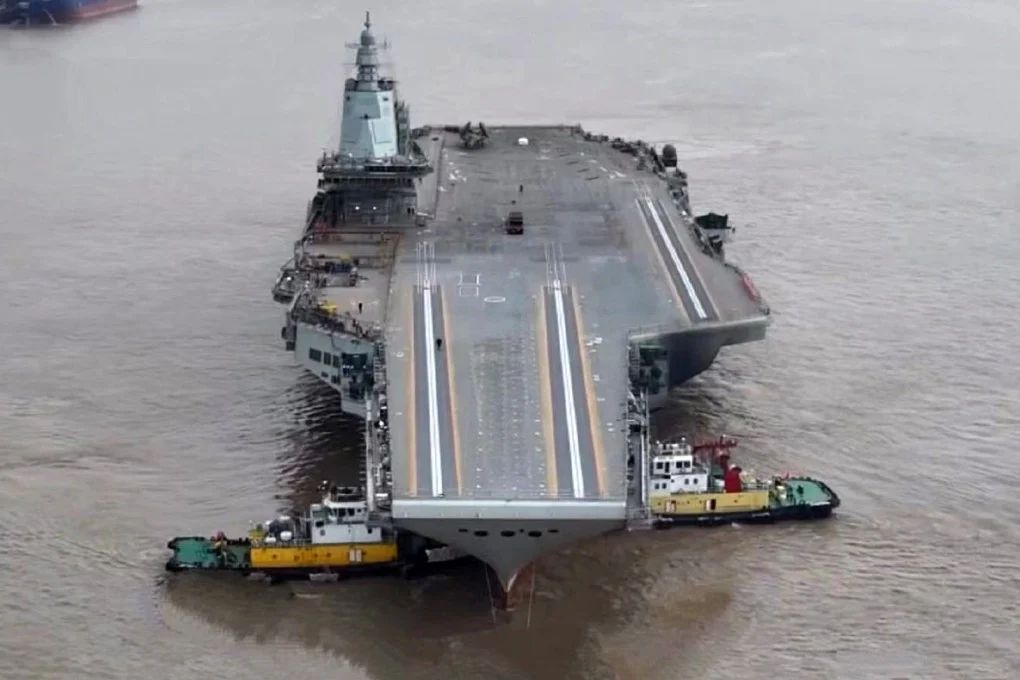
China's fourth aircraft carrier is a large carrier under construction at the Dalian Shipyard in Liaoning province. The vessel is commonly referred to in open-source reporting as the Type 004, although many details of its final configuration remain unconfirmed.
The carrier is expected to become larger than China's first three aircraft carriers and is widely assessed as likely to use nuclear propulsion. Satellite imagery has also provided evidence for a catapult-equipped flight deck, but the final number of catapults, elevators, and other major systems has not yet been established.
The project represents the next stage of China's carrier development after Liaoning, Shandong, and Fujian. It combines lessons from earlier Chinese carrier construction with a substantially larger hull and potentially introduces nuclear propulsion to a Chinese surface warship for the first time.
Construction
Reporting indicates that work associated with the fourth carrier was underway at Dalian by at least 2024. CSIS identified prefabricated hull components in the shipyard's graving dock in early 2025. Within less than a year, these modules had been assembled into a clearly recognizable aircraft-carrier hull.
The vessel is being assembled in the same graving dock where China completed Liaoning and built Shandong. Liaoning originated as the unfinished Soviet carrier Varyag, while Shandong became China's first domestically built aircraft carrier. China's third carrier, Fujian, was instead constructed at Jiangnan Shipyard in Shanghai.
By May 2026, CSIS measured the unfinished hull at approximately 286 m long and 46 m wide. At that stage, the bow remained incomplete. CSIS noted that the hull was already wider than Fujian at a comparable stage of construction.
Further assembly continued through the summer of 2026. Open-source imagery reported in August showed the bow module installed and additional large prefabricated sections arriving at the construction site. Satellite imagery reviewed later that month indicated that the hull had grown to approximately 320 m in length while retaining a maximum observed hull beam of about 46 m. These measurements do not represent the completed ship because additional structure and the flight deck remain to be added.
Propulsion assessment
The carrier's propulsion system has not been officially confirmed. However, analysis of satellite imagery has produced significant evidence that it is likely to be nuclear-powered. CSIS identified two approximately 15 m by 15 m compartments visible in May 2026 imagery that it assessed as having characteristics consistent with shielded nuclear-reactor containment spaces.
The assessment is also supported by earlier evidence of Chinese work on naval nuclear propulsion. CSIS cited open-source research linking a land-based naval reactor prototype in Sichuan to the 701st Research Institute, an organization associated with Chinese aircraft-carrier design. Chinese authorities have acknowledged that a fourth carrier program exists but have not publicly confirmed its propulsion system.
If the assessment is correct, the ship would become China's first nuclear-powered aircraft carrier and the country's first nuclear-powered surface combatant. Nuclear propulsion would reduce dependence on propulsion fuel during long deployments and could provide substantial electrical power for aircraft launch systems and other onboard equipment. The carrier would still require regular replenishment of aviation fuel, food, munitions, and other supplies.
Design
Hull and flight deck
The unfinished vessel is already larger than earlier Chinese carriers at comparable stages of construction. CSIS assessed in May 2026 that its 46 m hull beam exceeded the approximately 40 m beam of Fujian at a similar construction stage. The final flight deck will extend beyond the hull, so the completed dimensions cannot yet be established.
Fujian measures approximately 303 m at the waterline and about 316 m overall. Open-source analysis therefore indicates that the fourth carrier is likely to become China's largest aircraft carrier. Claims that it could approach the overall dimensions of the 337 m Gerald R. Ford class remain projections rather than confirmed specifications.
Aircraft launch system
The vessel is expected to use a catapult-assisted takeoff but arrested recovery configuration. This would continue the major design transition introduced by Fujian, which replaced the ski-jump arrangement of Liaoning and Shandong with electromagnetic aircraft launch catapults.
CSIS assesses that the fourth carrier will use electromagnetic catapults, but the final number remains uncertain. Fujian has three catapults. A large module observed near the Dalian construction site has been interpreted as possibly containing trenches for two waist catapults, which could result in a four-catapult arrangement, but CSIS states that it is unclear whether this structure is intended for installation on the carrier or serves as a test or demonstrator component.
Aircraft elevators
The number and arrangement of aircraft elevators have not yet been confirmed. Liaoning, Shandong, and Fujian use two aircraft elevators on the starboard side. Open-source assessments have suggested that the larger fourth carrier could add a third elevator, potentially on the port side, but available imagery has not established this configuration.
Island arrangement
Models, renderings, and China's full-scale land-based carrier test facility at Wuhan have suggested a future Chinese carrier layout with a relatively compact island located farther aft than on earlier designs. These sources are indicative rather than definitive, and the final island configuration of the fourth carrier has not yet been confirmed.
Air wing
The carrier's operational air wing has not been announced. Aircraft being developed or introduced for China's catapult-equipped carrier force include the J-15 family, the J-35 stealth fighter, and the KJ-600 airborne early warning and control aircraft. Uncrewed aircraft and helicopters are also being developed for Chinese naval aviation. Their eventual inclusion aboard the fourth carrier remains dependent on the ship's final configuration and PLAN deployment plans.
Program status
As of August 2026, the carrier remained under construction at Dalian. Its bow had been substantially assembled, but the flight deck, island, and many upper structures were not yet complete.
No confirmed launch or commissioning date has been announced. After launch, the vessel will require fitting out, harbor testing, and sea trials before it can enter PLAN service. CSIS assesses that several years of work remain before commissioning.
The carrier forms part of a wider expansion of China's carrier fleet. According to CSIS, the 2025 U.S. Department of Defense assessment stated that China aims to add six aircraft carriers by 2035, which would bring the PLAN fleet to nine carriers if the objective is achieved.
Specifications (China's fourth aircraft carrier, under construction)
General characteristics
- Type: Aircraft carrier
- Builder: Dalian Shipyard, Dalian, China
- Construction status: Under construction as of August 2026
- Observed hull length: Approximately 320 m by August 2026; incomplete and subject to increase
- Observed maximum hull beam: Approximately 46 m during construction
- Propulsion: Likely nuclear, but not officially confirmed
Aviation facilities
- Flight deck configuration: Expected CATOBAR configuration
- Aircraft launch system: Expected electromagnetic catapults
- Number of catapults: Three or four discussed in open-source assessments; final configuration not confirmed
- Aircraft elevators: Final number and arrangement not confirmed
Related equipment
- Liaoning: China's first aircraft carrier, completed at Dalian from the unfinished Soviet-built Varyag and later commissioned into PLAN service.
- Shandong: China's first domestically built aircraft carrier and the second PLAN carrier, assembled at Dalian.
- Fujian: China's third aircraft carrier and first Chinese carrier equipped with electromagnetic aircraft launch catapults.
Detailed open-source analysis of the ship's construction and propulsion evidence is available from CSIS. Additional reporting on the project has been published by Army Recognition, Future Warfare Magazine, Asia Times, and Zona Militar.
 Argentina
 Armenia
 Australia
 Austria
 Austria-Hungary
 Belgium
 Brazil
 United Kingdom
 United States
 Brunei
 Bulgaria
 Canada
 Chile
Chile Colonial America
 Colombia
 Confederate States
 Croatia
 Czech
Czech Denmark
 Egypt
Egypt Finland
 France
 Georgia
 Germany
 German Imperial
 Greece
 Holland
 Hungary
 India
India Indonesia
 Iran
Iran Iraq
Iraq Ireland
 Israel
 Italy
Italy Japan
Japan Japan (1940)
 Jordan
 Kingdom of Italy
 Malaysia
 Mexico
 Myanmar
 Nazi Germany
 Netherlands
 New Zealand
 North Korea
 Norway
 Pakistan
 Peru
Peru Philippines
 Poland
 Portugal
 Prussia
 Romania
 Russia
 Saudi Arabia
 Serbia
 Singapore
 Slovakia
 Slovenia
 South Africa
 South Korea
 Soviet Union
 Spain
Spain Sweden
 Switzerland
 Syria
Syria Taiwan
 Thailand
 Turkey
 UAE
UAE Ukraine
 Vietnam
 Yugoslavia