
History
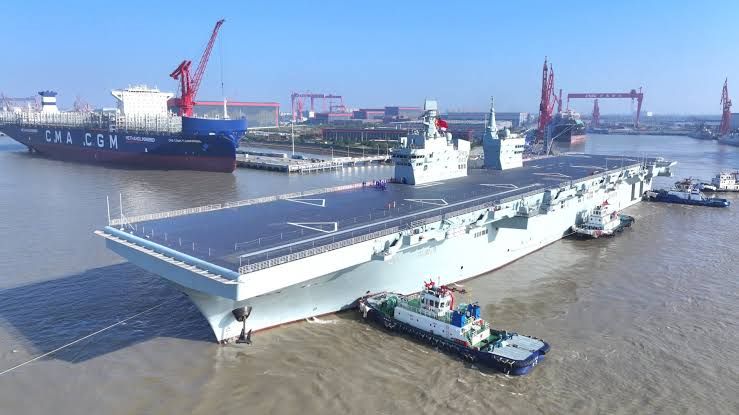
The Type 076 Sichuan is a large amphibious assault ship built for the People's Liberation Army Navy by Hudong-Zhonghua Shipbuilding, a subsidiary of China State Shipbuilding Corporation. It combines a full-length flight deck and fixed-wing aviation systems with vehicle and well decks for amphibious operations.
Sichuan is the first known amphibious assault ship fitted with an electromagnetic aircraft catapult and arrested-recovery equipment. This arrangement is intended to support helicopters and heavier fixed-wing aircraft, particularly unmanned aircraft, without removing the ship's ability to carry landing forces and equipment.
The design represents a substantial development of China's Type 075 amphibious assault ships. Its enlarged aviation facilities place the Type 076 between a conventional landing helicopter dock and a light aircraft carrier, although it remained in testing as of August 2026.
Construction and launch
Sichuan was constructed at Hudong-Zhonghua's Changxing Island shipyard in Shanghai. The ship was launched in December 2024. Contemporary analysis based on satellite imagery and launch photographs identified a broad flight deck, twin-island superstructure, large aircraft elevators and a well deck. The Sasakawa Peace Foundation analysis described the ship as having greater emphasis on aviation than the Type 075, with expanded hangar space and reduced room for landing vehicles.
Sea trials and systems testing
Sichuan began its first sea trial in November 2025 and subsequently completed several trial campaigns. By July 2026, deck markings had been applied and Chinese state media reported that the catapult and arresting equipment had been completed.
Official footage released in 2026 showed the ship deploying defensive countermeasures and launching a red dead-load test cart with its electromagnetic catapult. A dead-load launch tests catapult performance and power management before launches with aircraft. The footage provided public confirmation that qualification had progressed beyond installation of the launch system. The reported trials are summarized by Marine Insight.
Computer-generated footage broadcast by CCTV depicted the ship launching a GJ-21 unmanned combat aircraft. This was a representation of an intended capability rather than evidence of an actual aircraft launch. In July 2026, the next expected stage was ship-aircraft integration training. China had not announced a commissioning date.
Design
Hull and internal arrangement
The Type 076 has a full-length flight deck and two separate island structures. Chinese authorities describe its displacement as exceeding 40,000 tonnes, while open-source estimates place full-load displacement between approximately 40,000 and 50,000 tonnes. Published estimates place its overall length at approximately 252 to 260 metres. The flight deck has also been reported as approximately 250 metres long and 62 metres wide.
The ship retains the principal internal features of an amphibious assault vessel. Its upper internal level contains the aviation hangar. Vehicle and well decks below it accommodate troops, armoured vehicles, landing craft and other amphibious equipment. Reports state that the well deck can operate Type 726 Yuyi-class air-cushion landing craft. The competing requirements of aviation facilities and amphibious stowage mean that the ship cannot maximize both roles simultaneously.
Propulsion and electrical power
Open-source assessments describe an integrated electric propulsion system supplied by two gas turbines rated at approximately 21 MW each and six diesel generators rated at approximately 6 MW each. The reported total installed electrical output is about 78 MW. This electrical architecture supports propulsion, ship services, sensors and the high power demand of the electromagnetic catapult. These figures have not been released as a complete official specification.
Aviation facilities
The flight deck incorporates one electromagnetic catapult and arrested-recovery equipment. Two large elevators connect the flight deck with the aviation hangar, while imagery indicates an additional forward elevator. Electromagnetic launch equipment can regulate launch energy for aircraft of different weights. It also permits heavier fuel and payload loads than vertical take-off, provided that a compatible aircraft and recovery system are available.
The ship is designed to operate helicopters and fixed-wing aircraft. Its most consistently reported intended role is the operation of fixed-wing unmanned aircraft for reconnaissance, surveillance, target acquisition, electronic warfare and strike missions. Chinese media have associated the ship with the proposed GJ-21 naval unmanned combat aircraft. Possible operation of crewed aircraft, including the J-35 fighter or KJ-600 airborne early-warning aircraft, remains speculative and had not been demonstrated during the reported trials. The distinction between demonstrated and depicted capabilities is also noted in the South China Morning Post report.
Amphibious capability
Sichuan is intended to transport landing forces, vehicles, helicopters and landing craft. The well deck preserves a ship-to-shore role using air-cushion or conventional landing craft, while helicopters can move personnel and equipment beyond the shoreline. Some reports state that the ship can embark more than 1,000 marines and two Type 726 air-cushion landing craft, but China has not published a complete capacity specification.
Defensive systems
Published assessments identify a planned self-defence suite of three Type 1130 close-in weapon systems, three HHQ-10 short-range surface-to-air missile launchers and multiple decoy launchers. The 2026 footage confirmed live deployment of countermeasures, but it did not establish the complete operational configuration of every defensive system.
Program status
As of August 2026, Sichuan had completed multiple sea trials and had entered advanced systems qualification. The electromagnetic catapult had launched a dead-load test cart, and the ship had demonstrated defensive countermeasure deployment. No launch or arrested recovery of an operational aircraft had been publicly confirmed.
The Type 076 is intended to combine amphibious transport with sustained aviation operations. Its catapult could allow fixed-wing unmanned aircraft to operate at greater range and with heavier payloads than aircraft dependent on vertical take-off. However, the ship's operational air group, sortie rate, embarked-force capacity and ability to alternate between flight operations and well-deck operations remained unconfirmed.
Specifications (Type 076 Sichuan)
General characteristics
- Type: Amphibious assault ship with catapult-assisted aviation capability
- Builder: Hudong-Zhonghua Shipbuilding, China State Shipbuilding Corporation
- Displacement: More than 40,000 tonnes officially stated; approximately 40,000–50,000 tonnes full load in open-source estimates
- Overall length: Approximately 252–260 m in published estimates
- Flight deck: Approximately 250 m long and 62 m wide
- Superstructure: Twin-island arrangement
- Aviation elevators: Two large hangar elevators and one reported forward elevator
- Well deck capacity: Reportedly two Type 726 Yuyi-class air-cushion landing craft
- Embarked force: Reportedly more than 1,000 marines
Propulsion and power
- Propulsion: Integrated electric propulsion
- Reported generating plant: Two approximately 21 MW gas turbines and six approximately 6 MW diesel generators
- Reported installed electrical output: Approximately 78 MW
Aviation equipment
- Launch system: One electromagnetic aircraft catapult
- Recovery system: Arresting gear
- Intended aircraft types: Fixed-wing unmanned aircraft and helicopters; compatible crewed fixed-wing aircraft have been discussed but not demonstrated
Reported defensive armament
- Close-in weapon systems: Three Type 1130 systems
- Short-range surface-to-air missiles: Three HHQ-10 launchers
- Countermeasures: Multiple decoy launchers
Related equipment
- Type 075: The preceding Chinese amphibious assault ship design, centred on helicopter operations and conventional amphibious transport.
- Type 003 Fujian: China's larger aircraft carrier equipped with electromagnetic catapults; its launch technology is related to the aviation architecture adopted for the Type 076.
- GJ-21: A proposed naval derivative of the GJ-11 unmanned combat aircraft depicted in Chinese computer-generated imagery operating from Sichuan.
 Argentina
 Armenia
 Australia
 Austria
 Austria-Hungary
 Belgium
 Brazil
 United Kingdom
 United States
 Brunei
 Bulgaria
 Canada
 Chile
Chile Colonial America
 Colombia
 Confederate States
 Croatia
 Czech
Czech Denmark
 Egypt
Egypt Finland
 France
 Georgia
 Germany
 German Imperial
 Greece
 Holland
 Hungary
 India
India Indonesia
 Iran
Iran Iraq
Iraq Ireland
 Israel
 Italy
Italy Japan
Japan Japan (1940)
 Jordan
 Kingdom of Italy
 Malaysia
 Mexico
 Myanmar
 Nazi Germany
 Netherlands
 New Zealand
 North Korea
 Norway
 Pakistan
 Peru
Peru Philippines
 Poland
 Portugal
 Prussia
 Romania
 Russia
 Saudi Arabia
 Serbia
 Singapore
 Slovakia
 Slovenia
 South Africa
 South Korea
 Soviet Union
 Spain
Spain Sweden
 Switzerland
 Syria
Syria Taiwan
 Thailand
 Turkey
 UAE
UAE Ukraine
 Vietnam
 Yugoslavia