
History
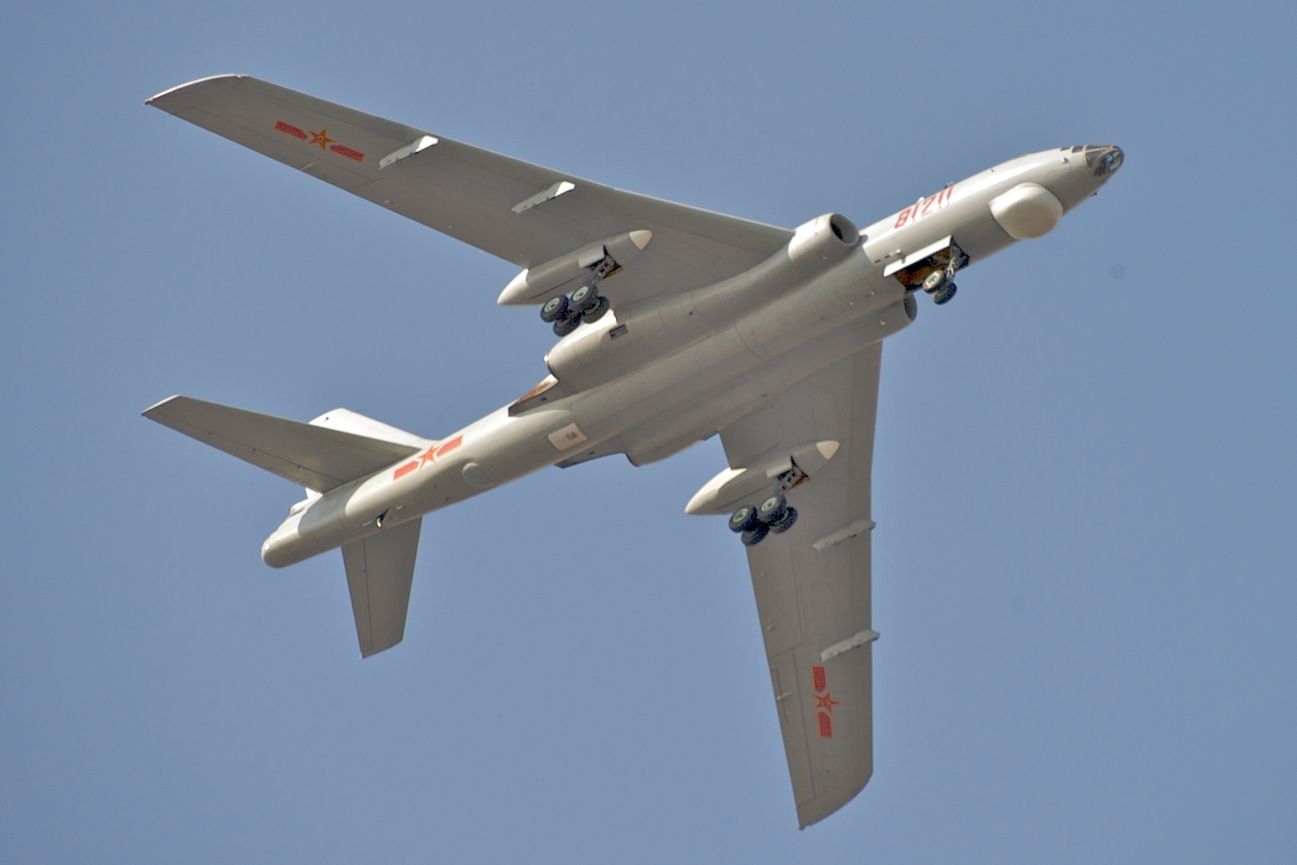
The Xi'an H-6N is a Chinese strategic bomber and long-range missile carrier developed from the modern H-6K family by Xi'an Aircraft Company. It combines the non-stealthy, subsonic H-6 airframe with aerial-refueling capability and provision for a large weapon carried beneath the fuselage.
The H-6N is associated with China's developing air-based strategic deterrent and with the carriage of large air-launched ballistic missiles. Public imagery has also shown the bomber operating with J-20 stealth fighters, illustrating a wider concept in which the bomber can be supported by fighter escorts and other elements of a joint strike network.
The aircraft remains part of the much older H-6 lineage, which originated from the Soviet Tupolev Tu-16 design. China continued developing the family through successive engine, avionics and weapon changes, eventually producing the H-6K and later the H-6N for long-range standoff strike roles.
Development
The H-6N followed the H-6K, which represented a major modernization of the H-6 family. The H-6K introduced a solid nose radome, a glass cockpit, more efficient turbofan engines and multiple underwing weapon pylons. The later H-6N added an aerial-refueling probe and a recess for a large air-launched weapon.
By November 2020, public imagery had shown an H-6N carrying a very large missile on its ventral mounting. A contemporary overview of the H-6K family described the H-6N as its newest member and identified Xi'an Aircraft Company as the producer of the modern family. The Diplomat discussed this configuration as part of the continuing development of China's long-range strike options.
The H-6N's aerial-refueling capability distinguishes it from earlier H-6 variants in the strategic role. The supplied reporting describes it as China's first nuclear-capable, air-refuelable bomber. Refueling allows the aircraft to be repositioned over greater distances and potentially approach different missile launch areas without relying only on its initial fuel load.
Strategic missile role
China publicly displayed the JL-1 air-launched long-range missile during its September 3, 2025 V-Day parade as part of a presentation of land-, sea- and air-based strategic nuclear forces. The public information supplied for this article does not establish the missile's range, propulsion system, warhead configuration, inventory size or operational alert status.
On August 4, 2026, CCTV News broadcast footage showing an H-6N with a large missile mounted beneath its fuselage while accompanied by two J-20 fighters. The footage appeared in a documentary segment concerning joint operations against a large naval formation. Chinese reporting did not definitively identify the weapon. Hong Kong media identified it as the JL-1, while a Chinese aviation specialist stated that the weapon could be an air-launched ballistic missile for anti-ship or ground-strike missions. Global Times noted that the long-range footage was insufficient to confirm whether the missile was actually the JL-1 or another model.
Design
The H-6N retains the conventional, non-stealthy and subsonic configuration of the modern H-6 family. The wider H-6 design traces its ancestry to the Soviet Tu-16, a twin-jet bomber of the 1950s. Rather than being configured to penetrate heavily defended airspace through stealth, the modern H-6 family is intended to employ long-range standoff weapons.
Airframe and refueling
The most important externally visible changes associated with the H-6N are its aerial-refueling probe and its provision for carrying a very large weapon beneath the fuselage. The ventral mounting allows the aircraft to carry weapons too large for the smaller missile stations normally associated with H-6 family wing pylons.
External carriage of a large weapon also imposes limitations. The supplied analysis notes that such carriage is likely to increase aerodynamic drag, restrict maneuvering flexibility and increase the bomber's radar signature. The H-6N therefore depends on releasing its weapon from a suitable standoff position rather than becoming a penetrating stealth bomber.
Mission support
The August 2026 footage showed two J-20 stealth fighters accompanying the H-6N. This should not be interpreted as evidence of a fixed two-aircraft escort formation. The material instead presents the fighters as part of a broader protected-strike concept.
In such a concept, fighters could operate ahead of or around the bomber to counter hostile aircraft while the H-6N approaches its planned launch area. The supplied reporting also identifies tankers, airborne early-warning aircraft, electronic-warfare platforms, ground-based sensors, communications systems and command networks as relevant supporting elements. Public information does not establish the precise composition of an operational H-6N mission package.
Armament
The H-6N has a ventral mounting or recess intended for a large air-launched weapon. Public imagery has shown the aircraft carrying a single large missile beneath the fuselage. The weapon shown in August 2026 resembled the JL-1 displayed in 2025, but the supplied sources do not establish its identity conclusively.
The available evidence therefore supports describing the H-6N as an air-launched ballistic-missile carrier while keeping the exact missile identification qualified. The same evidence does not establish the weapon's detailed performance or whether the configuration shown in the documentary represented a routine operational load.
Program status
The H-6N is presented in the supplied sources as part of the People's Liberation Army Air Force's modern H-6 family and as a platform associated with China's air-based strategic strike capability. The August 2026 CCTV footage demonstrated the aircraft carrying a large ventral missile while flying with J-20 fighters.
The footage does not by itself prove that the complete bomber, missile and escort architecture has reached a fully mature operational state. The reporting instead provides evidence of China's continuing integration of bombers, fighters and joint command networks for long-range strike missions.
The bomber's strategic value lies partly in mobility. Unlike a fixed missile launcher, an aircraft can move between bases, change its approach direction, be redirected during a mission or return without releasing its weapon. At the same time, the H-6N remains dependent on supporting infrastructure and is not a stealth aircraft, making its survivability closely related to standoff range, fighter protection, tanker support and the wider operational network.
Variants
- H-6K: Modernized H-6 family variant with a solid nose radome, glass cockpit, more efficient turbofan engines and six underwing pylons for long-range cruise missiles.
- H-6N: Strategic-bomber development of the modern H-6 family with aerial-refueling capability and provision for a single large air-launched weapon beneath the fuselage.
Operators
- China: The People's Liberation Army Air Force operates the H-6N as part of its modern long-range bomber force.
Specifications (H-6N)
General characteristics
- Type: Strategic bomber and long-range missile carrier
- Configuration: Non-stealthy, subsonic bomber derived from the H-6 family
- Refueling: Equipped for aerial refueling
- Large-weapon station: Ventral mounting or recess for a single large air-launched weapon
Armament
- Large air-launched missile: Public imagery has shown one large missile carried beneath the fuselage; August 2026 footage was reported as possibly showing the JL-1, but the exact missile identification was not confirmed.
Related equipment
- H-6K: Earlier modernized member of the H-6 family from which the H-6N was developed.
- JL-1: Chinese air-launched long-range missile publicly displayed in 2025 and associated in reporting with the H-6N strategic role.
- J-20: Chinese stealth fighter shown accompanying an H-6N carrying a large ventral missile in August 2026 footage.
 Argentina
 Armenia
 Australia
 Austria
 Austria-Hungary
 Belgium
 Brazil
 United Kingdom
 United States
 Brunei
 Bulgaria
 Canada
 Chile
Chile Colonial America
 Colombia
 Confederate States
 Croatia
 Czech
Czech Denmark
 Egypt
Egypt Finland
 France
 Georgia
 Germany
 German Imperial
 Greece
 Holland
 Hungary
 India
India Indonesia
 Iran
Iran Iraq
Iraq Ireland
 Israel
 Italy
Italy Japan
Japan Japan (1940)
 Jordan
 Kingdom of Italy
 Malaysia
 Mexico
 Myanmar
 Nazi Germany
 Netherlands
 New Zealand
 North Korea
 Norway
 Pakistan
 Peru
Peru Philippines
 Poland
 Portugal
 Prussia
 Romania
 Russia
 Saudi Arabia
 Serbia
 Singapore
 Slovakia
 Slovenia
 South Africa
 South Korea
 Soviet Union
 Spain
Spain Sweden
 Switzerland
 Syria
Syria Taiwan
 Thailand
 Turkey
 UAE
UAE Ukraine
 Vietnam
 Yugoslavia