

History
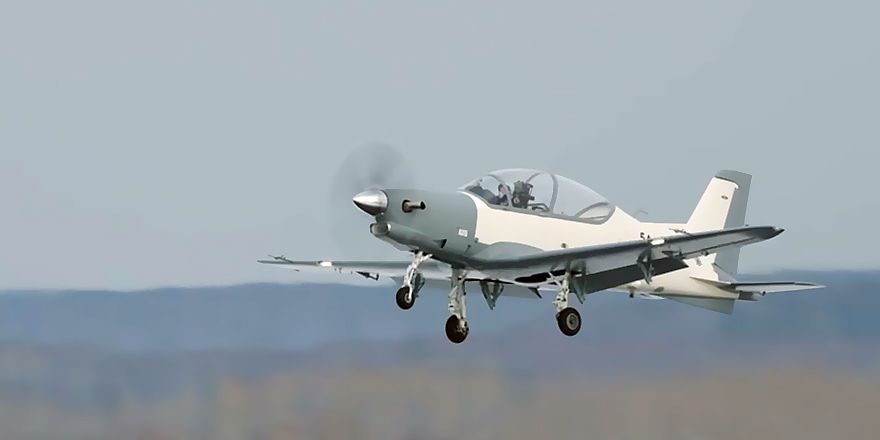
The UZGA UTS-800 is a Russian two-seat turboprop aircraft developed for basic military pilot training. It is intended for initial flight instruction, navigation training, aerobatic exercises, professional selection, and cadet orientation.
The aircraft is being developed by the Ural Works of Civil Aviation, also known as UZGA, in Yekaterinburg. The program is intended to provide a domestically produced training aircraft and has been associated with plans to replace older L-39 trainers while operating alongside more advanced training aircraft.
The UTS-800 uses tandem seating and is designed around the Russian VK-800SP turboprop engine. Its development has included flight testing, integration of domestic propulsion and avionics, testing of its emergency escape system, and preparation of additional aircraft.
Development
Russia began seeking a new basic trainer during the 2010s. A new competition was launched in 2021, with the UTS-800 competing against a re-engined Yak-152. UZGA had previously participated in licensed production of several foreign-designed aircraft, while development of a localized trainer related to the Diamond DART concept had begun earlier.
A static UTS-800 mockup was publicly displayed at the Army International Military-Technical Forum in August 2021. Supplied sources disagree on the date of the aircraft's first flight. One secondary source reports a prototype flight in 2021, while the more detailed program chronology gives 28 October 2023 as the first flight at Uktus Airport in Yekaterinburg. The 2023 aircraft used a General Electric H80 engine because the intended VK-800 powerplant was still under development.
On 28 December 2024, two UTS-800 aircraft were reported delivered to the Russian Ministry of Defence for further testing. Testing of these aircraft began in February 2025. In June 2025, ground testing of the Zvezda K-93 ejection seats was reported successful. Another UTS-800 made its first flight in late November 2025 and joined the flight-test program for verification of the aircraft's flight characteristics.
In February 2026, UZGA reported that the first VK-800SP engines had completed testing at the Baranov Central Institute of Aviation Motor Development. Integration with the UTS-800 and subsequent flight certification testing were expected to follow. Testing of the integrated PNK-800 flight and navigation system was also underway.
By August 2026, further evidence of aircraft construction was visible inside UZGA facilities in Yekaterinburg. During filming of the television program Военная приёмка, part of an assembly area containing military aircraft was blurred. Despite this, footage reportedly showed at least two, and possibly three, UTS-800 fuselages in the background. The images indicated that additional airframes were present at the factory, although the supplied material does not establish their completion status.
Design
The UTS-800 is a low-wing cantilever monoplane with two crew positions arranged in tandem. It is intended to provide basic flight training before pilots move to more advanced aircraft.
Airframe and manufacturing
UZGA has described the UTS-800 as its first aircraft project developed using a fully paperless digital manufacturing process. According to a RuAviation report citing the manufacturer's press service, the aircraft incorporates approximately 800 composite components. Electronic technical documentation is maintained within an integrated product lifecycle management system, while digital models are used for production planning and manufacturing.
The manufacturing process uses equipment including material-cutting plotters and laser projectors. These systems transfer dimensional data, composite-layer positioning, hole locations, tolerances, and other production information directly from digital models to tooling and raw materials.
Cockpit and avionics
The aircraft has two tandem crew positions and is fitted with Zvezda K-93 zero-zero ejection seats, designed to provide an escape capability from zero altitude and zero forward speed. An integrated oxygen system, air conditioning, and anti-icing equipment are also specified for the aircraft.
The UTS-800 incorporates the PNK-800 integrated flight and navigation system. Supplied program information states that the system can support simulated training scenarios, including air-to-air combat and close air support tasks. Testing of the PNK-800 system was reported underway in 2026.
Powerplant
The planned domestic powerplant is one Klimov VK-800SP turboprop. A UTS-800 technical profile lists takeoff power as 806 hp and identifies the Aerosila AV-410P propeller. Early flight testing used a General Electric H80 because development of the VK-800SP had not yet been completed.
UZGA has presented domestic production of the VK-800SP and other aircraft systems as an important element of the program. In June 2026, a company spokesperson told TASS that the company regarded domestic propulsion, low operating costs, and technological independence from foreign suppliers as major characteristics of the UTS-800.
Ground handling
The aircraft is equipped with a steerable nose wheel and differential braking. It is intended to operate from both paved and unpaved runways.
Program status
The UTS-800 remained in development and testing through 2026. Multiple aircraft had entered the test program, domestic VK-800SP engines were progressing toward aircraft integration, and the PNK-800 avionics suite was undergoing testing. Factory footage from August 2026 also showed additional UTS-800 fuselages in assembly facilities. The supplied evidence does not establish that the type had entered regular operational service.
Specifications (UTS-800 with VK-800SP)
General characteristics
- Crew: 2
- Length: approximately 10.7 m
- Height: approximately 3.4 m
- Wingspan: approximately 11.7 m
- Empty weight: 1,706 kg
- Normal takeoff weight: 2,560 kg
- Internal fuel: 554-664 litres
- Payload: 854 kg
- Powerplant: 1 × Klimov VK-800SP turboprop
- Takeoff power: 806 hp
- Propeller: Aerosila AV-410P
Performance
- Horizontal flight speed: 460 km/h
- Cruising speed: 350 km/h
- Landing speed: 124 km/h
- Practical range: 1,800 km with a stated 30-minute fuel reserve
- Endurance: 7 hours with a stated 30-minute fuel reserve
- Service ceiling: 6,000 m, with another reported figure of 8,000 m
- Rate of climb: 10 m/s
- Maximum load factor at 2,150 kg: +7/-4 g
- Maximum load factor at 2,560 kg: +5/-2.5 g
 Argentina
 Armenia
 Australia
 Austria
 Austria-Hungary
 Belgium
 Brazil
 United Kingdom
 United States
 Brunei
 Bulgaria
 Canada
 Chile
Chile China
China Colonial America
 Colombia
 Confederate States
 Croatia
 Czech
Czech Denmark
 Egypt
Egypt Finland
 France
 Georgia
 Germany
 German Imperial
 Greece
 Holland
 Hungary
 India
India Indonesia
 Iran
Iran Iraq
Iraq Ireland
 Israel
 Italy
Italy Japan
Japan Japan (1940)
 Jordan
 Kingdom of Italy
 Malaysia
 Mexico
 Myanmar
 Nazi Germany
 Netherlands
 New Zealand
 North Korea
 Norway
 Pakistan
 Peru
Peru Philippines
 Poland
 Portugal
 Prussia
 Romania
 Saudi Arabia
 Serbia
 Singapore
 Slovakia
 Slovenia
 South Africa
 South Korea
 Soviet Union
 Spain
Spain Sweden
 Switzerland
 Syria
Syria Taiwan
 Thailand
 Turkey
 UAE
UAE Ukraine
 Vietnam
 Yugoslavia