
History
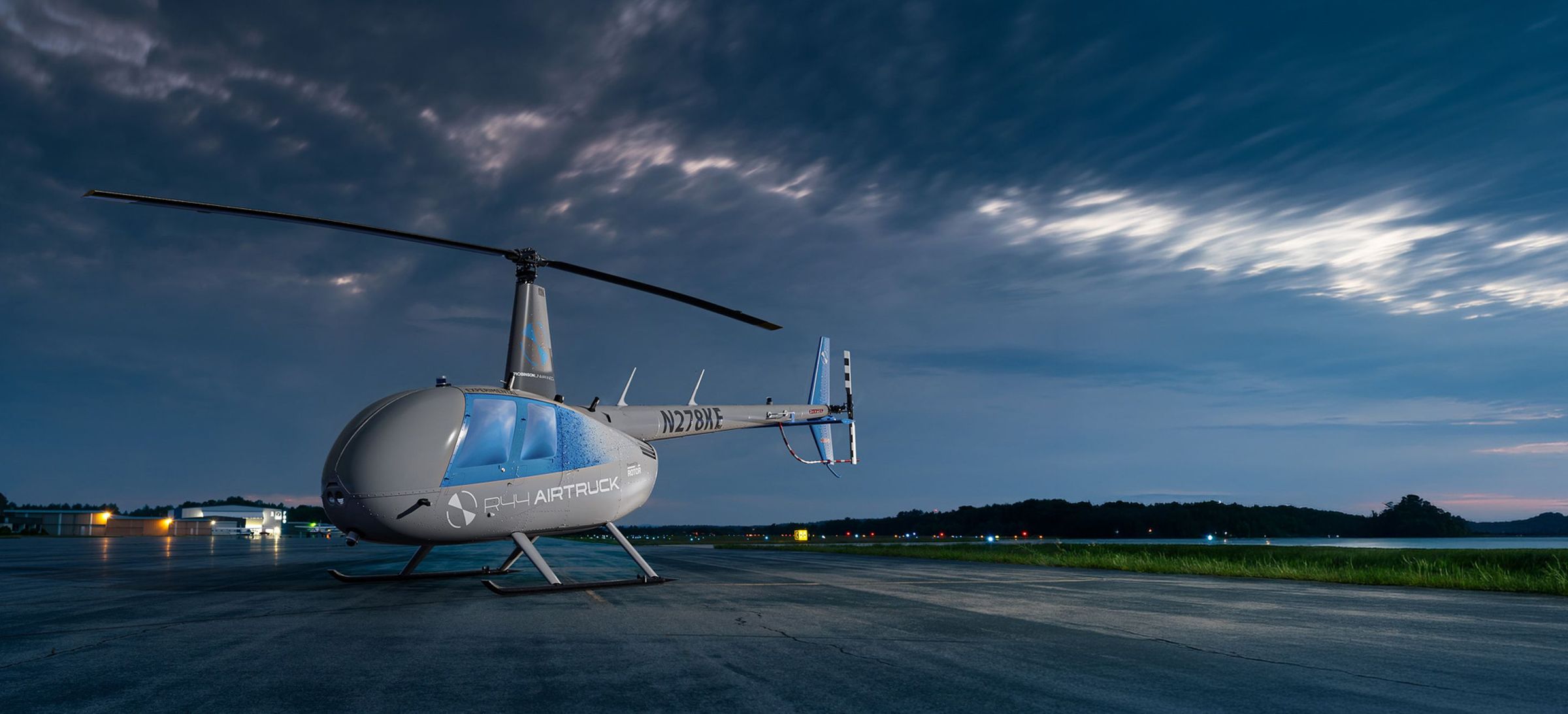
The Robinson R44 AirTruck is an unmanned cargo helicopter developed by Robinson Unmanned from the Robinson R44 light piston helicopter. It is intended for logistics, resupply and industrial transport missions in locations where carrying an onboard flight crew may be undesirable or hazardous.
The aircraft combines remote piloting with automated flight functions rather than operating solely as a fully autonomous helicopter. Rotor Technologies' RPX unmanned flight system provides full-authority fly-by-wire control, while automated functions support positioning, navigation, terrain avoidance and emergency recovery.
On 2 and 3 September 2026, Robinson Unmanned demonstrated the AirTruck in New Iberia, Louisiana, during missions designed around offshore oil and gas logistics. The flights provided a physical demonstration of the R44-derived unmanned platform and its cargo-handling and elevated-deck operating concept.
Offshore logistics demonstration
The two-day demonstration was conducted by Aviation Academy of Louisiana, a Robinson dealer and service organization operating from Acadiana Regional Airport. The AirTruck performed cargo loading and unloading drills, elevated-deck landings, precision positioning and airspace-integration exercises. It also made repeated approaches to a platform configured to represent an offshore deck. A contemporary demonstration report described the same September 2026 trials.
The aircraft was managed during the demonstration by a two-person ground team consisting of a remote pilot in command and a ground-support crew member. Robinson's published operating information recommends one remote pilot and one visual observer for the AirTruck.
Louisiana was selected as a relevant environment for offshore logistics demonstrations because operators serving the Gulf of Mexico routinely work in demanding maritime conditions. Robinson presented the trials as a way to demonstrate cargo delivery to offshore-style landing areas without placing a flight crew aboard the helicopter.
Design
Airframe and cargo arrangement
The AirTruck is based on the Robinson R44 airframe. Robinson states that the unmanned aircraft retains components and maintenance practices associated with the production R44, allowing existing support organizations familiar with the helicopter to maintain much of the platform.
The AirTruck has a maximum gross weight of 1,134 kg (2,500 lb) and a useful load of 454 kg (1,002 lb). Internal cargo volume is approximately 1.8 m³ (63 cu ft), and the aircraft can also carry an external sling load. Robinson describes it as a large, gas-powered vertical-takeoff-and-landing unmanned aircraft system for cargo transport, logistics and resupply. The manufacturer's current specifications are published on the R44 AirTruck product page.
Flight control and autonomy
Remote operation is enabled by Rotor Technologies' RPX unmanned flight system. The conversion replaces conventional cockpit control functions with a full-authority fly-by-wire architecture and integrates equipment required for unmanned flight.
The AirTruck provides a three-axis stability-augmentation mode and a four-axis mode for precision positioning and landing. Additional automated functions include waypoint navigation, terrain avoidance and emergency return-to-home. These functions supplement remote operation and do not eliminate the requirement for a remote pilot under the operating configuration described by Robinson.
Sensors and communications
The standard sensing suite includes two wide-field-of-view forward cameras, one downward-facing camera, one tail camera, a long-range forward lidar, a 360-degree collision lidar and a radar altimeter. These sensors support situational awareness, positioning and automated flight functions.
Standard communications equipment includes a 900 MHz line-of-sight radio, two 5G cellular links and a Starlink Mini satellite link. Robinson also lists an optional flight-termination system and states that additional communications links can be offered.
Powerplant and support equipment
The AirTruck uses a six-cylinder Lycoming aviation engine. Its fuel capacity is 47.3 L (12.5 US gal). Ground equipment identified by Robinson includes a ground control station and an R44 AirTruck transport trailer intended to support deployment and ground-based operations.
Program status
As of September 2026, the AirTruck had completed demonstration flights for offshore logistics applications in Louisiana. The demonstrated tasks included cargo handling, repeated offshore-deck-style approaches, elevated-deck landing and precision positioning. The available sources do not establish that the AirTruck had entered routine commercial offshore service at that time.
Robinson lists the AirTruck in the Experimental Category in the United States and states that commercial approval is available in Brazil and other countries. The aircraft is therefore presented as an unmanned logistics platform with demonstrated flight capability, while its regulatory and operational status can vary by jurisdiction.
Specifications (R44 AirTruck)
General characteristics
- Type: Unmanned cargo helicopter and VTOL unmanned aircraft system
- Maximum gross weight: 1,134 kg (2,500 lb)
- Useful load: 454 kg (1,002 lb)
- Internal cargo volume: approximately 1.8 m³ (63 cu ft)
- External load capability: sling load
- Fuel capacity: 47.3 L (12.5 US gal)
- Recommended ground crew: one remote pilot and one visual observer
Performance
- Cruise speed: 202 km/h (109 kn)
- Maximum operating altitude: 4,300 m (14,000 ft) MSL
Flight-control and mission equipment
- Flight-control system: full-authority fly-by-wire
- Automated flight functions: stability augmentation, precision positioning and landing, waypoint navigation, terrain avoidance and emergency return-to-home
- Standard sensors: two forward wide-field-of-view cameras, downward camera, tail camera, long-range forward lidar, 360-degree collision lidar and radar altimeter
- Standard communications: 900 MHz line-of-sight radio, two 5G cellular links and Starlink Mini
 Argentina
 Armenia
 Australia
 Austria
 Austria-Hungary
 Belgium
 Brazil
 United Kingdom
 Brunei
 Bulgaria
 Canada
 Chile
Chile China
China Colonial America
 Colombia
 Confederate States
 Croatia
 Czech
Czech Denmark
 Egypt
Egypt Finland
 France
 Georgia
 Germany
 German Imperial
 Greece
 Holland
 Hungary
 India
India Indonesia
 Iran
Iran Iraq
Iraq Ireland
 Israel
 Italy
Italy Japan
Japan Japan (1940)
 Jordan
 Kingdom of Italy
 Malaysia
 Mexico
 Myanmar
 Nazi Germany
 Netherlands
 New Zealand
 North Korea
 Norway
 Pakistan
 Peru
Peru Philippines
 Poland
 Portugal
 Prussia
 Romania
 Russia
 Saudi Arabia
 Serbia
 Singapore
 Slovakia
 Slovenia
 South Africa
 South Korea
 Soviet Union
 Spain
Spain Sweden
 Switzerland
 Syria
Syria Taiwan
 Thailand
 Turkey
 UAE
UAE Ukraine
 Vietnam
 Yugoslavia