History
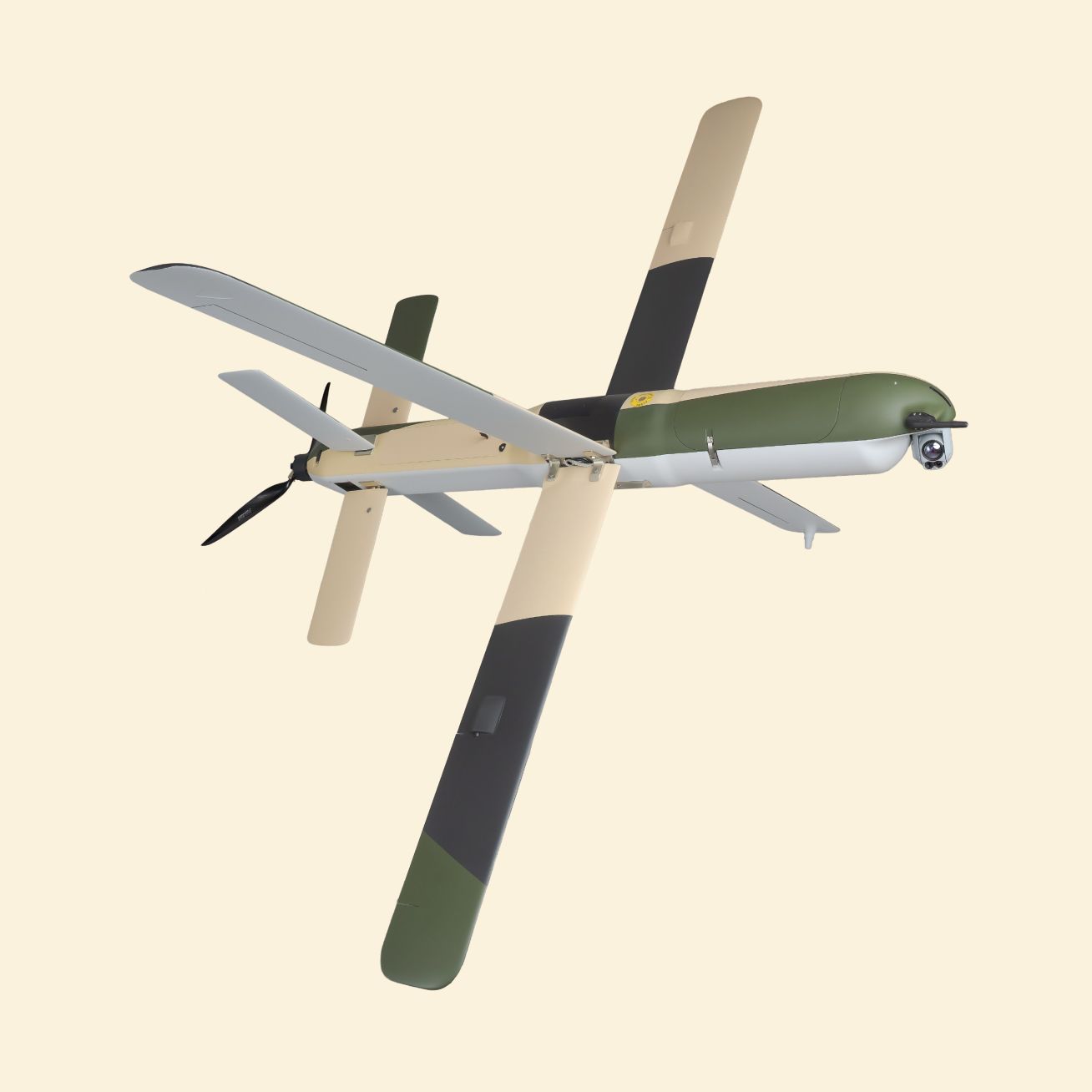
The Unmanned Defense Systems AVENGER 5 is a Lithuanian strike unmanned aerial vehicle and loitering munition developed by Unmanned Defense Systems (UDS). The manufacturer describes the AVENGER 5 as a long-range multi-purpose platform designed to carry modular payloads, including warheads, and to complete attacks autonomously after target acquisition.
The aircraft was developed with experience from modern warfare and the combat employment of unmanned systems in Ukraine in mind. AVENGER 5 was tested in Ukraine and was publicly presented at the MSPO exhibition in Poland on September 9, 2026, according to Militarnyi.
AVENGER 5 forms part of the UDS SwarmC2 ecosystem. The system supports mission planning, autonomous functions, target tracking and coordinated operation of multiple unmanned aircraft.
Development and testing
UDS designed AVENGER 5 for attacks against stationary and moving targets at medium to long distances from the launch position. The manufacturer states that the system can continue its terminal mission after target acquisition without depending on continuous radio communication or GNSS signals.
Testing in Ukraine was confirmed by a UDS representative during MSPO 2026. The available sources do not establish service adoption or operational deployment. As of September 2026, the documented status consists of development, testing in Ukraine and public exhibition.
Design
Airframe and launch system
AVENGER 5 has a reported wingspan of 1.8 m and a length of 1.6 m. Militarnyi gives a maximum takeoff weight of 17 kg. The current UDS specification lists a weight of 12 kg without the warhead and a maximum warhead mass of 5 kg, which is consistent with the reported maximum takeoff weight when the maximum warhead is installed.
Militarnyi describes the aircraft as being launched from a pneumatic launcher. UDS describes its system more generally as a mechanical launch system intended to reduce visual, acoustic and thermal signatures during launch.
Guidance and sensors
The UAV carries electro-optical and thermal imaging equipment for surveillance and visual target tracking. It can also operate using geographic coordinates. UDS states that automatic target tracking uses sensor-fusion technology and that terminal guidance can continue without an active radio link or GNSS reception after the target has been acquired.
The manufacturer lists proportional navigation and automatic terminal-phase guidance as targeting methods. It also describes configurable military-grade radio equipment, interference-avoidance functions and GNSS receivers intended to resist jamming and spoofing. UDS further states that current AVENGER 5 platforms incorporate counter-UAS detection equipment to improve survivability.
SwarmC2 integration
AVENGER 5 operates with the proprietary SwarmC2 command-and-control system. Functions described for the system include multi-waypoint route planning, altitude selection, terrain awareness, moving-target tracking and synchronized observation by several unmanned aircraft. Automated transmission of target information and support for artillery fire correction are also stated capabilities.
UDS describes additional SwarmC2 functions including autonomous swarm coordination, collision avoidance, automatic changes to altitude, flight path and formation, and automatic mission takeover by another UAV when an aircraft becomes unavailable or runs low on power. The baseline system is also described as supporting integration with battle management systems through an onboard edge-computing module, modular ground station and rugged operator tablet.
Warhead
AVENGER 5 can carry a warhead weighing up to 5 kg. Reported warhead options include high-explosive, high-explosive anti-tank and thermobaric types. The manufacturer describes the payload interface as modular, allowing different warheads to be integrated according to mission requirements.
Communications and performance
The current UDS product information gives a direct radio line-of-sight range of up to 60 km and up to 100 km when a repeater is used. Militarnyi reported a repeater-assisted range of up to 90 km at MSPO 2026. The difference may reflect different published configurations or specification revisions, but the supplied sources do not explain it.
UDS currently lists a mission endurance of 90 minutes, a maximum flight distance of 150 km, a cruise speed of 110 km/h and a maximum speed of 280 km/h. Militarnyi reported essentially the same cruise speed as 31 m/s and a maximum dive speed of about 80 m/s, as well as a service ceiling of 5,000 m.
Published specifications have not always been consistent. A BAVOVNA listing gives 60 minutes of endurance, 100 km maximum flight distance, 180 km/h maximum speed and a weight of 14 kg without the warhead. Because the current manufacturer data is more authoritative and is broadly consistent with the September 2026 exhibition report, the current UDS figures are used for the principal specifications below.
Program status
By September 2026, AVENGER 5 had undergone testing in Ukraine and had been displayed publicly at MSPO in Poland. The available material confirms an active development and demonstration program but does not confirm formal adoption by an armed force or operational combat deployment.
Specifications (AVENGER 5)
General characteristics
- Type: Strike UAV and loitering munition
- Developer: Unmanned Defense Systems
- Length: 1.6 m
- Wingspan: 1.8 m
- Weight without warhead: 12 kg
- Maximum takeoff weight: 17 kg
- Warhead mass: Up to 5 kg
- Launch method: Mechanical launcher; reported as pneumatic at MSPO 2026
- Operating temperature: -15 to +40 °C
- Precipitation resistance: Less than 1 mm/h
Performance
- Endurance: 90 minutes
- Maximum flight distance: 150 km
- Cruise speed: 110 km/h
- Maximum speed: 280 km/h
- Service ceiling: 5,000 m
- Direct radio line-of-sight: Up to 60 km
- Radio line-of-sight with repeater: Up to 100 km according to current UDS data; 90 km reported at MSPO 2026
Guidance and payload
- Targeting: Proportional navigation and automatic terminal-phase guidance
- Sensors: Electro-optical and thermal imaging systems
- Target engagement: Visual target tracking or operation using geographic coordinates
- Warhead options: High-explosive, high-explosive anti-tank and thermobaric
- Command system: SwarmC2
 Argentina
 Armenia
 Australia
 Austria
 Austria-Hungary
 Belgium
 Brazil
 United Kingdom
 United States
 Brunei
 Bulgaria
 Canada
 Chile
Chile China
China Colonial America
 Colombia
 Confederate States
 Croatia
 Czech
Czech Denmark
 Egypt
Egypt Finland
 France
 Georgia
 Germany
 German Imperial
 Greece
 Holland
 Hungary
 India
India Indonesia
 Iran
Iran Iraq
Iraq Ireland
 Israel
 Italy
Italy Japan
Japan Japan (1940)
 Jordan
 Kingdom of Italy
 Malaysia
 Mexico
 Myanmar
 Nazi Germany
 Netherlands
 New Zealand
 North Korea
 Norway
 Pakistan
 Peru
Peru Philippines
 Poland
 Portugal
 Prussia
 Romania
 Russia
 Saudi Arabia
 Serbia
 Singapore
 Slovakia
 Slovenia
 South Africa
 South Korea
 Soviet Union
 Spain
Spain Sweden
 Switzerland
 Syria
Syria Taiwan
 Thailand
 Turkey
 UAE
UAE Ukraine
 Vietnam
 Yugoslavia