
History
Lockheed Martin Vectis is an uncrewed Collaborative Combat Aircraft developed by Lockheed Martin Skunk Works in the United States. The company describes it as an autonomous, multi-mission aircraft designed for survivability, affordability and operation either independently or alongside crewed combat aircraft.
The aircraft uses a tailless configuration with a deeply recessed dorsal air inlet and an internal payload bay. Lockheed Martin is funding the program internally and is building an initial group of five aircraft. The first Vectis prototype is planned to fly by the end of 2027.
Vectis was publicly revealed in September 2025. Lockheed Martin positioned the aircraft within its broader work on collaborative autonomy and crewed-uncrewed teaming, including integration with aircraft such as the F-35 and potential future combat platforms. The company states on its official Vectis page that the aircraft is intended to be rapidly upgradeable and customizable.
Development
Skunk Works developed Vectis using digital engineering and manufacturing methods derived from earlier company programs. According to Lockheed Martin statements reported by TWZ, the development team moved from an initial design to wind-tunnel testing in less than two months. The first digital build was completed within six months and the first physical part was released for manufacture within eight months.
By September 2026, construction of the first prototype was underway. Lockheed Martin also committed internal funding for four additional Vectis aircraft, increasing the planned test fleet to five vehicles. The additional aircraft are intended to expand testing and mature the design before any potential production program.
Vectis is not an aircraft selected under the first U.S. Air Force Collaborative Combat Aircraft increment. Lockheed Martin is developing it with company funding while pursuing potential future U.S. and international opportunities. Secondary reporting collected with the program information confirms that no production or operational customer had yet been announced.
Manufacturing approach
The aircraft was designed in a fully integrated digital environment intended to maintain a continuous digital connection from design through manufacturing and sustainment. Skunk Works also applies production-oriented assembly methods during prototype construction rather than relying only on experimental tooling.
One method identified by the company is minimal tooling determinant assembly. Lockheed Martin says this technique reduces touch labor and simplifies assembly by controlling how major components fit together. Skunk Works reported labor-hour reductions of as much as 80 percent in some applications of these manufacturing methods. The company also says that Vectis has a reduced part count to support faster assembly and lower manufacturing cost.
Design
Airframe
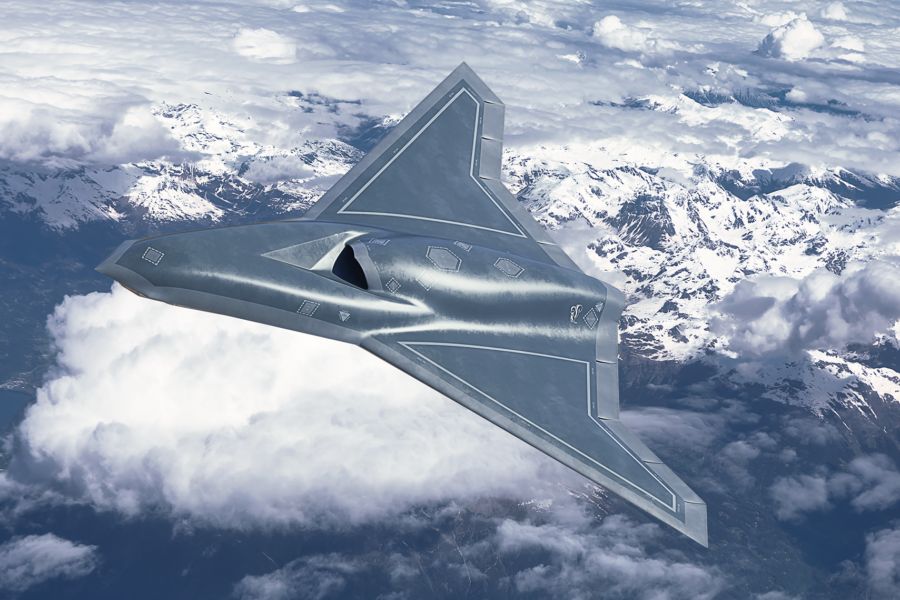
Vectis is a single-engine, tailless aircraft with a lambda-wing planform. The central fuselage blends into the wings, while the forward fuselage has pronounced chines and a broad, shovel-like nose. The lack of conventional vertical tail surfaces and the use of conformal apertures are consistent with the program's emphasis on reduced signatures and survivability.
Lockheed Martin disclosed in 2026 that the dorsal engine inlet is more deeply recessed than earlier renderings and scale models indicated. The inlet sits in a downward-sloping channel on the upper fuselage. Skunk Works stated that this arrangement had been part of the design from the beginning. Ron Fehlen, vice president and general manager of Skunk Works, said the configuration reduces frontal drag and can reduce the risk of foreign-object debris ingestion when operating from austere airfields.
The inlet arrangement is also associated with the aircraft's survivability requirements. Earlier Lockheed Martin imagery showed an S-shaped duct behind the inlet and shrouding around the exhaust, both of which are intended to limit direct exposure of engine components and reduce aircraft signatures.
Mission systems and autonomy
Vectis is being designed around modular systems and an open architecture so that sensors, autonomy software and other mission capabilities can be changed or upgraded without redesigning the complete aircraft. Lockheed Martin has connected the program with its wider work on autonomous flight, crewed-uncrewed teaming and the Multi Domain Combat System autonomy architecture.
Lockheed Martin has also been developing interfaces through which crewed aircraft could manage future collaborative aircraft. The company has discussed work involving the F-22 and F-35, while its Vectis promotional material also depicts control from a ground station. Skunk Works has emphasized that final command-and-control and autonomy arrangements would depend on customer requirements and could incorporate third-party systems.
Development of Vectis is also drawing on Lockheed Martin autonomy testing conducted with the X-62A experimental aircraft. Skunk Works has specifically linked autonomous air-intercept testing with the technology and experience being applied to the Vectis program.
Sensors
Lockheed Martin promotional imagery depicts an electro-optical and infrared sensor turret beneath the forward fuselage. The turret is shown behind a faceted enclosure intended to preserve the aircraft's external shaping when the sensor is not exposed. Other conformal apertures and antenna locations are visible in published renderings, but detailed sensor specifications have not been released.
Armament
Vectis is intended to support both air-to-air and air-to-ground missions. Promotional imagery shows an elongated internal weapons bay capable of holding at least two munitions. Lockheed Martin computer-generated material depicts weapons resembling AIM-120 air-to-air missiles and GBU-53/B Small Diameter Bomb II weapons. These depictions demonstrate the intended class of internal payload but do not establish that either weapon has completed integration or testing on Vectis.
Powerplant
Publicly available program information is inconsistent about the prototype engine. One secondary report identifies a Williams International FJ44-4A turbofan, while TWZ reported in September 2026 that Lockheed Martin had not disclosed the engine type. Because Lockheed Martin's supplied official material does not confirm a specific engine model, the powerplant designation is not treated here as established.
Program status
As of September 2026, the first Vectis prototype was under construction and four additional internally funded aircraft were also planned or being advanced as part of the development effort. Lockheed Martin is targeting the first flight for the end of 2027. The aircraft therefore remains a development program and is not an operational Collaborative Combat Aircraft.
Lockheed Martin describes Vectis as a survivable, flexible and multi-mission system intended for both domestic and international customers. The company has not tied the aircraft exclusively to a single procurement program. Reporting from TechTimes likewise describes the five-aircraft effort as company-funded and notes that no U.S. Air Force contract had been awarded for Vectis.
The design reflects a different balance of survivability, capability and cost from more expendable uncrewed aircraft concepts. Skunk Works has stated that it is seeking a price point competitive within the broader Collaborative Combat Aircraft market while retaining the signature-control and mission-system features considered important for contested environments.
Specifications (Vectis prototype)
General characteristics
- Type: uncrewed collaborative combat aircraft
- Developer: Lockheed Martin Skunk Works
- Configuration: tailless lambda-wing aircraft
- Length: approximately 10.4 m (34 ft)
- Wingspan: approximately 11.6 m (38 ft)
- Engines: one; specific engine model not confirmed in the supplied Lockheed Martin material
- Air intake: deeply recessed dorsal inlet
- Planned first flight: by the end of 2027
Mission equipment and armament
- Mission roles: planned air-to-air and air-to-ground missions, with broader multi-mission capability
- Weapons carriage: internal weapons bay
- Internal capacity: promotional imagery shows space for at least two munitions
- Sensors: promotional imagery depicts an electro-optical and infrared turret in a faceted ventral enclosure
- Architecture: modular, open-architecture mission systems
- Control concept: autonomous operation, ground control and crewed-uncrewed teaming are all part of the development approach
 Argentina
 Armenia
 Australia
 Austria
 Austria-Hungary
 Belgium
 Brazil
 United Kingdom
 Brunei
 Bulgaria
 Canada
 Chile
Chile China
China Colonial America
 Colombia
 Confederate States
 Croatia
 Czech
Czech Denmark
 Egypt
Egypt Finland
 France
 Georgia
 Germany
 German Imperial
 Greece
 Holland
 Hungary
 India
India Indonesia
 Iran
Iran Iraq
Iraq Ireland
 Israel
 Italy
Italy Japan
Japan Japan (1940)
 Jordan
 Kingdom of Italy
 Malaysia
 Mexico
 Myanmar
 Nazi Germany
 Netherlands
 New Zealand
 North Korea
 Norway
 Pakistan
 Peru
Peru Philippines
 Poland
 Portugal
 Prussia
 Romania
 Russia
 Saudi Arabia
 Serbia
 Singapore
 Slovakia
 Slovenia
 South Africa
 South Korea
 Soviet Union
 Spain
Spain Sweden
 Switzerland
 Syria
Syria Taiwan
 Thailand
 Turkey
 UAE
UAE Ukraine
 Vietnam
 Yugoslavia