
History
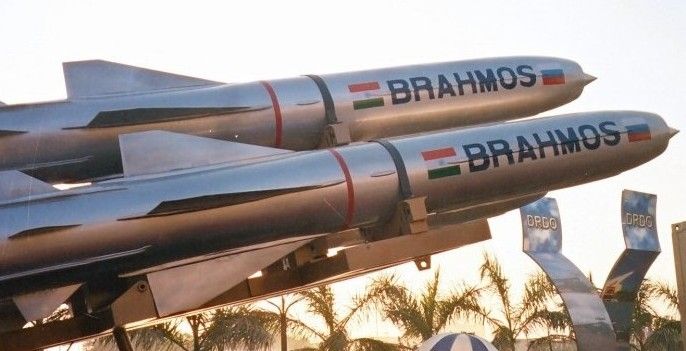
The BrahMos-A is the air-launched version of the BrahMos supersonic cruise missile developed by BrahMos Aerospace, the India-Russia joint venture formed by India's Defence Research and Development Organisation and Russia's NPO Mashinostroyeniya. The air-launched weapon was developed for the Indian Air Force's Sukhoi Su-30MKI strike fighter and is intended to attack both ships and land targets from stand-off range.
The air version required dedicated aircraft integration because of the missile's size and mass. Hindustan Aeronautics Limited modified a Su-30MKI for the BrahMos programme, while BrahMos Aerospace developed an airborne launcher and the mechanical, electrical and avionics interfaces required to carry and release the missile.
The first live launch from a Su-30MKI occurred on 22 November 2017 over the Bay of Bengal. Subsequent tests demonstrated anti-ship and land-attack roles, and a December 2021 test was described by the Indian Ministry of Defence as an important step toward serial production of the air-version missile.
Integration and testing
Hindustan Aeronautics Limited handed over the first Su-30MKI modified for the BrahMos programme to BrahMos Aerospace during Aero India 2015. The airborne launcher was cleared for integration with the Su-30MKI in 2016. According to BrahMos Aerospace, a demonstration flight on 25 June 2016 validated integration of the launcher with the modified aircraft.
The integration programme included aerodynamic-load analysis, computational fluid dynamics studies, wind-tunnel testing, vibration trials, software development and evaluation of the electrical interface linking the aircraft, launcher and missile. Dummy-weapon drop trials in 2016 and the first half of 2017 checked the release mechanism and the behaviour of the weapon after separation from the aircraft.
On 22 November 2017, an Indian Air Force Su-30MKI conducted the first successful live firing of the air-launched BrahMos against a sea target in the Bay of Bengal. The missile was gravity-dropped from the aircraft before its propulsion system started. The event was also reported by the CSIS Missile Defense Project.
Further Su-30MKI launches in 2019 were used to validate land-attack and anti-ship capability. The air version was flight-tested again in July 2021. On 8 December 2021 another Su-30MKI launch followed the planned trajectory and met its stated objectives. An Indian Ministry of Defence release reproduced by Naval News stated that the test cleared the air-version system for serial production in India.
Design
The BrahMos-A adapts the BrahMos missile for release from a combat aircraft. BrahMos is a two-stage supersonic cruise missile. A solid-propellant rocket stage provides initial acceleration, while a liquid-fuelled ramjet sustains supersonic cruise after the booster phase.
The air-launched version uses a gravity-assisted release. After separation from the carrier aircraft, the missile stabilizes before its propulsion sequence begins. The air version incorporates changes associated with aerial release, including a reduced booster compared with surface-launched versions and additional tail surfaces for stability.
Aircraft integration
The BrahMos-A was designed around the Su-30MKI. Its approximate 2.5-tonne mass required modification of the aircraft and a purpose-built launcher. The launcher provides the structural attachment, release mechanism and interfaces between the fighter's avionics and the missile.
Because the weapon is carried beneath the fuselage, successful integration required analysis of aerodynamic loads and separation behaviour as well as structural, vibration, electrical and software testing. These changes allowed the Su-30MKI to carry and release the missile without treating it as a simple standard-store installation.
Guidance and attack profile
BrahMos-A is intended for precision attacks against surface ships and land targets. BrahMos Aerospace states that the air-launched system supports day-and-night and all-weather operation. The missile can approach targets at very low altitude during part of its flight, while published BrahMos data also describe flight profiles reaching substantially higher altitude.
Published figures for speed and range differ between configurations and sources. A 2024 report concerning possible Southeast Asian Su-30 integration described BrahMos-A as approximately Mach 2.8 and cited a 290 km export range, while describing a 450 km extended-range version for India. Other reporting on the BrahMos family cites higher maximum speed and range figures, so these values should not be treated as universal for every BrahMos-A configuration.
Program status
The BrahMos air-launched weapon has been tested and inducted with the Indian Armed Forces, with the Su-30MKI serving as the confirmed carrier aircraft for the air version. Continued flight testing through 2021 supported domestic production of the air-launched missile and associated assemblies.
Malaysia has also examined the weapon for possible integration with its Su-30MKM fleet. A September 2026 report stated that Malaysian Prime Minister Anwar Ibrahim confirmed that the government was exploring acquisition of air-launched BrahMos missiles. The Su-30MKM is related to the Su-30MKI, but Malaysian aircraft would still require a dedicated integration and certification programme. Earlier reporting from IDRW discussed structural strengthening, launcher integration and aircraft software changes for potential Malaysian and Indonesian Su-30 applications. Malaysia should therefore be regarded as a prospective customer rather than an operator.
Operators
- India: The Indian Air Force operates the BrahMos air-launched weapon with modified Su-30MKI fighters.
Specifications (BrahMos-A)
General characteristics
- Type: Air-launched supersonic cruise missile.
- Primary carrier: Sukhoi Su-30MKI.
- Approximate mass: 2.5 tonnes.
- Diameter: 0.70 m.
- Wingspan: 1.7 m.
- Warhead: Up to 300 kg for the aircraft-launched version.
- Launch method: Gravity-assisted release from the carrier aircraft.
Performance
- Propulsion: Two-stage system with a solid-propellant booster followed by a liquid-fuelled ramjet.
- Reported speed: Approximately Mach 2.8 in reporting on the BrahMos-A export configuration; some sources cite higher maximum speeds for the wider BrahMos family.
- Reported range: 290 km in reporting on a prospective export configuration and 450 km for an Indian extended-range configuration. Published BrahMos-family figures vary by version.
- Flight altitude: Published BrahMos data describe terminal flight as low as approximately 5 m and a maximum altitude of about 15,000 m.
Target capability
- Target types: Surface ships and land targets.
- Operating conditions: Designed for day-and-night and all-weather attack.
 Argentina
 Armenia
 Australia
 Austria
 Austria-Hungary
 Belgium
 Brazil
 United Kingdom
 United States
 Brunei
 Bulgaria
 Canada
 Chile
Chile China
China Colonial America
 Colombia
 Confederate States
 Croatia
 Czech
Czech Denmark
 Egypt
Egypt Finland
 France
 Georgia
 Germany
 German Imperial
 Greece
 Holland
 Hungary
 Indonesia
 Iran
Iran Iraq
Iraq Ireland
 Israel
 Italy
Italy Japan
Japan Japan (1940)
 Jordan
 Kingdom of Italy
 Malaysia
 Mexico
 Myanmar
 Nazi Germany
 Netherlands
 New Zealand
 North Korea
 Norway
 Pakistan
 Peru
Peru Philippines
 Poland
 Portugal
 Prussia
 Romania
 Russia
 Saudi Arabia
 Serbia
 Singapore
 Slovakia
 Slovenia
 South Africa
 South Korea
 Soviet Union
 Spain
Spain Sweden
 Switzerland
 Syria
Syria Taiwan
 Thailand
 Turkey
 UAE
UAE Ukraine
 Vietnam
 Yugoslavia