
History
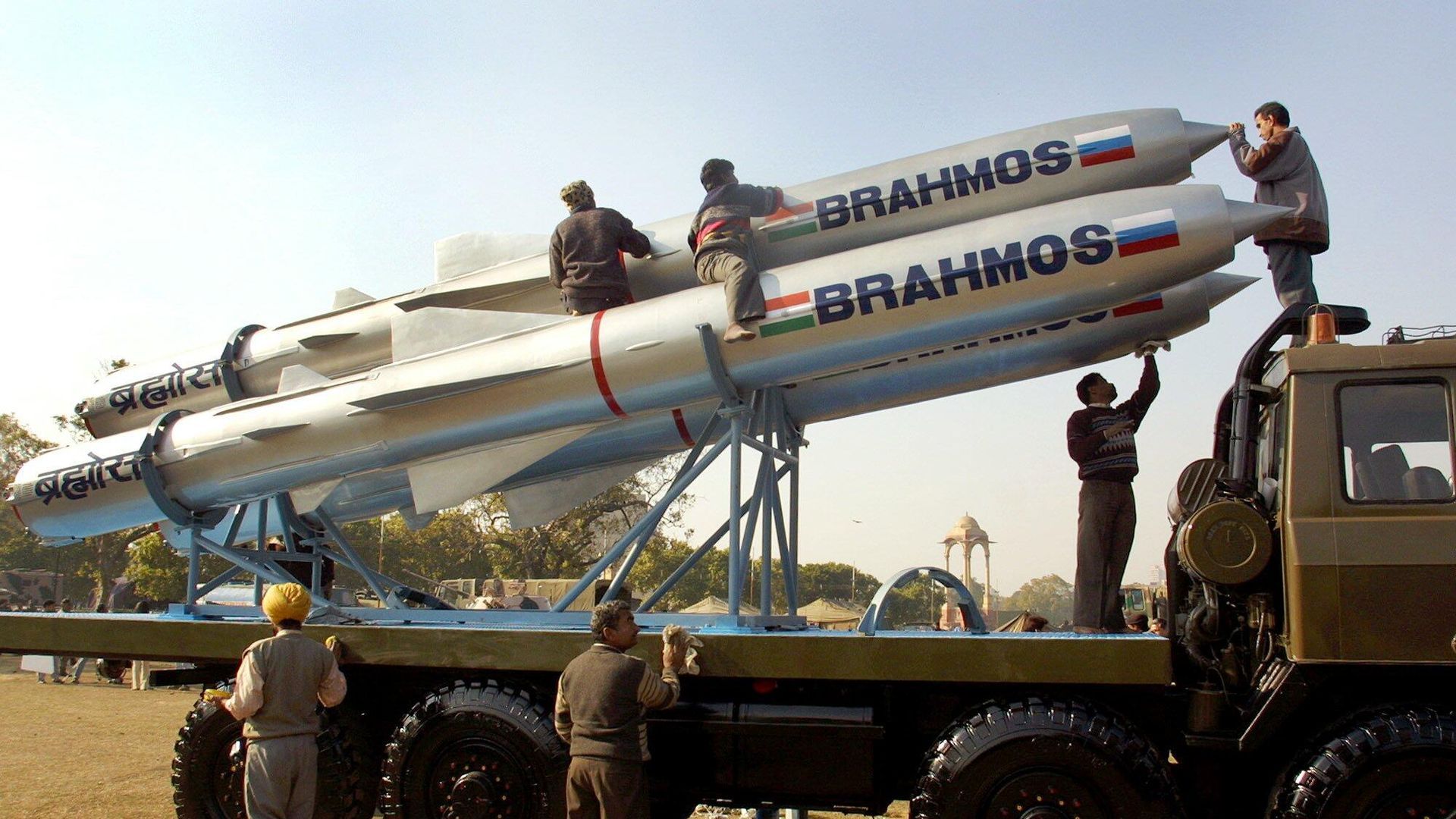
The BrahMos is a ramjet-powered supersonic cruise missile family developed through Indian-Russian cooperation. It is intended for anti-ship and land-attack missions and has been adapted for launch from land vehicles, surface ships, aircraft and submarine-related platforms.
The missile combines a solid-propellant booster with a liquid-fueled ramjet sustainer. BrahMos Aerospace states that the baseline weapon maintains supersonic speed through its flight and cruises at about Mach 2.8, while the original published range was up to 290 km.
The system entered service first in naval form and later expanded into land- and air-launched configurations. By 2026, the Philippines was also employing the shore-based anti-ship version and integrating it into exercises that connected unmanned aerial surveillance with coastal missile targeting.
Development
BrahMos originated from cooperation between India's Defence Research and Development Organisation and Russia's NPO Mashinostroyeniya. The missile is derived from the Russian P-800 Oniks family. The joint organization BrahMos Aerospace was created to develop and manufacture the weapon, with India holding the larger share of the joint venture.
The name BrahMos combines the Brahmaputra River in India with the Moskva River in Russia. The missile is also identified as PJ-10. A reported first flight took place on June 12, 2001. The Indian Navy began deploying BrahMos in 2005, according to BrahMos Aerospace.
Development subsequently produced launch arrangements for surface ships, road-mobile land batteries and aircraft. A submerged launch demonstration from a barge was conducted in 2013, showing the feasibility of underwater deployment. The air-launched configuration was integrated with the Su-30MKI fighter.
Export development
The Philippines became the first export customer for a complete BrahMos weapon system. A 2022 agreement valued at about US$375 million covered three shore-based anti-ship missile batteries. The system later became part of Philippine maritime-denial planning using dispersed road-mobile launchers.
Design
Propulsion and flight profile
BrahMos uses two-stage propulsion. A solid-propellant booster accelerates the missile to supersonic speed after launch and then separates. A liquid-fueled ramjet sustainer powers the cruise stage. According to the manufacturer's missile description, the baseline version cruises at approximately Mach 2.8.
The published flight profile allows cruising at altitudes up to about 15 km and terminal flight as low as approximately 5 m. A low terminal trajectory reduces the time available for a surface target to detect and respond to the incoming missile.
Guidance
The naval weapon uses an inertial navigation system during the mid-course phase and a radar seeker for terminal homing. BrahMos Aerospace states that GPS, GLONASS and India's GAGAN satellite-navigation system can supplement navigation accuracy. The missile is designed to operate on a fire-and-forget basis after launch.
Launch systems
The ship-launched BrahMos can use vertical or inclined launchers. BrahMos Aerospace developed a Universal Vertical Launcher Module for canisterized missiles installed below a warship's deck. The company also developed a quadruple canisterized inclined launcher capable of carrying four missiles and supporting individual or salvo firing.
The land-based weapon is launched vertically from a Mobile Autonomous Launcher. Mobility allows a battery to change firing positions and reduce exposure to reconnaissance and counterattack. The air-launched weapon is carried by the Su-30MKI and differs from the surface-launched missile in features required for airborne release.
The baseline land, sea and sub-sea configurations use a transport-launch canister that protects the missile during storage and transport and also serves as its launch tube.
Warhead and target set
BrahMos was developed for both anti-ship and land-attack missions. BrahMos Aerospace gives a conventional warhead weight of up to 200 kg for the baseline missile. Other published technical references describe payload weights between 200 and 300 kg depending on configuration, so warhead figures should be associated with the specific launch version rather than applied to the entire family.
Operational history
The Indian Navy has operated ship-launched BrahMos missiles since 2005 on surface combatants including destroyers and frigates. Official manufacturer material describes successful sea-to-sea and sea-to-land firings and testing of salvo launches in which multiple missiles follow different trajectories.
Land-launched and air-launched versions have also been inducted by the Indian armed forces. The weapon family therefore provides a common supersonic strike capability across several launch environments.
In September 2026, U.S. and Philippine Marines conducted maritime-targeting training in northern Luzon that connected Philippine Air Force Hermes drone tracks with procedures for employment of Philippine BrahMos coastal-defense batteries. The simulated opposing force represented two Type 052D destroyers, one Type 054A frigate and one Type 901 support ship. The activity concerned simulated targets and did not represent an attack on actual Chinese warships.
The exercise emphasized the sensor-to-shooter process rather than a missile firing. Drone-derived tracks were used for target identification, track maintenance, weapon assignment and engagement timing. This demonstrated how a road-mobile BrahMos battery could receive targeting information from an external surveillance platform while remaining dispersed ashore.
Variants
- Ship-launched BrahMos: Naval configuration for vertical or inclined launch from surface combatants against sea or land targets.
- Land-based BrahMos: Road-mobile configuration launched vertically from a Mobile Autonomous Launcher for anti-ship and land-attack missions.
- BrahMos-A: Air-launched configuration integrated with the Su-30MKI fighter aircraft.
- BrahMos Block III: A developed land-attack variant identified in published sources as capable of engaging land targets.
- BrahMos ER: Extended-range development of the missile family.
- BrahMos-NG: A later-generation BrahMos development listed by BrahMos Aerospace among its future missile programs.
- BrahMos-II: Proposed hypersonic development associated with Indian-Russian cooperation and a planned scramjet propulsion concept.
Operators
- India: BrahMos configurations have been inducted across the Indian armed forces. The Indian Navy has deployed the ship-based weapon since 2005.
- Philippines: First export customer. A 2022 contract worth approximately US$375 million covered three shore-based anti-ship missile batteries. Philippine forces were training with the system as part of coastal-defense operations by 2026.
Specifications (baseline ship and land-launched BrahMos)
General characteristics
- Type: Supersonic cruise missile
- Roles: Anti-ship and land attack
- Length: Approximately 8.2 m
- Body diameter: Approximately 0.67 m
- Launch weight: Approximately 3,000 kg
- Warhead: Conventional warhead up to 200 kg according to BrahMos Aerospace
- Propulsion: Solid-propellant first-stage booster and liquid-fueled ramjet sustainer
Performance
- Published baseline range: Up to 290 km
- Cruise speed: Approximately Mach 2.8
- Maximum cruising altitude: Up to approximately 15 km
- Terminal altitude: As low as approximately 5 m
Guidance
- Mid-course guidance: Inertial navigation system
- Terminal guidance: Radar seeker
- Navigation augmentation: GPS, GLONASS and GAGAN can be used to improve accuracy
Related equipment
The BrahMos design is based on the Russian P-800 Oniks family of supersonic cruise missiles. Later BrahMos programs include BrahMos-NG and the proposed BrahMos-II hypersonic missile.
 Argentina
 Armenia
 Australia
 Austria
 Austria-Hungary
 Belgium
 Brazil
 United Kingdom
 United States
 Brunei
 Bulgaria
 Canada
 Chile
Chile China
China Colonial America
 Colombia
 Confederate States
 Croatia
 Czech
Czech Denmark
 Egypt
Egypt Finland
 France
 Georgia
 Germany
 German Imperial
 Greece
 Holland
 Hungary
 Indonesia
 Iran
Iran Iraq
Iraq Ireland
 Israel
 Italy
Italy Japan
Japan Japan (1940)
 Jordan
 Kingdom of Italy
 Malaysia
 Mexico
 Myanmar
 Nazi Germany
 Netherlands
 New Zealand
 North Korea
 Norway
 Pakistan
 Peru
Peru Philippines
 Poland
 Portugal
 Prussia
 Romania
 Russia
 Saudi Arabia
 Serbia
 Singapore
 Slovakia
 Slovenia
 South Africa
 South Korea
 Soviet Union
 Spain
Spain Sweden
 Switzerland
 Syria
Syria Taiwan
 Thailand
 Turkey
 UAE
UAE Ukraine
 Vietnam
 Yugoslavia