
History
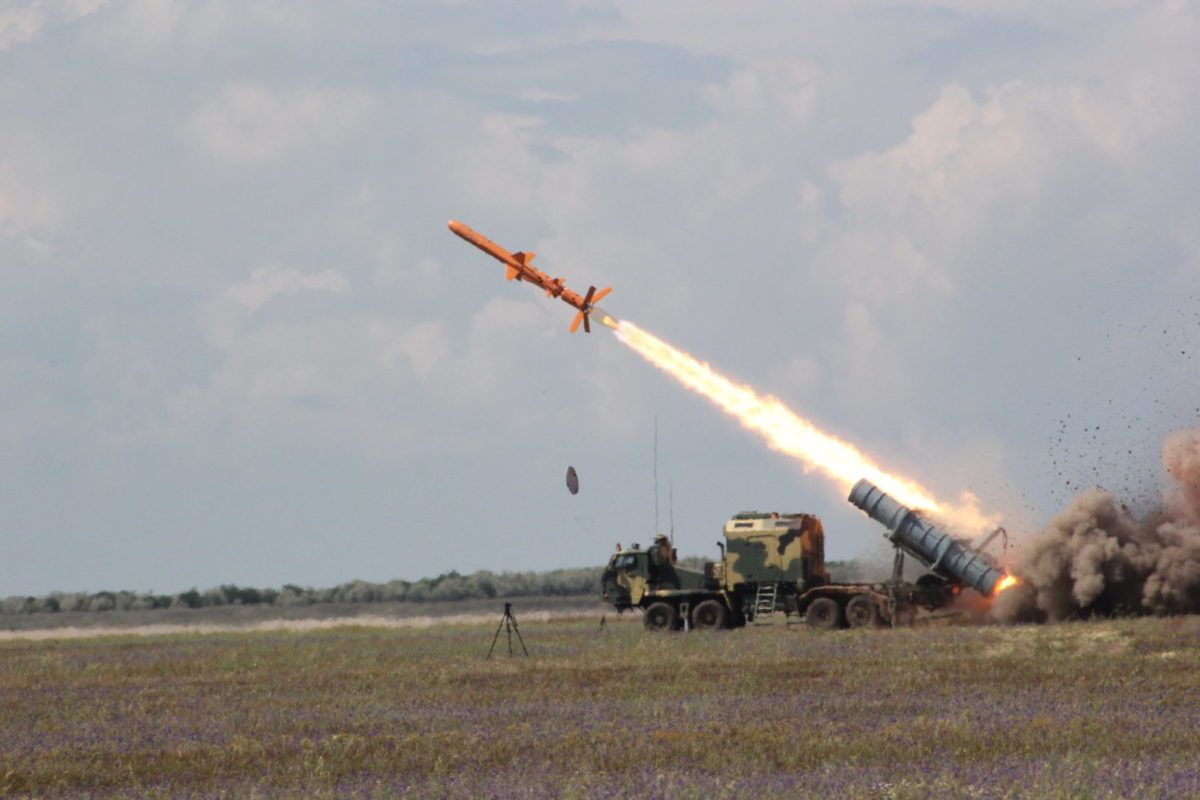
The Luch R-360 Neptun is a Ukrainian subsonic cruise missile developed by the Luch Design Bureau primarily for anti-ship warfare. The baseline weapon is launched from a road-mobile coastal-defense system and is intended to engage surface warships and transport vessels.
Neptun was derived from the Soviet Kh-35 concept but incorporated Ukrainian propulsion, guidance, electronics and other components. The missile later became the basis for land-attack and extended-range derivatives developed during the Russia-Ukraine war.
The program was publicly revealed at the Arms and Security exhibition in Kyiv in 2015. According to available information, the first flight examples were manufactured during the second quarter of 2016, and initial system tests took place on 22 March 2016. R-360 Neptune overview records further development and testing of the system.
Testing and introduction
The first successful flight tests publicly announced by Ukrainian authorities took place on 30 January 2018. On 17 August 2018, a missile reportedly struck a target at a distance of 100 km during testing in southern Odesa Oblast. Another successful test was reported near Odesa on 6 April 2019.
Sources differ on the exact point at which Neptun entered service. Covert Shores describes the system as entering limited service in 2019, while another account states that the Ukrainian Navy received its first training missile battalion in March 2021. Covert Shores describes the subsequent evolution of the missile family.
Design
The baseline R-360 is a road-launched anti-ship cruise missile. A solid-fuel booster accelerates the missile after launch. Once the booster is exhausted and separates, an MS400 turbojet engine manufactured by Motor Sich provides propulsion for sustained cruise flight.
The missile, including its launch booster, is approximately 5.05 m long and has cruciform wings. It is carried inside a transport-launch container measuring approximately 5.3 m long and 0.6 m by 0.6 m in cross-section. The missile weighs approximately 870 kg and carries a 150 kg warhead.
Coastal-defense system
The road-mobile coastal-defense configuration uses the USPU-360 launcher carrying four missiles. A complete battery also includes the RCP-360 command-and-control vehicle, TZM-360 transport and reload vehicles, and special cargo vehicles. Production configurations use Czech Tatra T815-7 trucks in place of the KrAZ vehicles used during prototype development. The system is designed to operate from positions as far as approximately 25 km inland from the coastline.
Operational history
During the Russian invasion of Ukraine, Neptun became operationally significant in the Black Sea. Ukrainian sources reported that the Russian frigate Admiral Essen was damaged by a Neptun missile on 3 April 2022, although Russia did not publicly confirm the claimed missile hit.
On 13 April 2022, Ukrainian sources reported that two Neptun missiles struck the Russian Black Sea Fleet cruiser Moskva. The ship suffered a major fire and ammunition explosions and later sank while being towed. Russia acknowledged the fire and loss of the ship but did not confirm that Ukrainian missiles caused the damage.
From 2023, modified Neptun missiles were also reported in attacks against land targets. Ukrainian reports connected the missile family with strikes on Russian air-defense systems, military facilities, oil infrastructure and other targets in occupied Crimea and Russia. These missions involved modified land-attack versions rather than the original anti-ship configuration.
On 9 September 2026, the Ukrainian Navy reported that a Neptun missile struck the Russian frigate Admiral Essen at the Novorossiysk naval base. The reported attack represented another use of the missile family against a major Black Sea Fleet surface combatant.
Variants
- R-360 Neptun: baseline anti-ship cruise missile with a reported range of approximately 280 km and a 150 kg warhead.
- Modified land-attack Neptun: derivative equipped with a guidance system adapted for strikes against fixed land targets. Ukrainian forces began reporting operational use of this configuration in 2023.
- Long Neptun: extended-range derivative with a substantially enlarged airframe. Ukrainian officials have claimed a range of up to 1,000 km. The variant is intended for land and maritime targets.
- RK-360L Neptun-D: extended-range configuration publicly identified in 2025 with a longer fuselage and enlarged external fuel sections ahead of the main wings.
- Neptun 2: planned further development announced through a memorandum of understanding between Luch Design Bureau and MBDA on 16 June 2026. No confirmed technical specifications were released with the announcement.
Specifications (R-360 Neptun anti-ship missile)
General characteristics
- Type: subsonic anti-ship cruise missile
- Length: approximately 5.05 m including launch booster
- Launch weight: approximately 870 kg
- Warhead: 150 kg
- Main engine: Motor Sich MS400 turbojet
- Launch booster: solid-fuel rocket booster
- Transport-launch container: approximately 5.3 × 0.6 × 0.6 m
Performance
- Reported range: approximately 280 km for the baseline anti-ship variant
Launch system
- Launcher: USPU-360 road-mobile launcher
- Missiles per launcher: four
- Supporting vehicles: RCP-360 command-and-control vehicle, TZM-360 transport/reload vehicle and special cargo vehicle
- Launcher chassis: Tatra T815-7 in production configuration
 Argentina
 Armenia
 Australia
 Austria
 Austria-Hungary
 Belgium
 Brazil
 United Kingdom
 United States
 Brunei
 Bulgaria
 Canada
 Chile
Chile China
China Colonial America
 Colombia
 Confederate States
 Croatia
 Czech
Czech Denmark
 Egypt
Egypt Finland
 France
 Georgia
 Germany
 German Imperial
 Greece
 Holland
 Hungary
 India
India Indonesia
 Iran
Iran Iraq
Iraq Ireland
 Israel
 Italy
Italy Japan
Japan Japan (1940)
 Jordan
 Kingdom of Italy
 Malaysia
 Mexico
 Myanmar
 Nazi Germany
 Netherlands
 New Zealand
 North Korea
 Norway
 Pakistan
 Peru
Peru Philippines
 Poland
 Portugal
 Prussia
 Romania
 Russia
 Saudi Arabia
 Serbia
 Singapore
 Slovakia
 Slovenia
 South Africa
 South Korea
 Soviet Union
 Spain
Spain Sweden
 Switzerland
 Syria
Syria Taiwan
 Thailand
 Turkey
 UAE
UAE Vietnam
 Yugoslavia