
History
The Luch Palianytsia UAV-290 is a Ukrainian ground-launched, turbojet-powered missile-drone developed for long-range attacks against fixed ground targets. The weapon combines characteristics of a cruise missile and a one-way attack unmanned aircraft and uses autonomous navigation after launch.
Ukraine publicly unveiled Palianytsia on 24 August 2024 after President Volodymyr Zelenskyy announced its first successful combat use. Ukrainian officials said the project had progressed from initial design to combat use in about 18 months. Contemporary reporting also noted disagreement over whether the system should technically be classified as a cruise missile or a high-speed one-way attack drone, reflecting its hybrid design. The early program and classification debate were described by the Kyiv Independent.
For several years the names Palianytsia and UAV-290 appeared separately in public presentations. At MSPO 2026, Ukrainian Defense Industry disclosed that UAV-290 and Palianytsia were the same weapon and identified the State Design Bureau Luch as its developer and manufacturer. The 2026 presentation also supplied updated technical figures, including a 350 kg total mass, a 100 kg warhead and a stated range of 650 km.
Development and production
The project emerged during the Russia-Ukraine war as Ukraine expanded domestic production of long-range strike weapons. At the August 2024 unveiling, officials stated that Palianytsia had already been used against a Russian military target. Its domestic development also allowed Ukraine to employ it without the geographical restrictions attached to some foreign-supplied weapons.
Initial public information was limited. Reports in 2024 described the weapon as ground-launched, turbojet-powered and guided by a combination of satellite and inertial navigation. Ukrainian officials also indicated that the system was intended to reach numerous military airfields inside Russia. A unit cost below US$1 million was reported in August 2024.
On 4 December 2024, Ukraine's defence minister was reported to have announced that Palianytsia had entered serial production. This chronology is summarized by both GlobalMilitary.net and the Palianytsia reference article.
More detailed specifications became public at MSPO 2025. Defense Express reported a mass of 320 kg, a payload of 100 kg, a maximum range of 650 km, an operating altitude of 15 to 500 m and a stated speed of up to 900 km/h. The publication also emphasized that, at that time, there was no independent public confirmation of the weapon's claimed combat use.
The later UAV-290 presentation in 2026 revised some published figures. The disclosed total mass increased to 350 kg while the 100 kg warhead and 650 km range remained unchanged. The 2026 information gave a cruising speed of up to 800 km/h rather than the earlier figure of up to 900 km/h. These values therefore represent different public disclosures rather than a single consistent specification set.
Design
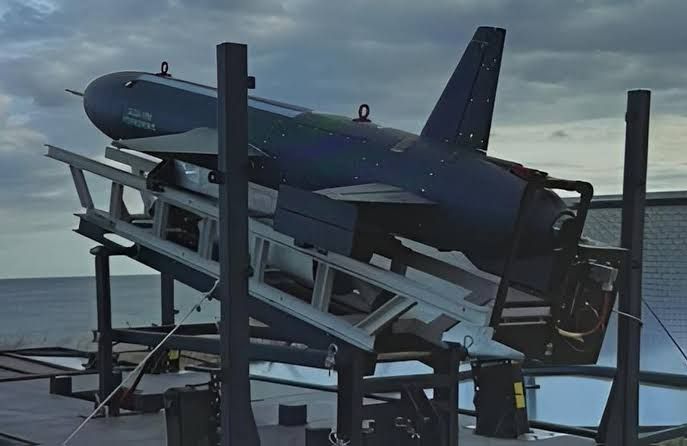
UAV-290 has the general configuration of a compact cruise missile or jet-powered strike UAV. The airframe is 3.5 m long with a wingspan of 1.7 m. Public imagery and descriptions show a central fuselage with wings and a tail equipped with control surfaces.
Propulsion and launch
The missile-drone uses a turbojet engine for sustained flight. It is launched from a trailer or semi-trailer with the assistance of a solid-propellant booster. After acceleration and departure from the launcher, the weapon transitions to autonomous powered flight under its turbojet engine.
The 2026 UAV-290 disclosure states a cruising speed of up to 800 km/h. Earlier specifications presented in 2025 and repeated by UNITED24 Media gave a figure of up to 900 km/h. The available sources do not establish whether this difference reflects a revised specification, a different flight condition or an earlier estimate.
Guidance
Navigation uses an integrated inertial navigation system and GPS. The inertial system provides autonomous navigation, while satellite navigation can correct accumulated position errors. Ukrainian disclosures describe this combination as allowing continued navigation when electronic warfare interferes with satellite signals, although the available public information does not describe a separate terminal seeker.
Warhead
The 2026 UAV-290 specification gives a warhead mass of 100 kg. Earlier reporting contained widely varying estimates before official figures became available, ranging from several tens of kilograms to substantially higher values. The later 100 kg figure is therefore the clearest disclosed value for the UAV-290 configuration.
Operational history
On 24 August 2024, President Volodymyr Zelenskyy announced the first successful combat use of Palianytsia against a Russian military target. Ukrainian authorities did not initially disclose the exact target. Subsequent media reports associated Palianytsia with several deep-strike operations, but some of these attributions remained unconfirmed.
In August 2026, Zelenskyy stated that UAV-290 was among the weapons used in a strike against the Russian naval base and port facilities at Novorossiysk. Reporting on the operation described Palianytsia as operating alongside other Ukrainian long-range missile-drone systems, missiles and unmanned vehicles. This statement also provided later official confirmation connecting the UAV-290 designation with an operational strike.
Operators
- Ukraine: Used by the Ukrainian Defense Forces for long-range strikes against fixed targets.
Specifications (UAV-290 Palianytsia)
General characteristics
- Length: 3.5 m
- Wingspan: 1.7 m
- Total mass: 350 kg according to the 2026 UAV-290 disclosure
- Warhead: 100 kg
- Powerplant: Turbojet engine
- Launch system: Ground launch from a trailer or semi-trailer using a solid-propellant booster
- Guidance: Inertial navigation system with GPS correction
Performance
- Range: 650 km
- Cruising speed: Up to 800 km/h according to the 2026 UAV-290 disclosure
- Earlier published speed: Up to 900 km/h in 2025 exhibition specifications
- Earlier published operating altitude: 15 to 500 m
 Argentina
 Armenia
 Australia
 Austria
 Austria-Hungary
 Belgium
 Brazil
 United Kingdom
 United States
 Brunei
 Bulgaria
 Canada
 Chile
Chile China
China Colonial America
 Colombia
 Confederate States
 Croatia
 Czech
Czech Denmark
 Egypt
Egypt Finland
 France
 Georgia
 Germany
 German Imperial
 Greece
 Holland
 Hungary
 India
India Indonesia
 Iran
Iran Iraq
Iraq Ireland
 Israel
 Italy
Italy Japan
Japan Japan (1940)
 Jordan
 Kingdom of Italy
 Malaysia
 Mexico
 Myanmar
 Nazi Germany
 Netherlands
 New Zealand
 North Korea
 Norway
 Pakistan
 Peru
Peru Philippines
 Poland
 Portugal
 Prussia
 Romania
 Russia
 Saudi Arabia
 Serbia
 Singapore
 Slovakia
 Slovenia
 South Africa
 South Korea
 Soviet Union
 Spain
Spain Sweden
 Switzerland
 Syria
Syria Taiwan
 Thailand
 Turkey
 UAE
UAE Vietnam
 Yugoslavia