
History
The Shenyang J-50/XDS is a tentative designation for a Chinese twin-engine, tailless fighter prototype developed by Shenyang Aircraft Corporation. The aircraft combines a lambda-wing configuration with movable wingtips and thrust-vectoring exhaust nozzles.
The prototype was first observed in flight near Shenyang in December 2024. Subsequent imagery through 2025 and 2026 showed continued flight testing and progressively revealed details of the cockpit, control surfaces, landing gear, intakes, internal bays, sensors, and propulsion arrangement.
The J-50, J-XD, and J-XDS names remain unofficial temporary designations. China has not publicly confirmed the aircraft's official designation, detailed requirements, performance, engine type, or intended service role.
Development and testing
Shenyang Aircraft Corporation was reportedly working on next-generation aircraft prototypes by 2018. On 26 December 2024, a previously unseen Shenyang prototype was observed flying near the company's facilities with a Shenyang J-16 acting as a chase aircraft. Unconfirmed accounts placed its first flight several days earlier, on 20 December.
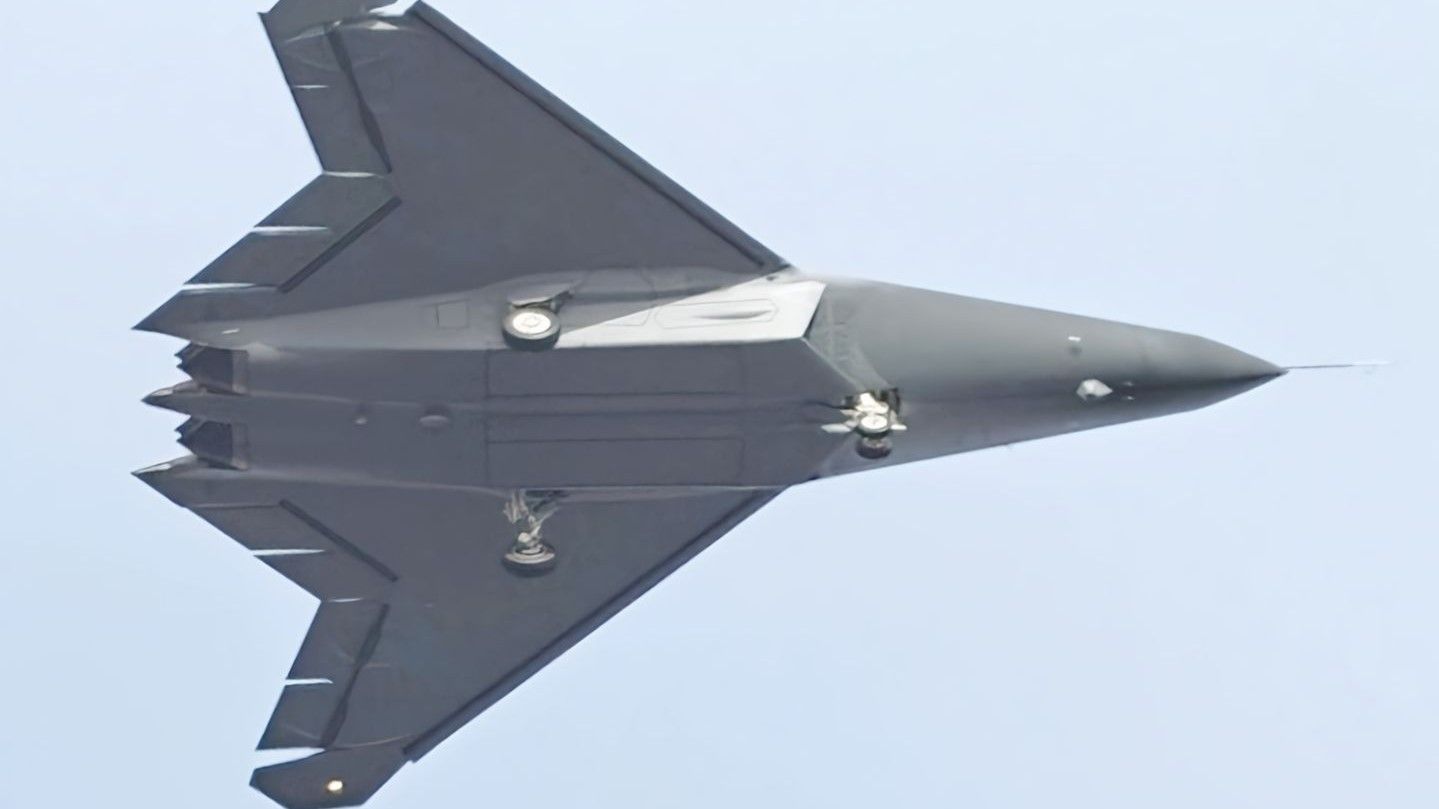
Images released during January and April 2025 showed a sharply swept lambda-wing aircraft with articulating wingtips, twin engines, and thrust-vectoring exhaust nozzles. Early uncertainty over whether the aircraft was crewed was reduced by later imagery that clearly showed a cockpit. Photographs from 2025 also revealed a long nose, ventral diverterless supersonic intakes, a sensor housing beneath the forward fuselage, and two internal ventral bays.
Additional flight testing continued during May 2025. In September, imagery showed an aircraft believed to be another prototype taxiing at Shenyang without the prominent nose-mounted air-data probe associated with earlier flight-test configurations. Satellite imagery later placed Shenyang's prototype and the separately developed Chengdu J-36 at an experimental airfield near Lop Nur during August and September 2025, indicating that the two programs were being tested in parallel.
New imagery in September 2026 showed the J-50/XDS continuing low-altitude flight testing. The aircraft displayed a differently colored nose radome and no clearly visible pitot tube or flight-test probe. The changed radome could be associated with radar integration, but the imagery does not establish that a new radar was installed. Larger exhaust nozzles were also observed on the aircraft, although their relationship to any specific engine remains unconfirmed.
Design
Airframe and flight controls
The J-50/XDS uses a tailless cranked-arrow or lambda-wing planform without conventional vertical stabilizers and rudders. Its sharply swept wings include triangular trailing-edge extensions and several movable surfaces. The outer wingtips can articulate and function as flight-control surfaces. Differential movement can contribute to roll control, while symmetrical movement can contribute to pitch control.
The absence of vertical tails reduces the number of conventional aerodynamic control surfaces. The twin exhausts incorporate thrust-vectoring nozzles that provide an additional means of controlling the aircraft, particularly in pitch. The precise flight-control architecture has not been disclosed.
Cockpit and sensors
A streamlined, low-profile canopy is positioned above the forward fuselage and accommodates a pilot. Beneath the nose is a diamond-shaped electro-optical sensor or aperture resembling an electro-optical targeting system installation. Smaller panels have also been observed on the forward fuselage, but their functions have not been confirmed.
The aircraft has a long, broad nose radome. A visibly different radome appeared during 2026 testing and may reflect changes to the radar or test configuration, although the presence and type of any installed radar have not been independently established from the available imagery.
Powerplant and intakes
The prototype is powered by two jet engines fed by ventral V-shaped diverterless supersonic intakes. The engines terminate in serrated thrust-vectoring exhaust nozzles. The engine model has not been confirmed. WS-10-series and WS-15 engines have both been proposed as possibilities, but neither identification has been established.
Landing gear and internal bays
The aircraft uses tricycle landing gear with a twin-wheel nose unit and two single-wheel main landing-gear units. Two separate internal bays are visible on the lower fuselage with a recessed centerline area between them. These bays are consistent with internal weapons carriage, although no specific weapon load has been confirmed.
Program status
The Shenyang J-50/XDS remained in flight testing as of September 2026. Multiple configurations or airframes appear to have participated in the program, but the exact number of prototypes has not been officially confirmed.
The aircraft is widely associated with China's next-generation combat-aircraft development effort. A December 2025 United States assessment stated that China was developing two sixth-generation aircraft that could become operational around 2035, but the precise relationship between that forecast and the unofficially designated J-50/XDS has not been publicly defined.
Specifications (J-50/XDS prototype)
General characteristics
- Type: Experimental tailless fighter prototype
- Crew: One pilot
- Configuration: Tailless cranked-arrow or lambda wing
- Powerplant: Two jet engines; exact type unconfirmed
- Air intakes: Two ventral diverterless supersonic intakes
- Exhaust: Twin thrust-vectoring nozzles
- Landing gear: Tricycle arrangement with twin-wheel nose gear and single-wheel main gear units
Systems and control features
- Primary aerodynamic controls: Multiple wing control surfaces and articulating wingtips
- Electro-optical system: Chin-mounted electro-optical sensor or aperture observed beneath the nose
- Radar: Type unconfirmed; an updated radome was observed during 2026 testing
Armament
- Internal carriage: Two ventral internal bays observed; weapon types and capacity unconfirmed
Related equipment
The Chengdu J-36 is a separate Chinese next-generation combat-aircraft prototype that emerged publicly at approximately the same time as the Shenyang aircraft and has undergone testing in parallel. The two designs differ substantially in size, configuration, and propulsion arrangement.
 Argentina
 Armenia
 Australia
 Austria
 Austria-Hungary
 Belgium
 Brazil
 United Kingdom
 United States
 Brunei
 Bulgaria
 Canada
 Chile
Chile Colonial America
 Colombia
 Confederate States
 Croatia
 Czech
Czech Denmark
 Egypt
Egypt Finland
 France
 Georgia
 Germany
 German Imperial
 Greece
 Holland
 Hungary
 India
India Indonesia
 Iran
Iran Iraq
Iraq Ireland
 Israel
 Italy
Italy Japan
Japan Japan (1940)
 Jordan
 Kingdom of Italy
 Malaysia
 Mexico
 Myanmar
 Nazi Germany
 Netherlands
 New Zealand
 North Korea
 Norway
 Pakistan
 Peru
Peru Philippines
 Poland
 Portugal
 Prussia
 Romania
 Russia
 Saudi Arabia
 Serbia
 Singapore
 Slovakia
 Slovenia
 South Africa
 South Korea
 Soviet Union
 Spain
Spain Sweden
 Switzerland
 Syria
Syria Taiwan
 Thailand
 Turkey
 UAE
UAE Ukraine
 Vietnam
 Yugoslavia