
History
The Chengdu J-36 is the unofficial open-source designation for a large tailless combat aircraft prototype under development by Chengdu Aircraft Corporation in China. The designation is derived from the number 36011 seen on an early prototype and has not been confirmed as an official model name by Chinese authorities. The aircraft is widely associated with China's sixth-generation combat-aircraft development effort.
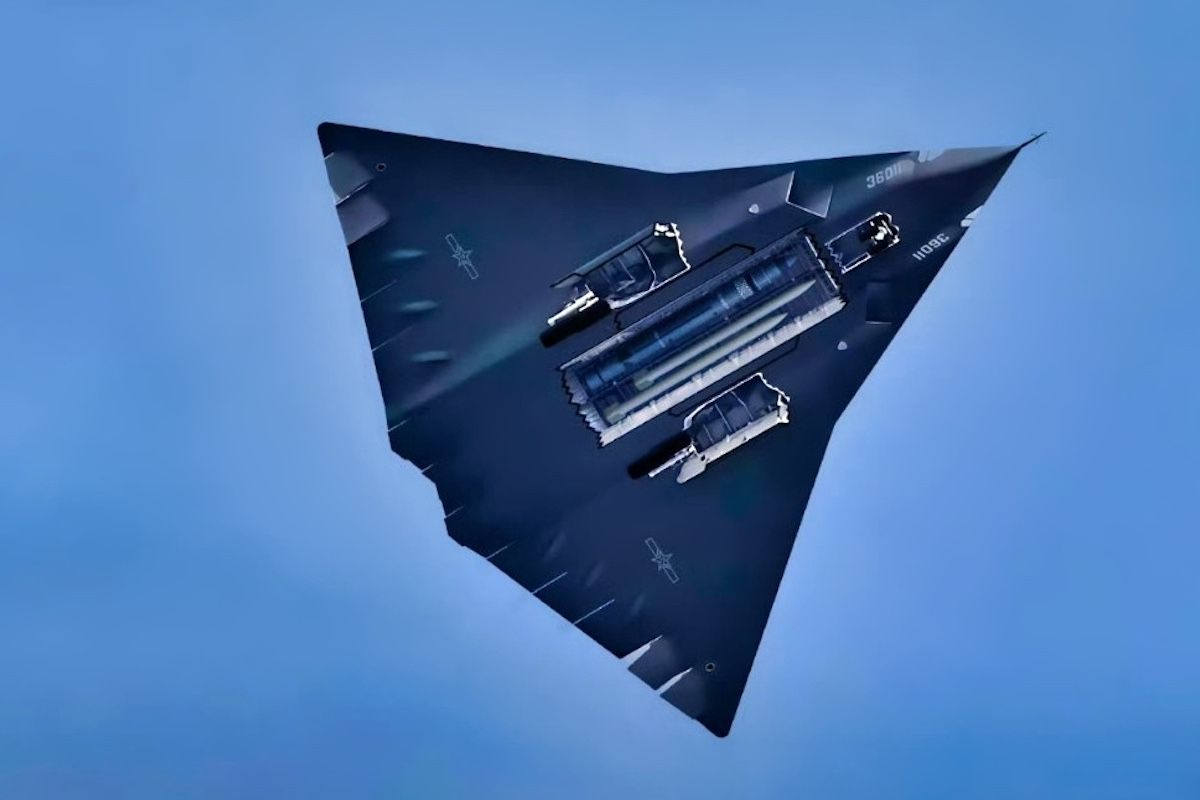
The aircraft became publicly recognizable on 26 December 2024, when a large Chengdu-built prototype was filmed and photographed in flight over Chengdu with a two-seat J-20S acting as a chase aircraft. Its first public appearance revealed a broad, tailless double-delta planform and a three-engine arrangement. Subsequent test flights during 2025 exposed additional details of the airframe, control surfaces, inlets, internal bays and cockpit.
By 2026 the program remained in flight testing. Chinese military media showed the aircraft in official footage in June 2026, providing the first clear official acknowledgment of the type's existence reported by MiGFlug. Later footage described in August 2026 showed a high-alpha, high-energy maneuver with a rapid pitch-over, near-vertical dive, sharp recovery and climb. One source expects service entry around 2030, while earlier Chinese program commentary had pointed to a 2035 horizon; no confirmed official service-entry date has been published.
Development
Open-source reporting traces Chengdu's sixth-generation work to at least 2018, when the company was reported to have submitted eight design proposals and tested four in low-altitude wind tunnels. In January 2019, Chengdu chief designer Wang Haifeng said China had begun pre-research on a sixth-generation aircraft and indicated that the effort could mature by about 2035.
A tailless aircraft was observed at Chengdu facilities in 2021. In February 2023, Aviation Industry Corporation of China released sixth-generation concept imagery featuring a diamond-like, tailless configuration. These earlier concepts did not establish the final design, but they were broadly consistent with the layout later seen on the aircraft that emerged publicly in December 2024.
The 26 December 2024 flight was the first widely documented appearance of the Chengdu prototype. The airframe carried the number 36011, which led outside analysts to use the name J-36. Contemporary technical analysis, including The Diplomat, treated J-36 as a provisional designation rather than an officially announced model name.
Flight testing
Images from 17 March 2025 showed another public test flight without the J-20S chase aircraft. Additional imagery on 7 April showed the prototype landing at Chengdu's test facility. On 21 April the aircraft was filmed maneuvering, and rear-aspect images published later that month provided clearer views of the recessed engine exhaust area and the broad cockpit section. The War Zone was among the outlets documenting the second publicly observed flight.
Further flights in May and June 2025 produced clearer views of the nose, air intakes, ventral weapon-bay doors and cockpit. Open-source observers reported multiple prototypes, although no official prototype count has been released. In June 2026 the aircraft appeared briefly in a People's Liberation Army video, marking a significant change from the earlier period in which the program had not been formally acknowledged in public military media.
Footage released or circulated in August 2026 showed the aircraft performing a demanding high-alpha maneuver. It pitched rapidly, entered a near-vertical dive, recovered sharply and climbed away. The sequence demonstrated that the large tailless airframe could sustain aggressive pitch changes during flight testing, although no official maneuverability limits or performance figures have been published.
Design
Airframe
The J-36 prototype uses a tailless, blended double-delta planform with a broad center body and no conventional vertical or horizontal tail surfaces. The wing has a leading-edge kink that creates two sweep angles. This geometry is intended to combine low-observable shaping with efficient transonic and supersonic flight. Continuous chine and edge alignment, recessed apertures and the absence of conventional tail surfaces are consistent with an effort to reduce radar reflections from multiple aspects.
Analyst Bill Sweetman estimated the prototype at about 23 m in length, with a wingspan of about 19 m and a wing area near 200 m². These are open-source estimates based on imagery and comparison with the J-20 chase aircraft, not manufacturer specifications. The aircraft uses dual-wheel nose landing gear and tandem-wheel main landing-gear units, features associated with a comparatively large and heavy airframe.
The trailing edge carries multiple movable panels that provide pitch and roll control in place of conventional tailplanes. The outer surfaces have been interpreted as split brake-rudders for yaw control. Analysts have also proposed that engine thrust or other control effectors may contribute to stability and maneuvering, but the precise flight-control architecture has not been disclosed.
Cockpit and avionics
The prototype has a wide, dark-tinted cockpit canopy. Later imagery has been interpreted as showing a side-by-side two-seat arrangement, but Chinese authorities have not published an official crew specification. Large electro-optical apertures are visible around the forward fuselage, and the design appears to incorporate flush sensor installations rather than prominent external housings.
Open-source analysis has suggested an active electronically scanned array radar, distributed electro-optical sensing and extensive networking functions. These capabilities remain unconfirmed in official technical data. The aircraft's size and internal volume have also led analysts to discuss a possible command-and-control role for cooperating crewed and uncrewed aircraft, but this remains an assessment rather than a published operational requirement. A related analysis by the Royal United Services Institute has examined the potential value of large crewed combat aircraft in the Indo-Pacific.
Powerplant
The most distinctive propulsion feature is the use of three engines arranged across the rear of the center body. Two engines are fed by side inlets beneath the forward wing roots, while the center engine is fed by a dorsal diverterless supersonic inlet. The exact engine models, thrust ratings and production configuration have not been officially identified.
The exhausts are recessed ahead of the trailing edge. Analysts have proposed that this arrangement could help reduce radar and infrared signatures while supporting high-speed flight. Some assessments have also linked the trijet layout to supercruise, electrical-power demand or flight-control requirements, but none of these explanations has been confirmed by the manufacturer.
Internal weapons carriage
Imagery indicates a large central internal weapons bay with two smaller bays alongside it. One technical assessment estimated the main bay at about 7.6 m in length. The size of the bay has prompted speculation that the aircraft could carry long-range air-to-air or large air-to-surface weapons internally, but no official weapon integration list has been released.
Program status
The Chengdu aircraft remains a development and flight-test program. Multiple prototypes have been reported in open sources, but neither the People's Liberation Army Air Force nor Chengdu Aircraft Corporation has published a definitive prototype count, final designation, production configuration or operational inventory. The aircraft therefore should not be treated as an operational fighter.
The program is one of at least two Chinese next-generation combat-aircraft efforts observed in flight, the other being a smaller tailless design associated with Shenyang Aircraft Corporation and commonly referred to as J-50. The exact relationship between the Chengdu and Shenyang programs, including whether they represent competing designs, complementary roles or separate service requirements, has not been officially defined.
The source published in August 2026 expects the Chengdu aircraft to enter active service around 2030. Earlier commentary connected with Chengdu's sixth-generation research had referred to a 2035 timeframe. Until Chinese authorities announce a formal schedule, these dates should be treated as expectations rather than confirmed program milestones.
Specifications (J-36 prototype)
No official manufacturer specification sheet has been released. The dimensions below are open-source estimates for the prototype observed from December 2024 onward.
General characteristics
- Manufacturer: Chengdu Aircraft Corporation
- Configuration: Tailless blended diamond-double-delta combat aircraft
- Length: Approximately 23 m, analyst estimate
- Wingspan: Approximately 19 m, analyst estimate
- Wing area: Approximately 200 m², analyst estimate
- Powerplant: Three jet engines; exact type and thrust not disclosed
- Air intakes: Two side inlets and one dorsal diverterless supersonic inlet
Armament arrangement
- Internal bays: One large central bay with two smaller adjacent bays observed in imagery
- Main bay length: Approximately 7.6 m, analyst estimate
Related equipment
The Shenyang next-generation aircraft commonly referred to as J-50 is a separate Chinese tailless combat-aircraft prototype that has also been seen in flight testing. The Chengdu J-20S served as a chase aircraft during the J-36's first widely documented flight and provided a useful visual reference for estimating the new aircraft's size.
 Argentina
 Armenia
 Australia
 Austria
 Austria-Hungary
 Belgium
 Brazil
 United Kingdom
 United States
 Brunei
 Bulgaria
 Canada
 Chile
Chile Colonial America
 Colombia
 Confederate States
 Croatia
 Czech
Czech Denmark
 Egypt
Egypt Finland
 France
 Georgia
 Germany
 German Imperial
 Greece
 Holland
 Hungary
 India
India Indonesia
 Iran
Iran Iraq
Iraq Ireland
 Israel
 Italy
Italy Japan
Japan Japan (1940)
 Jordan
 Kingdom of Italy
 Malaysia
 Mexico
 Myanmar
 Nazi Germany
 Netherlands
 New Zealand
 North Korea
 Norway
 Pakistan
 Peru
Peru Philippines
 Poland
 Portugal
 Prussia
 Romania
 Russia
 Saudi Arabia
 Serbia
 Singapore
 Slovakia
 Slovenia
 South Africa
 South Korea
 Soviet Union
 Spain
Spain Sweden
 Switzerland
 Syria
Syria Taiwan
 Thailand
 Turkey
 UAE
UAE Ukraine
 Vietnam
 Yugoslavia