
History
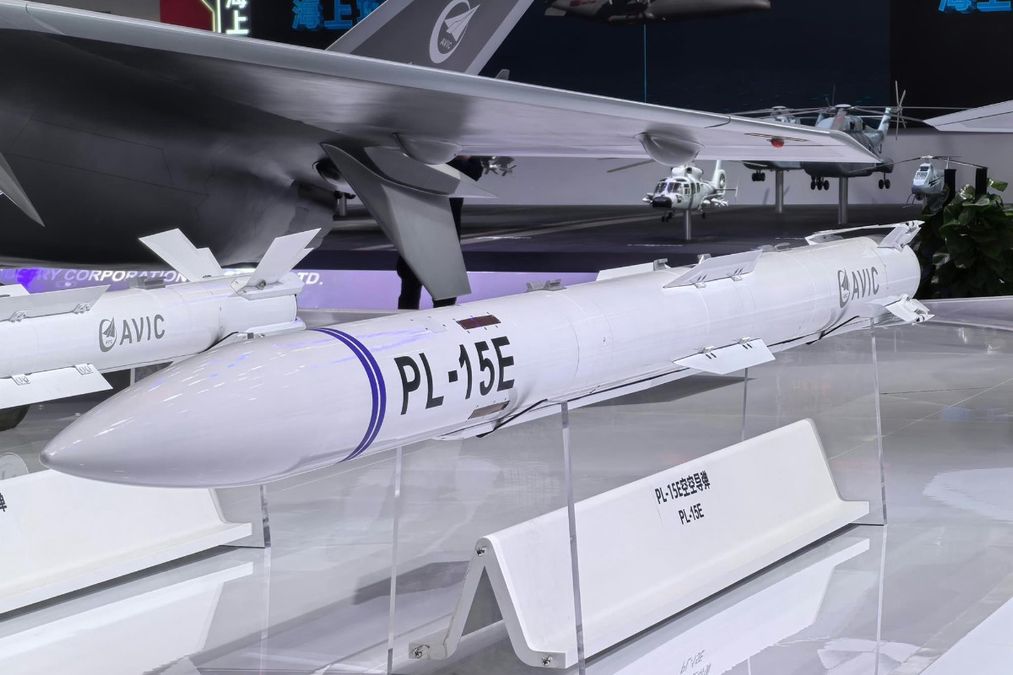
The PL-16 is a reported Chinese long-range, beyond-visual-range air-to-air missile intended for use by stealth combat aircraft. Public information about the weapon remains limited, and China has not officially confirmed its designation, specifications, manufacturer, development schedule, or operational status.
Reports published in 2026 described the PL-16 as a compact successor or complement to the PL-15. Its reported design priorities include long-range interception, efficient internal carriage, improved terminal energy, and resistance to electronic countermeasures.
The available information is based largely on presentation slides circulated after a Chinese military aviation seminar, secondary reporting, and images described as showing a possible test launch. These materials indicate that a physically recognizable weapon may have entered testing by 2026, but they do not establish that the missile has entered production or operational service.
Development background
China developed the PL-16 within a continuing progression of beyond-visual-range weapons that includes the PL-11, PL-12, and PL-15. The PL-15 introduced substantially greater reported range than the earlier missiles and became an important internal weapon for the Chengdu J-20 stealth fighter. However, the dimensions of the PL-15 reportedly limit the J-20 to four missiles in its main internal weapons bay.
The PL-16 is reported to address this limitation through a slimmer body and folding or retractable control surfaces. Analysts have suggested that these features could permit a J-20 to carry six PL-16 missiles internally instead of four PL-15s. The same compact arrangement has also been associated with the J-35 and possible future Chinese combat aircraft, although public evidence of completed integration is unavailable.
Reports in June 2026 linked the missile to Chinese research into variable-thrust solid rocket motors. One cited study from 2014 examined how controlled thrust profiles could extend the range of a tactical missile. However, no public evidence directly connects that research program to the PL-16.
Public disclosure
A series of presentation slides circulated publicly in 2026 and described the PL-16 as an ultra-long-range missile. The slides reportedly attributed an active electronically scanned array radar seeker, a two-way data link, variable-thrust propulsion, and a range exceeding 300 km to the weapon. A contemporary account and additional technical discussion were published by Aviacionline.
Other assessments give a broader estimated range of 200–300 km and describe the motor as either dual-pulse or variable-thrust. The different descriptions may reflect uncertainty, translation, or incomplete technical information. They should not be treated as confirmed manufacturer specifications.
Design
Configuration
The reported PL-16 configuration emphasizes compact internal storage aboard low-observable aircraft. Folding or retractable control surfaces reduce the space required around each missile while it is carried inside a weapons bay. Internal carriage allows a stealth aircraft to retain a lower radar signature than it would with externally mounted weapons.
Unofficial dimensions include a length of approximately 4 m, a diameter of about 203 mm, and a mass near 200 kg. Another secondary compilation gives an estimated length of about 3.8 m and a diameter between 180 and 203 mm. China has not confirmed either set of figures, and no authoritative dimensional drawing has been released.
Propulsion
Reports describe the PL-16 as using a solid-propellant rocket motor with either a dual-pulse or variable-thrust operating cycle. A dual-pulse motor divides its propulsive energy between two distinct burns. The later burn can restore speed before interception. A variable-thrust motor instead regulates the thrust profile more continuously to conserve energy during parts of the flight and provide greater acceleration when required.
Both approaches are intended to retain energy during the terminal phase, when the missile must respond to a manoeuvring target. The available evidence does not establish which propulsion arrangement is installed in the reported PL-16.
Guidance
The circulated presentation attributes an active electronically scanned array radar seeker and a two-way data link to the PL-16. If this description is accurate, the data link would allow targeting information to be updated during the missile's flight, while the onboard radar seeker would support autonomous terminal homing. Reports also claim that the seeker is intended to improve target discrimination and resistance to electronic jamming.
These guidance features remain unconfirmed. No public source provides detailed seeker performance, data-link frequencies, counter-countermeasure characteristics, or information about the missile's navigation system.
Engagement role
The PL-16 is described primarily as a beyond-visual-range weapon for engaging combat aircraft. Its reported range could also permit attacks on larger support aircraft, including airborne early-warning platforms, reconnaissance aircraft, and aerial-refuelling tankers. Actual engagement distance would depend on launch altitude, launch speed, target movement, guidance updates, and the amount of energy required for terminal manoeuvres.
The reported range should therefore not be interpreted as a guaranteed no-escape distance. A missile may travel farther against a large, non-manoeuvring target than against a fast fighter performing defensive manoeuvres.
Program status
As of 2026, the Chinese government and the People's Liberation Army had not publicly acknowledged the PL-16 program. No official statement had identified its manufacturer, confirmed flight testing, announced a production contract, or declared the missile operational.
One published image was described as a possible test launch, while secondary sources characterized the weapon as emerging or in limited service. Neither claim provides sufficient evidence to confirm operational deployment. The missile should consequently be regarded as a reported development or test program rather than an established in-service weapon.
The PL-16 has been associated with the J-20 and J-35 internal weapons bays. Some reporting also mentions possible future compatibility with aircraft known informally as the J-36 and J-50. These associations describe proposed or expected integration and do not confirm that qualification testing has been completed.
Specifications (reported PL-16)
General characteristics
- Type: Long-range beyond-visual-range air-to-air missile
- Country of development: China
- Length: Approximately 3.8–4 m, according to conflicting unofficial estimates
- Diameter: Approximately 180–203 mm, according to unofficial estimates
- Launch mass: Approximately 200 kg, unconfirmed
- Control surfaces: Reported folding or retractable surfaces for compact internal carriage
Performance
- Reported range: Approximately 200–300 km; circulated presentation material claims more than 300 km
- Reported speed: More than Mach 4, unconfirmed secondary estimate
- Propulsion: Solid-propellant rocket motor; described inconsistently as dual-pulse or variable-thrust
Guidance
- Terminal guidance: Reported active radar homing with an AESA seeker
- Mid-course guidance: Reported data-link updates
- Data link: Reported two-way connection
Carriage
- Reported launch platforms: Chengdu J-20 and Shenyang J-35
- Reported J-20 internal capacity: Up to six missiles
Related equipment
- PL-15: Earlier Chinese beyond-visual-range air-to-air missile and the reported predecessor or complementary weapon to the PL-16.
- PL-17: Larger Chinese very-long-range air-to-air missile associated with attacks on high-value support aircraft.
- AIM-260 JATM: United States next-generation air-to-air missile frequently compared with the reported PL-16.
Additional secondary assessments are available from Indian Defence Research Wing, MiGFlug, and The Defense Watch. Their technical figures should be treated as estimates until confirmed by an authoritative Chinese source.
 Argentina
 Armenia
 Australia
 Austria
 Austria-Hungary
 Belgium
 Brazil
 United Kingdom
 United States
 Brunei
 Bulgaria
 Canada
 Chile
Chile Colonial America
 Colombia
 Confederate States
 Croatia
 Czech
Czech Denmark
 Egypt
Egypt Finland
 France
 Georgia
 Germany
 German Imperial
 Greece
 Holland
 Hungary
 India
India Indonesia
 Iran
Iran Iraq
Iraq Ireland
 Israel
 Italy
Italy Japan
Japan Japan (1940)
 Jordan
 Kingdom of Italy
 Malaysia
 Mexico
 Myanmar
 Nazi Germany
 Netherlands
 New Zealand
 North Korea
 Norway
 Pakistan
 Peru
Peru Philippines
 Poland
 Portugal
 Prussia
 Romania
 Russia
 Saudi Arabia
 Serbia
 Singapore
 Slovakia
 Slovenia
 South Africa
 South Korea
 Soviet Union
 Spain
Spain Sweden
 Switzerland
 Syria
Syria Taiwan
 Thailand
 Turkey
 UAE
UAE Ukraine
 Vietnam
 Yugoslavia