
History
The YJ-20 is a Chinese ship-launched hypersonic anti-ship missile associated with the People's Liberation Army Navy. It is intended to attack large surface vessels at long range while using high speed and maneuvering flight to complicate interception.
The weapon has been launched from both the Type 055 large destroyer and the smaller, more numerous Type 052D destroyer. These demonstrations indicate compatibility with China's universal naval vertical launch system, although the extent of operational deployment and the number of missiles produced have not been disclosed.
Public information about the YJ-20 remains limited. Its flight profile, range, speed, guidance system, warhead, inventory, and service status are described mainly through Chinese media statements and external assessments rather than detailed official specifications.
In April 2022, footage showed an unidentified large missile being launched from a Type 055 destroyer. It was initially widely identified outside China as the YJ-21. After the YJ-20 designation became public, analysts noted that the 2022 weapon may instead have been the YJ-20 or an earlier development version. This attribution remains uncertain because the missile was not officially named in the original footage.
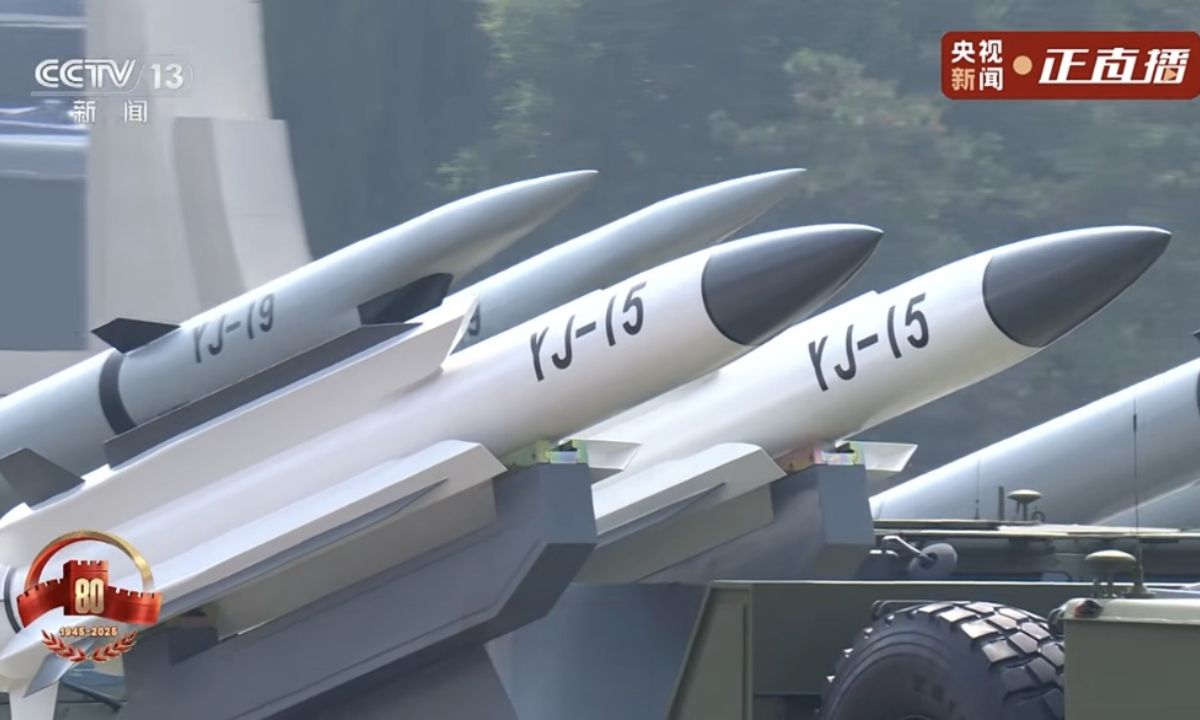
The YJ-20 was publicly displayed under its official designation during China's military parade in Beijing on 3 September 2025. In December 2025, Chinese military media released footage of the Type 055 destroyer Wuxi launching the missile. The event was described as a finalization test and provided the first official acknowledgement of the ship-launched YJ-20.
On 29 July 2026, Chinese state media showed a YJ-20 launch from an unidentified Type 052D destroyer. The missile was ejected from a cell in the forward vertical launch system before its rocket motor ignited. The footage did not show a target engagement. The Chinese report confirmed the launch platform, but did not establish fleet-wide deployment.
Integration with the Type 052D could distribute the missile across a larger part of the Chinese surface fleet than deployment limited to the Type 055. The Type 052D has 64 vertical launch cells, divided equally between forward and aft groups, while the Type 055 has 112 cells. It is not publicly known whether every cell or every ship of either class is configured and certified for the YJ-20.
Design
Configuration and flight profile
The YJ-20 is generally described as a hypersonic anti-ship ballistic missile with a biconic, or double-cone, aerodynamic body. Chinese commentary describes a boost-glide arrangement in which a solid-propellant rocket accelerates the weapon before a maneuverable vehicle continues toward the target. Other reporting characterizes its path as aero-ballistic or quasi-ballistic. The precise profile has not been officially detailed.
The biconic vehicle is intended to maneuver during descent rather than remain on a fully predictable ballistic trajectory. A steep terminal approach and changes in direction can reduce the time available for a ship's sensors and defensive weapons to calculate an interception. Public footage confirms cold launch: gas pressure ejects the missile from the ship's vertical cell, and the motor starts only after the weapon has cleared the launcher.
Guidance and target engagement
The YJ-20 is intended primarily for attacks on large and medium surface vessels, including aircraft carriers and other major combatants. External assessments suggest that navigation and mid-course updates may be followed by active radar, infrared homing, or a combination of terminal sensors. China has not published an authoritative description of the guidance arrangement. Claims of a secondary land-attack role also remain unconfirmed.
Long-range engagement of a moving ship requires more than missile performance. The launch platform needs sufficiently recent target data from an external reconnaissance and communications network. The effectiveness of the complete detection, tracking, targeting, and update chain has not been demonstrated in combat.
Performance assessments
No comprehensive official performance specification has been released. Published estimates generally place the missile's range at approximately 1,000–1,500 km (620–930 mi), while some estimates extend to about 2,000 km (1,240 mi). Reported speed estimates begin above Mach 6 and extend to approximately Mach 9 or Mach 10 during the terminal phase. These figures should be treated as assessments rather than confirmed limits.
The warhead is described as conventional, but its mass and type have not been disclosed. High impact velocity would add kinetic energy to the warhead's explosive effect. Accuracy, seeker performance, resistance to electronic countermeasures, reliability, and effectiveness against layered naval defenses remain unknown.
Program status
The September 2025 public unveiling and the December 2025 finalization test show that the program had progressed beyond an unidentified developmental weapon. The July 2026 Type 052D launch demonstrated integration with a second destroyer class. A contemporary independent assessment nevertheless noted that the Type 052D event could still represent a trial rather than proof of large-scale fielding.
Some sources list the YJ-20 as in service from 2025, but China has not publicly disclosed a formal service-entry declaration, missile inventory, production rate, standard ship loadout, or the number of certified launch platforms. Available evidence supports describing the weapon as undergoing integration and transition toward a broader naval capability, not as confirmed standard equipment throughout both destroyer classes.
Operators
- People's Liberation Army Navy: demonstrated the YJ-20 aboard the Type 055 destroyer Wuxi in 2025 and an unidentified Type 052D destroyer in 2026. Deployed quantities and formal operational status are undisclosed.
Specifications (YJ-20)
General characteristics
- Type: ship-launched hypersonic anti-ship ballistic missile or boost-glide weapon
- Launch method: cold launch from a universal vertical launch system
- Propulsion: solid-propellant rocket booster
- Warhead: conventional; type and mass undisclosed
- Launch platforms demonstrated: Type 055 and Type 052D destroyers
Performance
- Estimated range: approximately 1,000–1,500 km (620–930 mi), with some external estimates reaching about 2,000 km (1,240 mi)
- Estimated speed: above Mach 6, with terminal estimates of approximately Mach 9–10
- Flight profile: maneuvering aero-ballistic or boost-glide trajectory; exact profile undisclosed
 Argentina
 Armenia
 Australia
 Austria
 Austria-Hungary
 Belgium
 Brazil
 United Kingdom
 United States
 Brunei
 Bulgaria
 Canada
 Chile
Chile Colonial America
 Colombia
 Confederate States
 Croatia
 Czech
Czech Denmark
 Egypt
Egypt Finland
 France
 Georgia
 Germany
 German Imperial
 Greece
 Holland
 Hungary
 India
India Indonesia
 Iran
Iran Iraq
Iraq Ireland
 Israel
 Italy
Italy Japan
Japan Japan (1940)
 Jordan
 Kingdom of Italy
 Malaysia
 Mexico
 Myanmar
 Nazi Germany
 Netherlands
 New Zealand
 North Korea
 Norway
 Pakistan
 Peru
Peru Philippines
 Poland
 Portugal
 Prussia
 Romania
 Russia
 Saudi Arabia
 Serbia
 Singapore
 Slovakia
 Slovenia
 South Africa
 South Korea
 Soviet Union
 Spain
Spain Sweden
 Switzerland
 Syria
Syria Taiwan
 Thailand
 Turkey
 UAE
UAE Ukraine
 Vietnam
 Yugoslavia