
History
The Type 25 air-launched cruise missile is a Japanese long-range standoff weapon under development for the Mitsubishi F-2 fighter. It is derived from the upgraded Type 12 Surface-to-Ship Missile program, whose ground-launched version received the Type 25 designation. The air-launched weapon is intended for attacks against ships and planned land targets at much greater distances than Japan's earlier air-launched anti-ship missiles.
The missile's formal air-service designation has not been publicly confirmed. Type 25 air-launched cruise missile is therefore a descriptive name based on its relationship to the Type 25 family. ASM-4 has appeared as a possible designation in reporting, but it remains speculative.
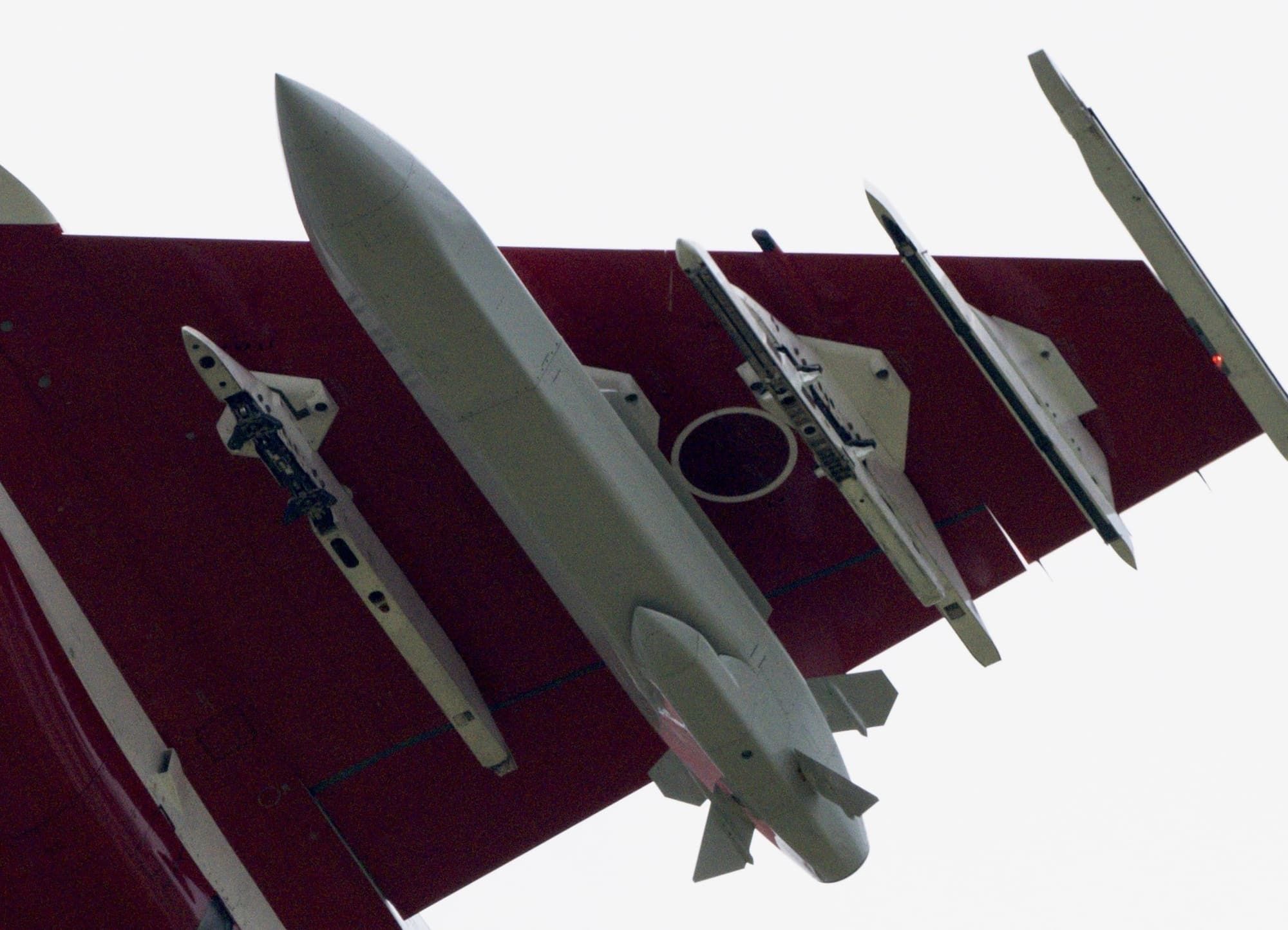
The first publicly documented captive-carry flight took place from Gifu Air Base on 30 July 2026. A Japan Air Self-Defense Force F-2B test aircraft carried two large missile test articles beneath its wings. This event confirmed aircraft-level integration work, but it did not demonstrate powered flight, guidance performance, target engagement, or operational readiness.
Development
The program originated in Japan's effort to extend the range and roles of the Type 12 coastal-defense missile. The upgraded weapon became a substantially redesigned, multi-platform missile family rather than a minor modification of the original Type 12. Development included ground-, ship-, and air-launched configurations.
The original ground-launched Type 12 had a reported range of about 200 km. Published estimates place the upgraded Type 25 family near 1,000 km, although the exact range of the air-launched variant has not been officially disclosed. Reports also describe the family as capable of attacking maritime targets and selected fixed land targets. These roles support Japan's developing long-range counterstrike policy.
Japan formally redesignated the completed ground-launched upgraded Type 12 as the Type 25 Surface-to-Ship Missile in March 2026. The Japan Ground Self-Defense Force then began introducing that version. The aircraft-launched configuration continued to be described in official material as the air-launched upgraded Type 12, which explains the uncertainty surrounding its final designation.
Flight testing
On 30 July 2026, photographers at Gifu Air Base recorded an F-2B assigned to the Air Development and Test Wing carrying two apparently inert missiles on its inboard wing pylons. The flight was accompanied by an F-2A test aircraft. Published accounts disagree on the F-2B serial, identifying it as either 63-8101 or 68-8101, so the serial cannot be stated conclusively from the available evidence. The event was described as the first publicly observed captive-carry test of the configuration by The Aviationist and other specialist publications.
Captive-carry testing allows engineers to examine aerodynamic loads, vibration, flutter, drag, aircraft handling, and the structural effects of carrying a large external store. It can also support checks of electrical interfaces, mission-computer functions, cockpit indications, and emergency jettison procedures. Safe-separation trials, powered launches, guidance tests, and live firings are separate later stages and were not demonstrated by the July 2026 flight.
The observed aircraft carried no other weapons or external fuel tanks. The missiles occupied the inboard stations identified in one report as stations 4 and 10. The configuration established that the F-2 can physically carry two test articles, but it did not confirm an operational loadout. Proposals for mixed carriage with ASM-3-family weapons remain unverified until the relevant combinations are certified.
Design
Airframe
The observed missile has a long fuselage with an angular or chined cross-section. Folding wings are mounted on the upper part of the body, and four tailfins form a cruciform control arrangement. Its external shape is larger than the ASM-2 and differs from the speed-oriented ASM-3. The angled surfaces have been interpreted as measures to reduce radar cross-section, but no measured signature has been published.
An intake-like opening is visible beneath the rear fuselage. This feature suggests an air-breathing cruise propulsion system, and reporting on the ground-launched Type 25 describes a compact turbofan. However, the engine installed in the air-launched test articles has not been officially identified. The missile lacks the launch booster used by ground- and ship-launched members of the family because the carrier aircraft provides initial altitude and speed.
Guidance and targeting
Published descriptions of the Type 25 family refer to inertial and satellite navigation, terrain-referenced guidance, network-enabled targeting, and a terminal radar seeker for maritime targets. Common use of these systems in the air-launched variant is expected, but its precise guidance package has not been officially detailed. Photographs show no obvious optical seeker window.
Long-range engagement of a moving ship would require recent target information and updates from external sensors. Maritime patrol aircraft, coastal sensors, ships, aircraft, and other surveillance platforms could contribute to this targeting network. The presence, format, and operational use of a missile datalink have not been confirmed for the air-launched test vehicle.
Carriage and launch
Air launch can increase effective reach by adding the F-2's altitude, speed, and displacement from its base before missile release. It also allows launch positions and approach directions to change more rapidly than those of a ground battery. Large external stores impose penalties in drag, fuel consumption, radar visibility, structural loading, and available pylon space. The operational effect on the F-2's radius, manoeuvre limits, and other weapon carriage has not been published.
The July 2026 test used two symmetrically mounted articles. Before service use, the program must demonstrate safe release throughout the approved launch envelope, reliable engine start, wing deployment, navigation, terminal guidance, electromagnetic compatibility, and integration with the F-2's stores-management and mission systems.
Program status
As of July 2026, the air-launched Type 25-related weapon was in captive-carry and aircraft-integration testing. The public flight showed a physical missile configuration on an F-2B, but did not prove that a complete operational missile had flown independently. A detailed flight-qualification assessment similarly distinguished the observed carriage test from separation, propulsion, seeker, and live-fire validation.
Japan has planned deployment of air- and ship-launched versions in fiscal year 2027. This remains a planned milestone for the air-launched weapon. The schedule requires completion of separation trials, powered testing, certification, training, logistics preparation, and operational integration. No production quantity, unit price, warhead specification, or confirmed service inventory for the air-launched variant has been published in the supplied evidence.
The ground-launched Type 25 entered service first and provides the most mature reference point for the family. Reporting on its induction and the fiscal-year 2027 plan for other launch modes is available from Army Recognition. A separate TURDEF report estimated the family range at 900 to 1,000 km, while other assessments have proposed higher figures. None establishes an official range for the aircraft-launched variant.
Intended role
The air-launched missile is intended to extend the F-2's maritime-strike reach beyond the shorter-ranged ASM-2. A land-attack role is also associated with the wider upgraded Type 12 and Type 25 program. Aircraft carriage would allow Japan to move launch capacity rapidly between sectors and create attack routes from different directions.
The missile is one part of a broader Japanese standoff arsenal that also includes the ground-launched Type 25, imported Tomahawk cruise missiles, the Joint Strike Missile for the F-35A, and development of other long-range weapons. A regional assessment described how an air-launched member could complicate surveillance and air defense by adding mobile launch axes. Such effects depend on operational range, targeting support, inventory, aircraft availability, and survivable command networks, all of which remain partly undisclosed.
Variants
- Type 25 Surface-to-Ship Missile: Ground-launched production member of the family, developed from the upgraded Type 12 program and inducted by the Japan Ground Self-Defense Force in 2026.
- Air-launched upgraded Type 12: Official development description for the F-2-carried configuration. It is commonly described as the air-launched Type 25, but its formal service designation remains unconfirmed.
- Ship-launched variant: Planned naval member of the multi-platform family. Deployment has been reported as planned for fiscal year 2027.
Specifications (Type 25 air-launched variant)
General characteristics
- Type: Air-launched long-range cruise missile and standoff weapon
- Country of origin: Japan
- Development status: Captive-carry and aircraft-integration testing publicly documented in July 2026
- Launch aircraft: Mitsubishi F-2 test aircraft
- Observed carriage: Two test articles on the F-2B's inboard wing pylons
- Configuration: Angular fuselage, folding upper-body wings, four cruciform tailfins, and a rear underslung intake-like feature
Performance
- Range: Not officially disclosed for the air-launched variant; estimates for the related Type 25 family are approximately 900 to 1,000 km
- Speed: Not officially disclosed; the configuration has been widely assessed as subsonic
Guidance and roles
- Navigation: Precise configuration undisclosed; family descriptions refer to inertial, satellite, and terrain-referenced navigation
- Terminal guidance: Not officially confirmed for the air-launched variant; a radar seeker is reported for the Type 25 family
- Intended targets: Maritime targets and planned fixed land targets
Related equipment
- Type 12 Surface-to-Ship Missile: Earlier Japanese coastal-defense missile from which the upgraded multi-platform program developed.
- ASM-2: Shorter-range air-launched anti-ship missile used by the F-2 and a likely system for the new weapon to complement or replace.
- ASM-3 Kai: Improved high-speed anti-ship missile undergoing a separate F-2 test program.
- New Surface-to-Ship Missile: Separate Japanese multi-platform missile project using an efficient turbofan and terminal manoeuvres; it should not be confused with the Type 25 family.
 Argentina
 Armenia
 Australia
 Austria
 Austria-Hungary
 Belgium
 Brazil
 United Kingdom
 United States
 Brunei
 Bulgaria
 Canada
 Chile
Chile China
China Colonial America
 Colombia
 Confederate States
 Croatia
 Czech
Czech Denmark
 Egypt
Egypt Finland
 France
 Georgia
 Germany
 German Imperial
 Greece
 Holland
 Hungary
 India
India Indonesia
 Iran
Iran Iraq
Iraq Ireland
 Israel
 Italy
Italy Japan (1940)
 Jordan
 Kingdom of Italy
 Malaysia
 Mexico
 Myanmar
 Nazi Germany
 Netherlands
 New Zealand
 North Korea
 Norway
 Pakistan
 Peru
Peru Philippines
 Poland
 Portugal
 Prussia
 Romania
 Russia
 Saudi Arabia
 Serbia
 Singapore
 Slovakia
 Slovenia
 South Africa
 South Korea
 Soviet Union
 Spain
Spain Sweden
 Switzerland
 Syria
Syria Taiwan
 Thailand
 Turkey
 UAE
UAE Ukraine
 Vietnam
 Yugoslavia