
History
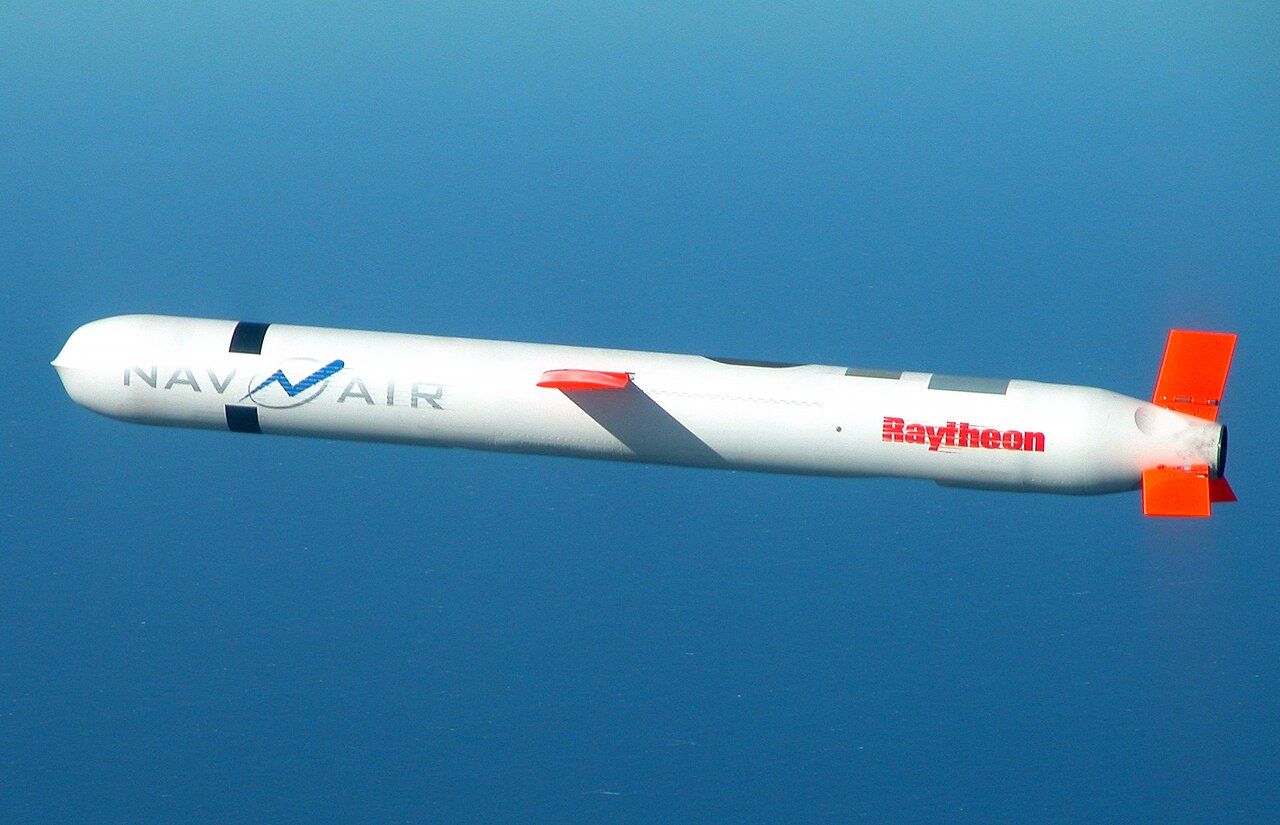
The BGM-109 Tomahawk is an American family of long-range, subsonic cruise missiles developed for precision attacks from naval platforms. Surface ships can launch it from vertical launch cells, while submarines employ encapsulated missiles or torpedo-tube launch arrangements.
The family has included land-attack, anti-ship, and retired nuclear variants. Successive blocks introduced satellite navigation, improved engines, two-way communications, in-flight retargeting, renewed maritime-strike capability, and additional warhead options.
General Dynamics developed the original missile during the 1970s after the United States Navy began work on sea-launched cruise missiles in 1972. A preserved flight-test vehicle described by the National Air and Space Museum participated in four tests conducted from 1976 through 1978.
Development and production
The Tomahawk was designed to travel long distances at low altitude and subsonic speed. Its modular architecture supported several launch methods, guidance configurations, and payloads. General Dynamics initially manufactured the missile. Production later passed through McDonnell Douglas and Hughes before Raytheon became the principal manufacturer.
The Tomahawk entered United States service in 1983. Block II versions were deployed during the following year. The first operational families included the nuclear TLAM-N, the conventional unitary-warhead TLAM-C, the submunition-carrying TLAM-D, and the TASM anti-ship missile.
The missile received extensive combat use during the 1991 Gulf War. Block III entered service in 1993 with GPS, improved Digital Scene Matching Area Correlation, a more efficient engine, a lighter unitary warhead, greater range, and time-of-arrival control. The original TASM anti-ship version was withdrawn in 1994, and surviving missiles were subsequently converted for land-attack use.
The United Kingdom agreed to acquire submarine-launched Tomahawks in 1995 and conducted its first test firing in 1998. Its missiles later saw operational use from Royal Navy submarines.
The Tactical Tomahawk program produced Block IV. Initial operational capability was achieved in 2004. The missile added faster mission planning, loitering, a two-way satellite data link, status reporting, and the ability to attack an alternative preplanned target or receive new coordinates during flight. A detailed history of these upgrades is available in the Tomahawk variant overview.
Block V developed from the recertification of Block IV missiles. It extends their service life and introduces updated navigation and communications. Block Va, also called Maritime Strike Tomahawk, is intended to engage moving ships. Block Vb integrates the Joint Multiple Effects Warhead System for a wider range of land targets.
International adoption
Australia acquired the weapon for its Hobart-class destroyers and conducted its first firing in December 2024. The Netherlands fired a Tomahawk from the frigate HNLMS De Ruyter in March 2025.
Japan selected Tomahawk as an interim long-range weapon while domestic standoff missiles enter service. Its acquisition covers as many as 400 Block IV and Block V missiles. The Kongō-class destroyer Chōkai received structural changes, combat-system software, and crew training in the United States. On 29 July 2026 Japan Standard Time, Chōkai conducted Japan's first Tomahawk firing in the Pacific with United States Navy support. The test confirmed shipboard integration and crew proficiency. Japan plans to modify additional Kongō-, Atago-, and Maya-class destroyers. The event is also documented in a contemporary technical overview.
Design
Airframe and propulsion
The Tomahawk has a cylindrical body with folding wings and tail surfaces that deploy after launch. This arrangement allows the missile to fit inside shipboard launch canisters and submarine launch systems. A solid-propellant booster accelerates the missile during launch and is then discarded. A Williams International F107 turbofan provides sustained cruise propulsion.
The missile follows a low-altitude flight profile to reduce detection range. Its subsonic speed supports fuel-efficient flight over long distances. Public dimensions for the naval missile are approximately 5.55 m without its booster and 6.25 m with the booster, with a body diameter of 0.52 m and a wingspan of about 2.67 m.
Guidance and mission control
Tomahawk guidance combines an inertial navigation system with Terrain Contour Matching. TERCOM compares measured terrain profiles with stored reference data to correct the missile's route. Later variants also use GPS and Digital Scene Matching Area Correlation. DSMAC compares observed features near the target with stored imagery for terminal position correction.
Block IV introduced a two-way satellite connection. Operators can monitor missile status, select an alternative stored target, provide coordinates for a new target, or direct the missile to remain in a holding pattern. Block V incorporates an updated communications architecture and improved resistance to navigation interference.
Launch systems
Surface combatants normally carry Tomahawk in strike-length Mk 41 Vertical Launching System cells. Submarine-compatible UGM versions can be fired through torpedo tubes, while some submarines have dedicated vertical launch tubes. A solid-fuel booster permits the missile to leave the launch system before transitioning to turbofan-powered flight.
Payloads
The family has carried several payloads. Early versions included the W80 nuclear warhead, a conventional unitary warhead, and a dispenser containing submunitions. The United States retired the nuclear TLAM-N. Modern operational missiles use conventional payloads. Block Vb is designed to carry the Joint Multiple Effects Warhead System, which combines blast-fragmentation and penetration effects.
Operational history
Tomahawk was first used in combat during Operation Desert Storm in 1991. United States surface ships and submarines subsequently launched the missile during operations in Iraq, the Balkans, Afghanistan, Libya, Syria, Yemen, and other theaters. Its principal role has been attacking fixed land targets from beyond the immediate reach of many defensive systems. A chronology and technical summary are provided by the CSIS Missile Threat project.
The Royal Navy has employed submarine-launched Tomahawks in combat. Australia, the Netherlands, and Japan later introduced or began introducing the surface-launched weapon. These export programs expanded Tomahawk beyond its original United States and British operator base.
The Japanese firing in July 2026 demonstrated integration with the Aegis combat system and Mk 41 launchers aboard Chōkai. Tomahawk gives Japan a long-range conventional land-attack capability while its upgraded Type 12 and other domestic standoff weapons are developed and fielded.
Variants
- RGM/UGM-109A TLAM-N: Nuclear land-attack variant fitted with a W80 warhead. It was removed from operational service.
- RGM/UGM-109B TASM: Original anti-ship version with active radar homing. It was withdrawn in 1994, and surviving examples were converted to land-attack configurations.
- RGM/UGM-109C TLAM-C: Conventional land-attack missile carrying a unitary warhead. Block III added GPS, improved terminal guidance, a more efficient engine, and increased range.
- RGM/UGM-109D TLAM-D: Land-attack version originally equipped with a dispenser carrying 166 combined-effects submunitions.
- RGM/UGM-109E Block IV: Tactical Tomahawk with two-way satellite communications, loitering, status reporting, and in-flight retargeting.
- RGM/UGM-109E Block V: Recertified and modernized Tactical Tomahawk with updated navigation and communications architecture.
- Block Va Maritime Strike Tomahawk: Block V derivative intended to find and attack moving maritime targets.
- Block Vb: Land-attack derivative designed to employ the Joint Multiple Effects Warhead System.
- BGM-109G Gryphon: Ground-launched, nuclear-armed Cold War derivative carrying a W84 warhead. It was eliminated under the Intermediate-Range Nuclear Forces Treaty.
Operators
- United States: The United States Navy operates ship- and submarine-launched Tomahawks. The United States Marine Corps also employs a land-based launcher for the missile.
- United Kingdom: The Royal Navy operates submarine-launched Tomahawks and has initiated conversion of its inventory to Block V standard.
- Australia: The Royal Australian Navy operates Tomahawk from Hobart-class destroyers and completed its first firing in 2024.
- Netherlands: The Royal Netherlands Navy is introducing Tomahawk for surface ships and submarines. A Dutch frigate completed the service's first firing in 2025.
- Japan: The Japan Maritime Self-Defense Force is acquiring up to 400 Block IV and Block V missiles. Chōkai completed Japan's first firing in July 2026.
Specifications (RGM/UGM-109E Block IV)
General characteristics
- Type: Long-range, subsonic land-attack cruise missile
- Length: Approximately 5.55 m without booster; 6.25 m with booster
- Diameter: Approximately 0.52 m
- Wingspan: Approximately 2.67 m
- Launch mass: Approximately 1,600 kg with booster
- Propulsion: Solid-propellant launch booster and Williams International F107 turbofan
Performance
- Maximum range: Approximately 1,600 km
- Speed: Subsonic, approximately Mach 0.74
- Typical flight altitude: Approximately 30–50 m above ground level during low-level flight
Guidance and armament
- Guidance: Inertial navigation, GPS, TERCOM, DSMAC, and two-way satellite data link
- Payload: Approximately 454 kg unitary conventional warhead
- Launch platforms: Surface ships using the Mk 41 Vertical Launching System and compatible submarines
Published specifications differ slightly among configurations and reporting sources because the Tomahawk family includes multiple blocks, launch capsules, boosters, and payloads. A broader compilation of family data is available in the Tomahawk missile reference.
 Argentina
 Armenia
 Australia
 Austria
 Austria-Hungary
 Belgium
 Brazil
 United Kingdom
 Brunei
 Bulgaria
 Canada
 Chile
Chile China
China Colonial America
 Colombia
 Confederate States
 Croatia
 Czech
Czech Denmark
 Egypt
Egypt Finland
 France
 Georgia
 Germany
 German Imperial
 Greece
 Holland
 Hungary
 India
India Indonesia
 Iran
Iran Iraq
Iraq Ireland
 Israel
 Italy
Italy Japan
Japan Japan (1940)
 Jordan
 Kingdom of Italy
 Malaysia
 Mexico
 Myanmar
 Nazi Germany
 Netherlands
 New Zealand
 North Korea
 Norway
 Pakistan
 Peru
Peru Philippines
 Poland
 Portugal
 Prussia
 Romania
 Russia
 Saudi Arabia
 Serbia
 Singapore
 Slovakia
 Slovenia
 South Africa
 South Korea
 Soviet Union
 Spain
Spain Sweden
 Switzerland
 Syria
Syria Taiwan
 Thailand
 Turkey
 UAE
UAE Ukraine
 Vietnam
 Yugoslavia