
History
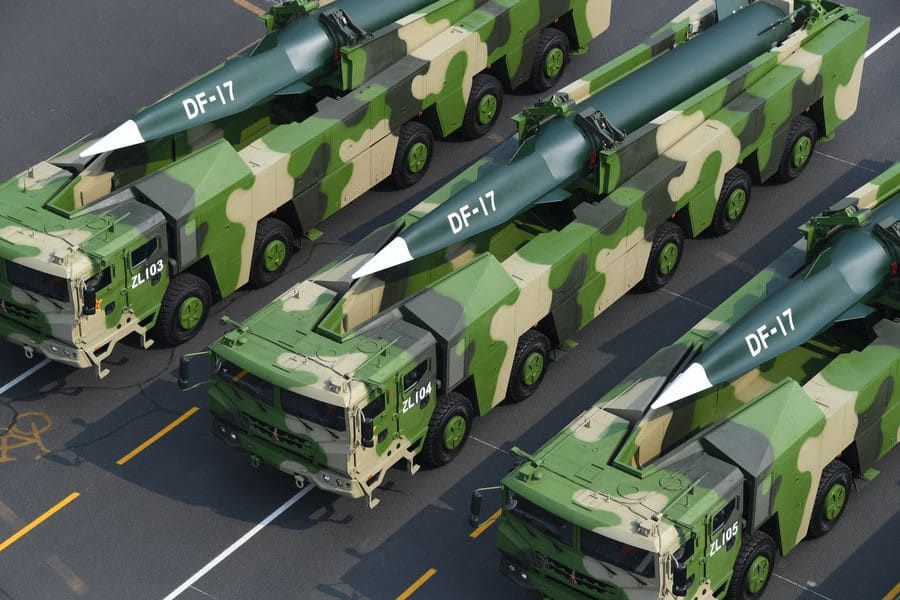
The DF-17 is a Chinese road-mobile medium-range missile system that carries the DF-ZF hypersonic glide vehicle. It is operated by the People’s Liberation Army Rocket Force and is intended for rapid precision strikes against defended targets.
The system combines a solid-fuel rocket booster with a maneuverable glide vehicle. Its relatively low glide trajectory and ability to change direction make its flight path harder to predict than that of a conventional ballistic reentry vehicle.
China publicly presents the DF-17 as a conventional weapon. External assessments indicate that the system may also be technically capable of carrying a nuclear payload, although publicly available information about its configuration remains limited.
Development and testing
China reportedly began developing the DF-ZF glide vehicle around 2009. United States officials confirmed the existence of prototypes associated with the program in 2014, when the vehicle was known outside China as Wu-14. The first reported flight test took place on 9 January 2014.
At least nine tests were reported between January 2014 and November 2017. One test in August 2014 failed, while later flights reportedly demonstrated high-speed maneuvering. During a test on 1 November 2017, the vehicle traveled approximately 1,400 km in eleven minutes and flew at an altitude of about 60 km. A second test on 15 November used a DF-17 booster to place the glide vehicle on its flight path. A detailed chronology is available in the CSIS Missile Threat profile.
The DF-17 made its first official public appearance on 1 October 2019 during the military parade marking the 70th anniversary of the People’s Republic of China. Sixteen systems were displayed. The presentation indicated that the weapon had reached an advanced deployment stage, and multiple sources list it as having entered service in 2019.
In 2026, Chinese state television released footage showing DF-17 launch operations and coordinated salvo firing. Chinese state media described the system as capable of operating without fixed launch sites and in different weather conditions. Analysts interpreted the broadcast as both a demonstration of operational capability and a strategic signal during major military exercises in the Asia-Pacific region.
Design
Missile and launcher
The DF-17 is transported and launched from a road-mobile transporter erector launcher. The launcher carries the missile horizontally during movement, raises it to a vertical position, and provides the platform for launch. Road mobility allows units to disperse and operate away from permanent launch facilities.
The missile uses a solid-fuel booster reportedly derived from the DF-16 family. Solid propellant permits the weapon to remain stored and reduces launch preparation requirements compared with many liquid-fuel systems. Public sources attribute development of the glide vehicle to the 10th Research Institute, also called the Near Space Flight Vehicle Research Institute, under the First Academy of the China Aerospace Science and Industry Corporation. Some references instead identify the China Academy of Launch Vehicle Technology as the missile manufacturer.
Boost-glide flight
After launch, the rocket booster accelerates the DF-ZF and places it on the required initial trajectory. The glide vehicle then separates and continues toward the target without its own main propulsion. Aerodynamic lift allows it to travel through the upper atmosphere while maneuvering laterally and vertically.
A conventional ballistic warhead normally follows a more predictable arc after its powered flight. The DF-ZF instead remains at a lower altitude for much of its glide phase and can alter its course. This can shorten the detection window for ground-based radar and complicate interception calculations. These characteristics, rather than speed alone, provide the principal defensive challenge associated with the system. The operating principles and their regional implications are examined by Taiwan’s Institute for National Defense and Security Research.
Payload and guidance
Chinese descriptions emphasize a conventional precision-strike role. United States assessments and independent analyses state that the DF-ZF may also be capable of carrying a nuclear payload. No publicly confirmed information establishes that operational DF-17 units are equipped with nuclear warheads.
Testing reportedly demonstrated an ability to maneuver during flight and strike stationary targets with an accuracy measured in meters. Exact guidance equipment and operational accuracy have not been officially disclosed.
Operational history
The People’s Liberation Army Rocket Force is the only confirmed operator. The system is intended to strengthen China’s ability to strike targets protected by regional air and missile defenses. Potential target sets discussed by analysts include missile-defense installations, airfields, command facilities, and large surface ships, but these assessments do not establish actual targeting plans.
The combination of road mobility, a lower flight profile, and terminal maneuverability is intended to complicate detection and interception. Coordinated salvo launches can further increase the demands placed on defensive sensors and interceptors. No combat use of the DF-17 has been confirmed in the supplied sources.
Variants
- DF-17: Road-mobile medium-range boost-glide missile carrying the DF-ZF hypersonic glide vehicle.
- Proposed anti-ship configuration: Reports in 2019 stated that an anti-ship version was under development. Its operational status and detailed configuration have not been confirmed.
- Reported air-launched development: Chinese military observers reported testing of an air-launched weapon related to the DF-17 concept in 2020. Public evidence does not establish it as an operational DF-17 variant.
Operators
- China: The People’s Liberation Army Rocket Force has operated the DF-17 since approximately 2019. Public sources do not provide a confirmed inventory specifically for this missile system.
Specifications (DF-17)
General characteristics
- Type: Road-mobile medium-range boost-glide missile system
- Developer: Reportedly the 10th Research Institute under the China Aerospace Science and Industry Corporation
- Length: Approximately 11 m (36 ft)
- Launch weight: Approximately 15,000 kg (33,000 lb)
- Propulsion: Solid-fuel rocket booster
- Launch platform: Road-mobile transporter erector launcher
Performance
- Estimated range: 1,800–2,500 km (1,118–1,553 miles)
- Reported glide speed: Mach 5–10
- Reported test altitude: Approximately 60 km during the November 2017 flight
Payload
- Glide vehicle: DF-ZF hypersonic glide vehicle
- Warhead: Conventional; external assessments describe a possible nuclear capability
 Argentina
 Armenia
 Australia
 Austria
 Austria-Hungary
 Belgium
 Brazil
 United Kingdom
 United States
 Brunei
 Bulgaria
 Canada
 Chile
Chile Colonial America
 Colombia
 Confederate States
 Croatia
 Czech
Czech Denmark
 Egypt
Egypt Finland
 France
 Georgia
 Germany
 German Imperial
 Greece
 Holland
 Hungary
 India
India Indonesia
 Iran
Iran Iraq
Iraq Ireland
 Israel
 Italy
Italy Japan
Japan Japan (1940)
 Jordan
 Kingdom of Italy
 Malaysia
 Mexico
 Myanmar
 Nazi Germany
 Netherlands
 New Zealand
 North Korea
 Norway
 Pakistan
 Peru
Peru Philippines
 Poland
 Portugal
 Prussia
 Romania
 Russia
 Saudi Arabia
 Serbia
 Singapore
 Slovakia
 Slovenia
 South Africa
 South Korea
 Soviet Union
 Spain
Spain Sweden
 Switzerland
 Syria
Syria Taiwan
 Thailand
 Turkey
 UAE
UAE Ukraine
 Vietnam
 Yugoslavia