

History
The UMPB-5R is a Russian jet-powered guided glide bomb developed for long-range strikes from tactical aircraft. It combines aerodynamic lift, satellite-aided navigation, and a compact jet engine to extend the distance between the launch aircraft and its target.
The weapon was first reported in combat during late spring and early summer 2025. Available information indicates that it evolved from the UMPB-5 family and Russia's broader development of guided glide munitions.
The manufacturer and complete technical configuration have not been officially disclosed. Most published information comes from recovered debris, Ukrainian authorities, open-source analysis, and reporting about Russian strikes.
Development
The UMPB-5 family represents a further development of Russian UMPK glide-and-correction systems. Reports describe an improved aerodynamic body, enlarged wings, and a revised tail section intended to increase range without fundamentally changing the navigation architecture.
Ukrainian reporting states that the unpowered UMPB-5 can travel as far as 160 km when released under favorable altitude and speed conditions. The UMPB-5R adds a compact jet engine, allowing powered flight after release instead of relying entirely on aerodynamic gliding.
The first reported combat uses of the powered model occurred in late spring and early summer 2025. These early appearances were limited, and no official Russian production or service-entry announcement has been published in the supplied evidence.
On 18 October 2025, Russian aviation reportedly used a UMPB-5R against Lozova in Ukraine's Kharkiv region. The Kharkiv Regional Prosecutor's Office assessed that the weapon had traveled approximately 130 km. Debris reportedly contained parts resembling a Chinese Swiwin SW800Pro compact jet engine. Contemporary details were published by Mezha.
During the final ten days of July 2026, Russian aircraft conducted three guided-bomb attacks on Pavlohrad on 20, 23, and 30 July. The city was approximately 75 km from the front line. Open-source analysis estimated a distance of about 150 km between the aircraft's release point and the impact area. These attacks may indicate renewed UMPB-5R use, although the weapon type has not been conclusively identified in every strike. The three attacks killed seven people and wounded more than 45, according to the available reporting from Militarnyi.
Design
Airframe
The UMPB-5R uses a winged body intended to generate lift after release. Published descriptions of the UMPB-5 family identify a revised glider body, increased wing area, and an elongated rear section. These features improve aerodynamic efficiency and provide space for the powered variant's propulsion system.
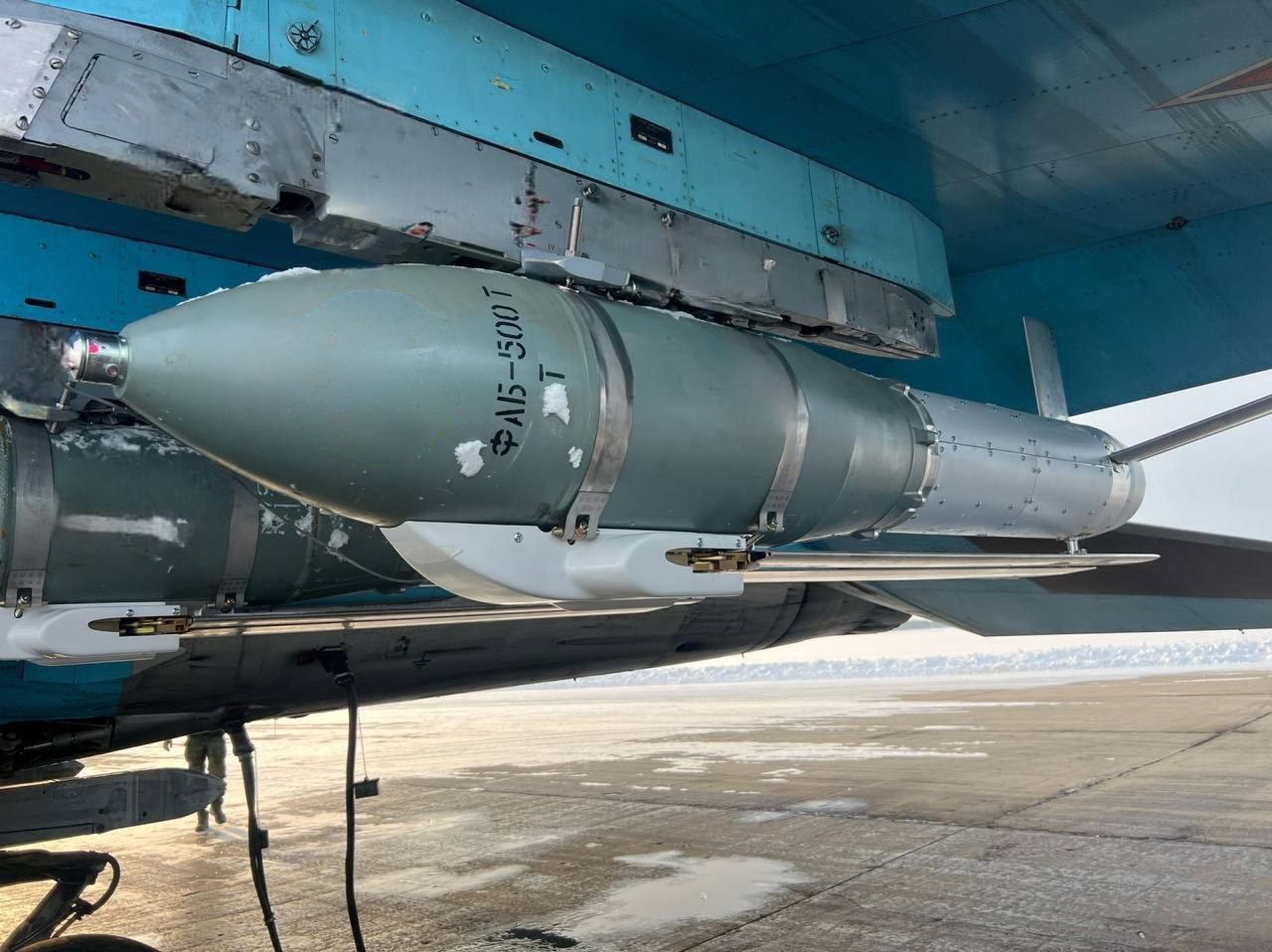
Some reporting describes the UMPB-5 family as a modular system based on an existing aerial bomb, with the UMPB-5 associated with the FAB-250 class. The exact internal arrangement and total mass of the UMPB-5R have not been officially released.
Guidance
Reports about the UMPB-5 family identify a combination of inertial and satellite navigation. The reported components include the SMART navigation system and the Kometa-M12 satellite-navigation module. This arrangement is intended for attacks against fixed targets and allows the weapon to continue toward programmed coordinates after release.
The degree to which the powered UMPB-5R shares every guidance component with the unpowered UMPB-5 has not been independently confirmed. Satellite-navigation performance can also be affected by electronic warfare and signal interference.
Propulsion
The defining feature of the UMPB-5R is its compact jet engine. Recovered fragments from the October 2025 Lozova strike reportedly resembled the Chinese Swiwin SW800Pro, while other reporting identifies the installation as the SW800Pro-Y. The same engine family has also been associated with the Russian S8000 Banderol weapon.
The engine enables the bomb to sustain flight after its initial glide and increases its stand-off range. Ukrainian Defense Intelligence has estimated a maximum range of up to 200 km. This figure is an assessment rather than a publicly verified manufacturer specification.
Launch platform
The weapon is intended for launch by Russian tactical combat aircraft. Reports concerning the UMPB-5 family identify the Sukhoi Su-34 fighter-bomber as the principal carrier. Greater range allows the aircraft to release the weapon farther from the target and potentially remain outside parts of the opposing air-defense network.
Operational history
Russia is the only reported combat user of the UMPB-5R. Its first recorded appearances occurred during Russia's war against Ukraine in 2025.
The October 2025 strike on Lozova provided important physical evidence of the powered configuration. Investigators identified engine-related debris, and the reported flight distance of approximately 130 km exceeded the usual reach attributed to earlier Russian glide-bomb installations.
The July 2026 attacks on Pavlohrad demonstrated a similarly long stand-off distance. However, analysts also identified other Russian weapons capable of reaching the area, including the extended-range UMPK-500 installation and the powered Grom-E1. Attribution of the Pavlohrad strikes to the UMPB-5R therefore remains probable rather than definitive.
Variants
- UMPB-5: Unpowered guided glide munition with revised aerodynamics and a reported maximum glide range of up to 160 km under favorable release conditions.
- UMPB-5R: Powered variant fitted with a compact jet engine. Ukrainian intelligence estimates a maximum range of up to 200 km.
Operators
- Russia: Reported combat user. Russian tactical aircraft, including the Su-34, have been identified as carriers for the UMPB-5 family.
Specifications (UMPB-5R)
General characteristics
- Type: Jet-powered guided glide bomb
- Country of origin: Russia
- Launch method: Air-launched
- Reported carrier: Sukhoi Su-34
- Guidance: Reported inertial and satellite navigation using SMART and Kometa-M12 family components
- Propulsion: Compact jet engine reportedly resembling the Swiwin SW800Pro or SW800Pro-Y
Performance
- Estimated maximum range: Up to 200 km
- Documented reported flight distance: Approximately 130 km during the October 2025 Lozova strike
- Estimated release-to-impact distance: Approximately 150 km in the suspected July 2026 Pavlohrad attacks
Related equipment
- UMPB D-30SN: Earlier Russian multipurpose guided glide munition designed for launch from aircraft and reportedly from ground-based systems.
- UMPK-500: Extended-range glide-and-correction module reported on FAB-500T bombs, with a claimed range exceeding 100 km.
- Grom-E1: Russian powered guided bomb using a propulsion system derived from the Kh-38 missile and reported to have a range of up to 120 km.
 Argentina
 Armenia
 Australia
 Austria
 Austria-Hungary
 Belgium
 Brazil
 United Kingdom
 United States
 Brunei
 Bulgaria
 Canada
 Chile
Chile China
China Colonial America
 Colombia
 Confederate States
 Croatia
 Czech
Czech Denmark
 Egypt
Egypt Finland
 France
 Georgia
 Germany
 German Imperial
 Greece
 Holland
 Hungary
 India
India Indonesia
 Iran
Iran Iraq
Iraq Ireland
 Israel
 Italy
Italy Japan
Japan Japan (1940)
 Jordan
 Kingdom of Italy
 Malaysia
 Mexico
 Myanmar
 Nazi Germany
 Netherlands
 New Zealand
 North Korea
 Norway
 Pakistan
 Peru
Peru Philippines
 Poland
 Portugal
 Prussia
 Romania
 Saudi Arabia
 Serbia
 Singapore
 Slovakia
 Slovenia
 South Africa
 South Korea
 Soviet Union
 Spain
Spain Sweden
 Switzerland
 Syria
Syria Taiwan
 Thailand
 Turkey
 UAE
UAE Ukraine
 Vietnam
 Yugoslavia