

History
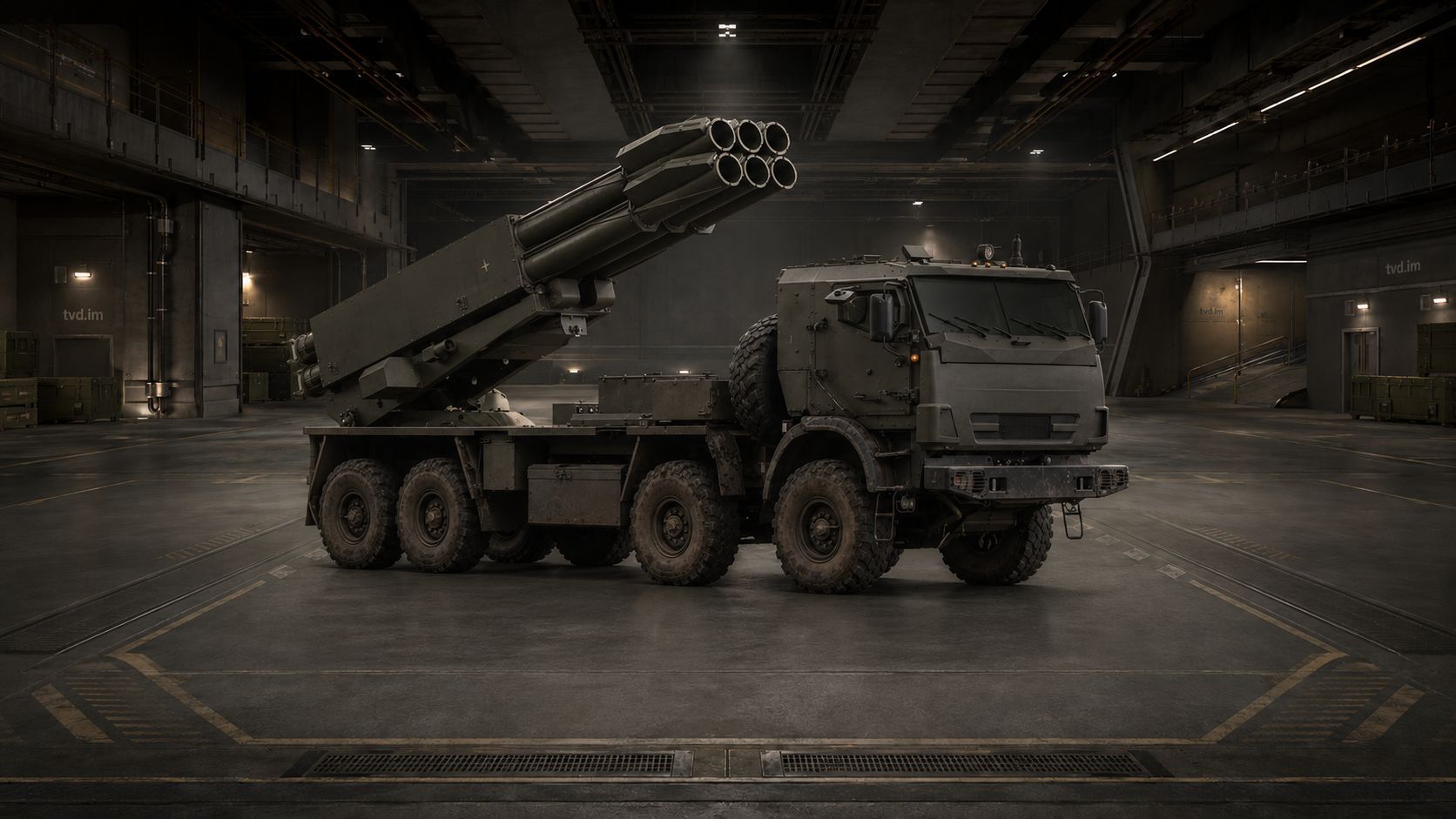
The Motovilikha 9A55E Sarma is a Russian 300 mm multiple launch rocket system developed as a lighter and more mobile alternative to the twelve-tube Smerch and Tornado-S systems. It carries six launch tubes on a protected KamAZ-63501 8×8 chassis.
Sarma is intended to conduct rapid artillery strikes with guided and unguided rockets. Its automated fire-control system allows the crew to prepare and execute a firing mission from inside the cabin or from a remote position.
The design is derived from the earlier 9K58-4 Kama project. The reduced launcher size, wheeled chassis, and short deployment cycle are intended to limit the system's exposure to counter-battery fire and reconnaissance drones.
Development
The 9K58-4 Kama concept was developed during the early 2000s. It combined six 300 mm launch tubes with a wheeled KamAZ chassis, but it did not enter large-scale production. Work on the related Sarma system reportedly began at Motovilikha Plants in 2022. The program was publicly acknowledged in 2023 as a project for a lighter launcher with an automated fire-control system and compatibility with guided ammunition. A detailed development account is available from Army Recognition.
The first publicly identified experimental Sarma vehicle was shown at Motovilikha Plants in September 2025. Published descriptions indicated that it was substantially lighter than the twelve-tube Tornado-S launcher. The vehicle retained the 300 mm calibre but reduced the ready-to-fire ammunition load to six rockets.
Reports differ on the timing of the initial Russian order. Procurement information cited by Ukrainian and specialist defence publications associates the first order with 2024. A later Defense News report stated that the system moved from the prototype stage to procurement in late 2025. Both accounts describe a small initial batch of two divisions, comprising 12 launchers and 12 transport-loading vehicles.
Public presentation
Rosoboronexport presented the export 9A55E Sarma at the World Defense Show in Riyadh in February 2026. The launcher appeared with the 9T265E transport-loading vehicle, an ABSh-2 Atlet command vehicle equipped with the Planshet-A artillery command system, and a Supercam 350 reconnaissance unmanned aircraft. This display presented Sarma as one component of a wider reconnaissance, command, and strike network. Technical information recorded at the exhibition was published by EDR Magazine.
Russian promotional material emphasized a guided-rocket range of 120 km and the ability to receive target coordinates from unmanned aircraft, command posts, or battery-level control systems. A Russian military commentator also described individual GLONASS-assisted guidance for the six rockets, as reported by Voennoe Delo. Some Russian reports have claimed ranges approaching 200 km for future or advanced ammunition, but this capability has not been independently demonstrated and is not included in the confirmed specifications.
Design
Vehicle and crew
The 9A55E launcher uses a KamAZ-63501 four-axle, all-wheel-drive truck. The engine and protected crew cabin are at the front, while the launcher and its elevation and traverse mechanisms occupy the rear. The crew consists of a commander, driver, and launcher operator.
The protected cabin is reported to provide protection against shell fragments and armor-piercing incendiary small-arms ammunition. The crew can receive firing data, calculate a firing solution, aim the launcher, and fire without leaving the cabin. A portable console also permits remote operation from approximately 50–60 m away.
Published mass figures vary between configurations. Reports concerning the Russian demonstrator give a combat weight of approximately 24–25 tonnes. EDR Magazine reported a mass of 28 tonnes for the export 9A55E displayed in Riyadh. The heavier figure is therefore used for the export variant specifications below. A regional account of the system's presentation and reported procurement data is available from Defence Security Asia.
Launcher and fire control
The launcher contains six 300 mm tubes arranged in two rows of three. Reducing the number of tubes from twelve lowers the mass carried by the chassis and produces a more compact system, although it also halves the ready ammunition compared with Smerch and Tornado-S launchers.
The automated fire-control equipment uses the vehicle's navigation data, target coordinates, and selected ammunition type to calculate launcher azimuth and elevation. Target information can be supplied through an artillery command network or by external reconnaissance systems. The launcher can fire individual rockets or a complete salvo.
According to information released for the export model, Sarma can prepare to fire within three minutes after stopping. It can launch all six rockets in 18 seconds and return to its travelling configuration in another three minutes. These timings support short fire missions followed by immediate relocation.
Ammunition
Sarma is designed for Russian 300 mm rocket ammunition associated with the Smerch and Tornado-S families. The available sources identify conventional and guided rockets with high-explosive fragmentation or submunition warheads.
The 9M543 guided rocket has a stated firing range of 30–120 km. It weighs 828 kg and carries a 234 kg high-explosive warhead. The 9M549 displayed with the export launcher has a reported 243 kg warhead intended for targets that include armoured vehicles. Procurement documents also reportedly listed the 9M543L, 9M557, and 9M558, but the supplied evidence does not establish complete specifications for these models.
Operational history
During 2026, specialist reporting described Sarma as entering Russian service in limited numbers. Publicly available information does not establish how many of the reported 12 launchers had been delivered to operational units by that time.
Ukrainian forces reported the first identified combat loss of a Sarma launcher on 22 July 2026 during fighting in the Dobropillia sector. According to the Ukrainian account, Russian forces employed the launcher to support a mechanized attack involving elements of the 8th and 41st Combined Arms Armies and the 90th Tank Division. The vehicle was subsequently struck by a fixed-wing attack drone. The identification and claimed destruction originated from Ukrainian wartime reporting and should be treated as a reported combat event rather than an independently verified loss assessment.
Variants
- Sarma domestic demonstrator: Experimental or initial Russian configuration publicly identified at Motovilikha Plants in September 2025. Published reports place its mass in the 24–25 tonne range.
- 9A55E Sarma: Export launcher presented by Rosoboronexport at the World Defense Show in February 2026. It has six 300 mm launch tubes and a reported combat mass of 28 tonnes.
- 9T265E: Dedicated transport-loading vehicle for the export Sarma system. It uses a similar KamAZ-63501 8×8 chassis and carries replacement rockets and loading equipment.
Operators
- Russia: Reported customer for an initial batch of 12 launchers and 12 transport-loading vehicles. Limited operational use was reported during 2026.
Specifications (9A55E Sarma)
General characteristics
- Type: 300 mm multiple launch rocket system
- Chassis: KamAZ-63501 8×8 wheeled truck
- Crew: 3
- Combat weight: 28,000 kg
- Transport-loading vehicle: 9T265E
Performance
- Maximum road speed: 95 km/h
- Time from stopping to first launch: 3 minutes
- Full-salvo time: 18 seconds
- Time to prepare for movement after firing: 3 minutes
- Remote-control distance: approximately 50–60 m
Armament
- Launcher: 6 × 300 mm launch tubes
- Guided-rocket range: up to 120 km with supported 9M543-class ammunition
- 9M543 rocket: 828 kg launch mass with a 234 kg high-explosive warhead
- 9M549 warhead: 243 kg
Related equipment
- 9K58-4 Kama: Earlier six-tube 300 mm wheeled launcher project from which the Sarma concept was developed.
- 9K58 Smerch: Soviet-designed twelve-tube 300 mm multiple launch rocket system.
- 9K515 Tornado-S: Heavier Russian twelve-tube 300 mm system that shares part of the Sarma ammunition family.
- M142 HIMARS: American mobile rocket artillery system frequently used as a conceptual comparison in Russian and international descriptions of Sarma. The systems use different launcher architectures and ammunition.
 Argentina
 Armenia
 Australia
 Austria
 Austria-Hungary
 Belgium
 Brazil
 United Kingdom
 United States
 Brunei
 Bulgaria
 Canada
 Chile
Chile China
China Colonial America
 Colombia
 Confederate States
 Croatia
 Czech
Czech Denmark
 Egypt
Egypt Finland
 France
 Georgia
 Germany
 German Imperial
 Greece
 Holland
 Hungary
 India
India Indonesia
 Iran
Iran Iraq
Iraq Ireland
 Israel
 Italy
Italy Japan
Japan Japan (1940)
 Jordan
 Kingdom of Italy
 Malaysia
 Mexico
 Myanmar
 Nazi Germany
 Netherlands
 New Zealand
 North Korea
 Norway
 Pakistan
 Peru
Peru Philippines
 Poland
 Portugal
 Prussia
 Romania
 Saudi Arabia
 Serbia
 Singapore
 Slovakia
 Slovenia
 South Africa
 South Korea
 Soviet Union
 Spain
Spain Sweden
 Switzerland
 Syria
Syria Taiwan
 Thailand
 Turkey
 UAE
UAE Ukraine
 Vietnam
 Yugoslavia