
History
The General Atomics Mojave STOL is a short-takeoff-and-landing medium-altitude, long-endurance unmanned aircraft developed by General Atomics Aeronautical Systems. It is a technical demonstrator derived from technology associated with the MQ-1C Gray Eagle and MQ-9 Reaper families and is intended to explore expeditionary operations from short, rough, and otherwise austere surfaces.
Mojave combines long-endurance unmanned-aircraft characteristics with enlarged high-lift wings, ruggedized landing gear, and a 450 hp turboprop engine. Its demonstrated roles include reconnaissance, surveillance, target acquisition, armed missions, maritime operations, and forward deployment from locations that do not provide conventional runway infrastructure.
The aircraft first flew in summer 2021 and was publicly unveiled in December 2021. Subsequent demonstrations progressively tested dirt-strip operations, aircraft-carrier operations, live-fire employment, amphibious-assault-ship launch operations, and recovery and relaunch from a rough battlefield maneuver route.
Development and early flight testing
Development began around 2018 or 2019. An early objective considered vertical takeoff and landing, but the design direction shifted toward STOL performance to avoid the payload and endurance compromises associated with vertical-lift arrangements. The resulting aircraft retained the general Predator-family configuration while receiving a substantially enlarged wing and reinforced landing system.
Mojave completed its first test flight in summer 2021. General Atomics formally unveiled the aircraft on December 9, 2021 as an expeditionary unmanned system intended to combine short-field operation with useful endurance and payload capacity.
Dirt-strip trials
On August 1, 2023, Mojave completed multiple takeoffs and landings from a dirt strip near El Mirage, California. These were the aircraft's first STOL operations on an unimproved dirt surface. Takeoff distances were demonstrated in as little as 179 m, while landings were completed in as little as 102 m. The trials concentrated primarily on obtaining aircraft and terrain data rather than establishing minimum possible distances.
The dirt tests demonstrated the combination of the aircraft's enlarged high-lift wing, 450 hp turbine engine, and ruggedized landing gear. They also showed that Mojave could operate from semi-improved locations without relying on standard airport infrastructure.
Naval demonstrations
On November 15, 2023, Mojave operated from the British aircraft carrier HMS Prince of Wales. The aircraft took off without catapult assistance and recovered aboard the ship without arresting gear. Its departure used an angled path rather than the carrier centerline or ski-jump.
On November 12, 2024, a Mojave-related Gray Eagle STOL demonstrator launched from the Republic of Korea Navy amphibious assault ship ROKS Dokdo. It conducted two simulated landing approaches before continuing to an ashore recovery at Pohang rather than landing back on the ship.
Weapons testing
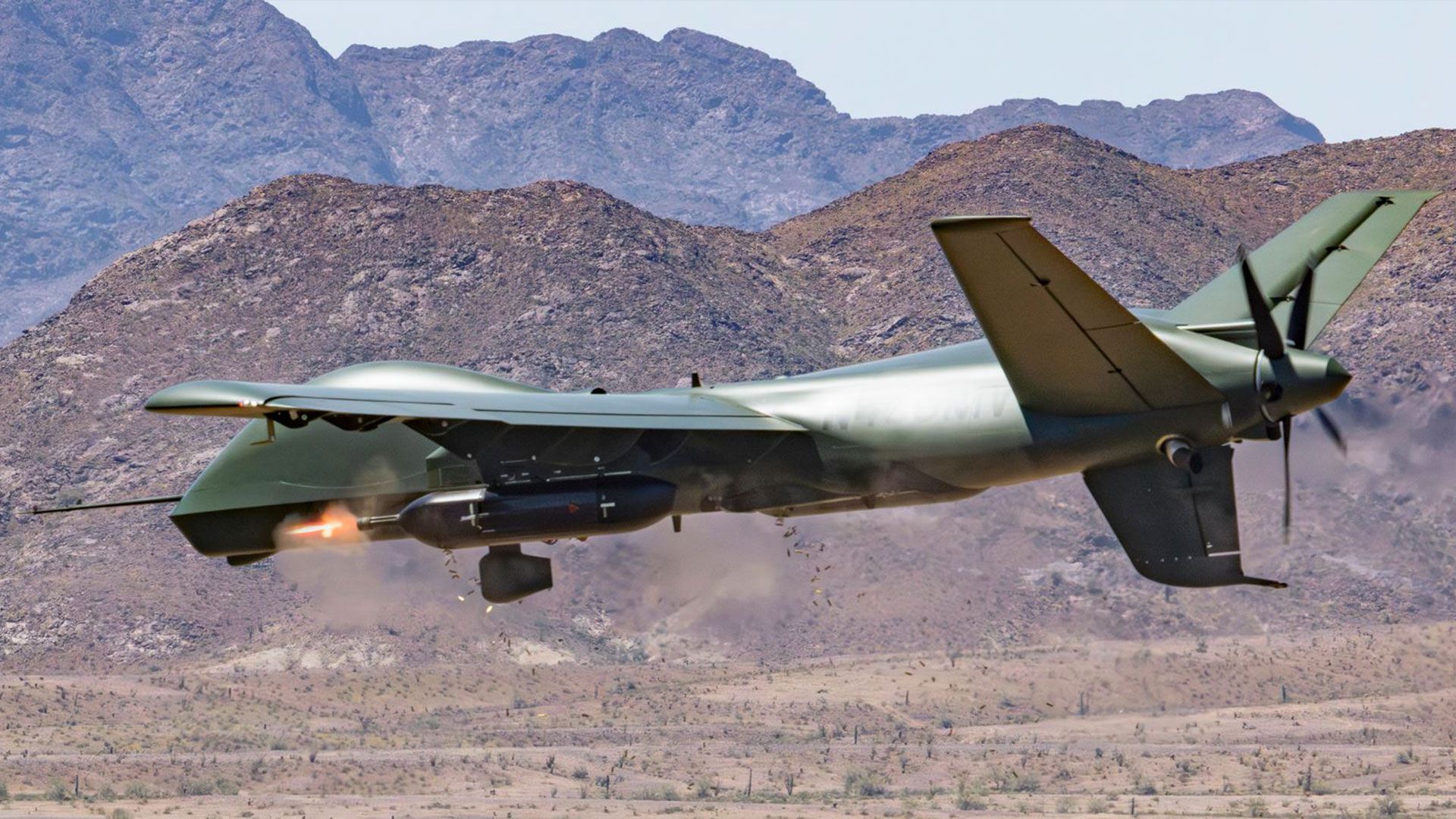
In April 2024, Mojave conducted live-fire testing at Yuma Proving Ground while fitted with two DAP-6 gun pods containing M134D-H miniguns. More than 10,000 rounds were fired against ground targets. The test demonstrated a direct-fire configuration in addition to the aircraft's ability to carry guided weapons and mission sensors.
Battlefield short-field demonstration
On September 16, 2026, General Atomics Aeronautical Systems and Hanwha Aerospace conducted a Mojave STOL demonstration in Pocheon-si, South Korea. The aircraft departed the Republic of Korea Army 513th Aviation Battalion airfield, flew to Seungjin Training Field, and landed on a rough maneuver route used mainly by tanks and artillery vehicles.
Mojave then took off again from the same route, resumed flight operations, and returned to the aviation battalion. It carried dual weapon rails with inert payloads. The aircraft required less than 200 m for takeoff and a landing roll in approximately the 100 m range during the demonstration.
The sortie demonstrated recovery and relaunch from a simulated battlefield operating site rather than merely a short landing. No refueling, live rearming, maintenance turnaround, or published timed ground-servicing cycle formed part of the demonstration.
Design
Airframe and STOL system
Mojave uses a conventional fixed-wing Predator-family arrangement with a low-mounted wing, a bulbous forward fuselage, a rear-mounted pusher propeller, and a Y-tail. Its short-field capability is provided by an enlarged wing equipped with leading-edge slats, double-slotted flaps, and drooping ailerons. These high-lift devices increase lift at low airspeed and reduce the runway distance required for takeoff and landing.
The landing gear is reinforced for rough-surface operation. Large tires, substantial shock absorption, and strengthened landing-gear components allow the aircraft to use dirt strips, semi-improved surfaces, and rough maneuver routes unsuitable for many conventional long-endurance unmanned aircraft.
The aircraft has a wingspan of approximately 16 m and a length of approximately 9 m. Maximum gross weight is 3,175 kg.
Powerplant
Mojave is powered by a 450 hp Rolls-Royce M250 turboprop driving a rear-mounted pusher propeller. The powerplant is combined with the aircraft's enlarged wing to provide the low-speed performance required for STOL operation while retaining long-endurance characteristics.
Avionics and mission systems
The demonstrator applies Modular Open System Approach principles and incorporates modernized avionics, data links, sensor integration, and a compact ground-control system associated with the Gray Eagle 25M program. The aircraft is operated by pilots from ground control stations.
Supported mission equipment includes electro-optical and infrared sensors, synthetic-aperture radar with ground-moving-target indication, electronic intelligence equipment, signals intelligence systems, and communications-relay payloads. The modular arrangement allows payload capacity to be distributed between sensors, weapons, launched effects, or logistical payloads according to mission requirements.
Transportability
Mojave was designed for expeditionary deployment. The aircraft can be disassembled for transport in a C-130-class transport aircraft and subsequently reassembled for operations by a small ground team. This transportability complements its ability to operate from locations without conventional airfield infrastructure.
Armament and external stores
Mojave has seven external stations. Four inboard hardpoints are rated at 295 kg each, two outboard stations at 159 kg each, and the centerline station at 227 kg. Wing loading is limited to 635 kg per wing and 1,270 kg across the wings.
The aircraft can carry up to 16 AGM-114 Hellfire missiles or equivalent stores under suitable loading conditions. Other demonstrated or described payloads include DAP-6 minigun pods, assorted munitions, launched effects, sensors, and logistical resupply pods.
Payload and fuel configuration strongly affect short-field performance and endurance. Published figures therefore represent different operating configurations rather than values that can necessarily be achieved simultaneously.
Program status
Mojave remains a technical demonstrator rather than an operational production fleet. Its flight-test program has been used to validate short-field and expeditionary concepts that are being transferred into a production-oriented STOL aircraft program.
General Atomics Aeronautical Systems and Hanwha Aerospace announced a partnership in 2025 to co-develop and co-produce a production STOL unmanned aircraft for South Korean, United States, and other international customers. A Critical Design Review was expected in November 2026, with first flight of the production aircraft planned for 2027 and first delivery planned for 2028.
The associated production concept combines the STOL operating approach demonstrated by Mojave with Gray Eagle 25M technology. Hanwha has targeted more than 70 percent Korean production content during mass production, while General Atomics retains final integration responsibilities.
Variants
- Mojave STOL: Technical demonstrator used to validate short-field, rough-surface, naval, armed, and expeditionary unmanned-aircraft operations.
- Gray Eagle STOL: Production-oriented development intended to incorporate the STOL concept demonstrated by Mojave with Gray Eagle 25M-related systems. First flight was planned for 2027 and initial delivery for 2028.
Specifications (Mojave STOL demonstrator)
General characteristics
- Length: approximately 9 m.
- Wingspan: approximately 16 m.
- Maximum gross weight: 3,175 kg.
- Useful load: approximately 1,542 kg.
- Powerplant: one Rolls-Royce M250 turboprop, 336 kW (450 hp).
- External stations: seven.
- Maximum wing-store load: 635 kg per wing; 1,270 kg total across both wings.
Performance
- Maximum speed: approximately 259 km/h (140 kt).
- Maximum altitude: approximately 7,620 m (25,000 ft).
- Maximum endurance: more than 25 hours in a suitable configuration.
- Ferry range: approximately 4,630 km (2,500 nmi) with satellite communications support.
- Published ISR takeoff ground roll: approximately 122 m.
- Published takeoff ground roll with 12 Hellfire missiles: approximately 305 m.
- Demonstrated dirt-strip takeoff: 179 m during August 2023 trials.
- Demonstrated dirt-strip landing: 102 m during August 2023 trials.
- 2026 battlefield-route takeoff: less than 200 m with dual weapon rails and inert payloads.
- 2026 battlefield-route landing roll: approximately 100 m with dual weapon rails and inert payloads.
Armament and mission payloads
- Guided weapons: up to 16 AGM-114 Hellfire missiles or equivalent stores under suitable loading conditions.
- Gun armament demonstrated: two DAP-6 pods containing M134D-H miniguns.
- Sensor options: electro-optical/infrared, synthetic-aperture radar/ground-moving-target indication, electronic intelligence, and signals intelligence systems.
- Other payloads: communications-relay equipment, launched effects, assorted munitions, and logistical resupply pods.
Related equipment
- MQ-1C Gray Eagle: A General Atomics unmanned-aircraft family that contributed technology and design lineage to Mojave.
- MQ-9 Reaper: A General Atomics long-endurance unmanned aircraft sharing elements of the broader Predator-family configuration and development heritage.
- Gray Eagle 25M: Modernized Gray Eagle development whose avionics, data links, sensor integration, and control technology are used in the Mojave demonstrator and associated production STOL program.
 Argentina
 Armenia
 Australia
 Austria
 Austria-Hungary
 Belgium
 Brazil
 United Kingdom
 Brunei
 Bulgaria
 Canada
 Chile
Chile China
China Colonial America
 Colombia
 Confederate States
 Croatia
 Czech
Czech Denmark
 Egypt
Egypt Finland
 France
 Georgia
 Germany
 German Imperial
 Greece
 Holland
 Hungary
 India
India Indonesia
 Iran
Iran Iraq
Iraq Ireland
 Israel
 Italy
Italy Japan
Japan Japan (1940)
 Jordan
 Kingdom of Italy
 Malaysia
 Mexico
 Myanmar
 Nazi Germany
 Netherlands
 New Zealand
 North Korea
 Norway
 Pakistan
 Peru
Peru Philippines
 Poland
 Portugal
 Prussia
 Romania
 Russia
 Saudi Arabia
 Serbia
 Singapore
 Slovakia
 Slovenia
 South Africa
 South Korea
 Soviet Union
 Spain
Spain Sweden
 Switzerland
 Syria
Syria Taiwan
 Thailand
 Turkey
 UAE
UAE Ukraine
 Vietnam
 Yugoslavia