History
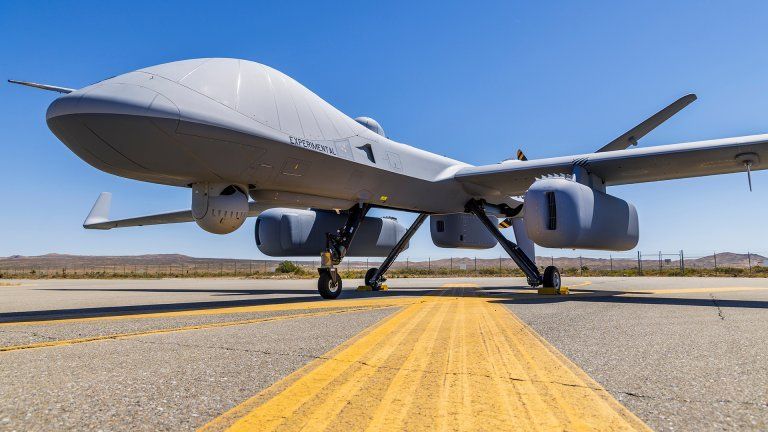
General Atomics Wildfire is a planned medium-altitude, long-endurance unmanned aircraft intended for intelligence, surveillance and reconnaissance and strike missions. General Atomics presented the system in August 2026 as a next-generation successor to the MQ-9 Reaper.
Wildfire was also submitted for the Pentagon Defense Innovation Unit's Massed Modular Aircraft competition, although General Atomics stated that development of the aircraft is not dependent on that program. Public information remained limited at the time of the announcement, and the company had not released images of the aircraft.
The concept was publicly reported on 20 August 2026 by The War Zone, while a subsequent Migflug report also described Wildfire as a new General Atomics MALE unmanned aircraft concept intended to follow the Reaper.
Massed Modular Aircraft competition
The Defense Innovation Unit announced its Massed Modular Aircraft program in July 2026. The program sought a cost-effective, theater-range and modular unmanned aircraft that could be produced and employed in significant numbers while accepting higher levels of combat attrition than more expensive aircraft.
The solicitation called for aircraft capable of carrying at least 1,270 kg (2,800 lb) of sensors and munitions, achieving an unrefueled combat radius of at least 4,260 km (2,300 nmi) with payload, and making a one-way self-deployment flight of at least 14,816 km (8,000 nmi). These figures were requirements of the Pentagon competition rather than confirmed Wildfire specifications.
The MMA requirements also called for a Modular Open Systems Approach to support rapid payload and system changes. Secondary objectives included operation of several aircraft by one pilot, hybrid satellite and mesh-network communications, continued local airfield operations with degraded command-and-control or satellite communications, a true airspeed of at least 370 km/h (200 knots), and operation from runways no longer than 1,829 m (6,000 ft). These requirements likewise do not establish that Wildfire has demonstrated or will necessarily meet each value.
Submissions for the MMA competition closed on 23 July 2026. The program required proposed solutions to be capable of full-scale prototype flight testing within 21 months of an award and targeted an initial operating capability in fiscal year 2031, defined as 20 mission-ready aircraft delivered to an operational unit. General Atomics later confirmed that it had submitted a proposal, but emphasized that Wildfire could proceed independently of the competition.
Public unveiling
General Atomics spokesman C. Mark Brinkley disclosed the Wildfire name and concept in August 2026. The company had not released photographs, drawings or detailed configuration information, preventing independent assessment of the aircraft's dimensions, aerodynamic layout, propulsion system or internal arrangement.
General Atomics described its engineering objectives in terms of substantially greater reach, weapons capacity, cooperative control and data fusion than earlier MALE unmanned aircraft. Brinkley cited goals including a 18,520 km (10,000 nmi) ferry range, carriage of four AGM-158C Long Range Anti-Ship Missiles, semi-autonomous control of as many as 100 aircraft, and fusion of their information into a common operating picture. These statements described development objectives and questions posed to the engineering team, not demonstrated production specifications.
The company also stated that Wildfire could be delivered years earlier than the MMA program's existing schedule. No specific Wildfire prototype, first-flight or production date was disclosed in the available material.
Design
Wildfire is described as a next-generation medium-altitude, long-endurance unmanned aerial system intended for ISR and strike missions. General Atomics has positioned it in the broad mission class occupied by the MQ-9 Reaper while emphasizing longer-range operations, greater weapons capacity, cooperative employment of many aircraft and scalable production.
No confirmed information has been released about the Wildfire airframe layout, dimensions, weight, propulsion system, landing gear, sensor installation or internal payload arrangement. General Atomics had also declined to provide images when the concept was publicly revealed. Consequently, descriptions of a particular planform or propulsion configuration cannot yet be treated as confirmed.
Mission systems and autonomy
General Atomics has discussed semi-autonomous operation of large groups of Wildfire aircraft as a development objective. The stated concept includes control of as many as 100 aircraft and fusion of information collected by the group into a common operating picture. The source material does not establish the number of operators that would be required for such a formation or the degree of autonomy that has been demonstrated.
Because Wildfire was submitted to the MMA competition, it was proposed in the context of Pentagon requirements for modular payload integration, resilient satellite and mesh communications and operation under degraded command-and-control conditions. However, detailed Wildfire-specific implementation of those features has not been publicly described.
Armament concept
General Atomics identified carriage of four AGM-158C Long Range Anti-Ship Missiles as one of the capability goals considered during Wildfire's development. This indicates an intended capacity for heavy long-range strike weapons, but the company did not disclose weapon stations, payload limits or a confirmed integrated armament list. The four-missile figure therefore remains a stated design objective rather than a demonstrated operational load.
Program status
As of August 2026, Wildfire was a General Atomics unmanned aircraft concept rather than an established production or operational type. The company had submitted it for the Defense Innovation Unit's Massed Modular Aircraft competition but stated that the aircraft was not dependent on the MMA program.
The MMA program targeted initial operating capability in fiscal year 2031. General Atomics said Wildfire could be delivered years before that schedule, but no exact Wildfire prototype, first-flight, production or service-entry year was provided. The 2031 date therefore represents the publicly stated MMA program target associated with the competition in which Wildfire was entered, not a confirmed Wildfire service-entry date.
Specifications (Wildfire concept)
General characteristics
- Type: medium-altitude, long-endurance unmanned aerial system.
- Primary roles: intelligence, surveillance and reconnaissance and strike.
- Development status: concept under development as of August 2026.
Proposed capabilities
- Ferry range objective: 18,520 km (10,000 nmi).
- Heavy weapon carriage objective: four AGM-158C Long Range Anti-Ship Missiles.
- Cooperative-control objective: semi-autonomous employment of up to 100 aircraft.
- Data-management objective: fusion of information from multiple aircraft into a common operating picture.
The figures above were presented by General Atomics as engineering goals for Wildfire. They had not been published as demonstrated performance specifications when the system was announced.
Related equipment
- General Atomics MQ-9 Reaper: the established MALE unmanned ISR and strike aircraft that Wildfire is intended to succeed.
 Argentina
 Armenia
 Australia
 Austria
 Austria-Hungary
 Belgium
 Brazil
 United Kingdom
 United States
 Brunei
 Bulgaria
 Canada
 Chile
Chile China
China Colonial America
 Colombia
 Confederate States
 Croatia
 Czech
Czech Denmark
 Egypt
Egypt Finland
 France
 Georgia
 Germany
 German Imperial
 Greece
 Holland
 Hungary
 India
India Indonesia
 Iran
Iran Iraq
Iraq Ireland
 Israel
 Italy
Italy Japan
Japan Japan (1940)
 Jordan
 Kingdom of Italy
 Malaysia
 Mexico
 Myanmar
 Nazi Germany
 Netherlands
 New Zealand
 North Korea
 Norway
 Pakistan
 Peru
Peru Philippines
 Poland
 Portugal
 Prussia
 Romania
 Russia
 Saudi Arabia
 Serbia
 Singapore
 Slovakia
 Slovenia
 South Africa
 South Korea
 Soviet Union
 Spain
Spain Sweden
 Switzerland
 Syria
Syria Taiwan
 Thailand
 Turkey
 UAE
UAE Ukraine
 Vietnam
 Yugoslavia