
History
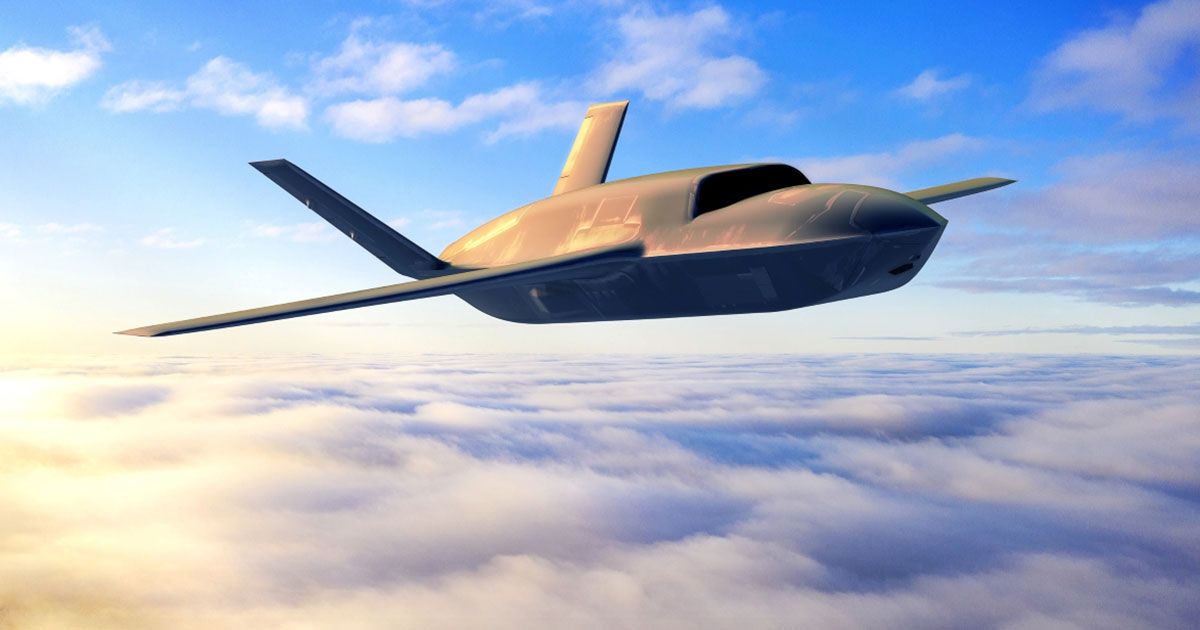
The General Atomics FQ-42A is a purpose-built uncrewed fighter developed for the U.S. Air Force Collaborative Combat Aircraft program. It is intended to operate with crewed aircraft and add combat capacity without placing an aircrew aboard the platform.
The aircraft combines a modular air vehicle with mission-autonomy software designed for human-machine teaming. Its configuration can accept different mission systems as operational requirements and software capabilities evolve.
The FQ-42A entered production after an accelerated prototype and flight-test program. Full-scale manufacturing was underway by July 2026, although the aircraft had not yet entered operational service.
Development
General Atomics Aeronautical Systems developed the aircraft using experience from its Gambit family and the XQ-67A Off-Board Sensing Station demonstrator. The common-core approach was created to support multiple mission configurations without requiring a completely separate airframe development program for each role.
In April 2024, the U.S. Air Force selected General Atomics to build production-representative aircraft for Increment 1 of the Collaborative Combat Aircraft program. The prototype carried the YFQ-42A designation, in which the Y prefix identified its prototype status.
Flight testing
The YFQ-42A completed its maiden flight in August 2025, approximately 15 months after the development contract award. The milestone demonstrated the rapid-development approach used for the program.
On April 6, 2026, a YFQ-42A was lost in an accident shortly after takeoff. No one was injured. A joint General Atomics and Air Force review attributed the accident to an autopilot calculation error involving the aircraft's weight and center of gravity. Flight testing was paused while the software was corrected, but ground testing and other risk-reduction work continued.
General Atomics announced on May 21, 2026, that the prototype had returned to flight following safety reviews and approval of the software changes. Further details are available in the company's flight-test statement.
Production
On June 17, 2026, General Atomics received an initial U.S. Air Force production contract for the FQ-42A. The removal of the Y prefix distinguished the forthcoming production aircraft from the YFQ-42A prototypes. General Atomics stated that manufacturing was already underway when it announced the production contract.
In July 2026, FQ-42A and competing FQ-44A aircraft participated in Collaborative Combat Aircraft activities at Creech Air Force Base, Nevada. These sorties were conducted by the Experimental Operations Unit to evaluate operations, integration with crewed aircraft and requirements for future employment. On July 28, General Atomics confirmed that full-scale FQ-42A manufacturing was underway. Independent reporting also described the transition to serial production.
Design
The FQ-42A is a jet-powered aircraft with no onboard crew. It was developed as a semi-autonomous fighter rather than as a remotely piloted adaptation of an existing crewed aircraft. Public descriptions emphasize collaborative operation with crewed platforms in complex combat environments.
Airframe and mission systems
The aircraft uses a modular design that permits the integration of different mission systems and payload-related equipment. General Atomics describes this as a common-core approach that can be adapted for mission sets including surveillance, air-to-air operations and air-to-ground strike.
Detailed dimensions, weights, engine data, payload capacity and performance figures have not been officially released. Published estimates should therefore not be treated as confirmed FQ-42A specifications.
Autonomy and control
Mission-autonomy software is intended to help the aircraft execute assigned tasks and cooperate with other platforms. The software architecture has been demonstrated through live flight testing on multiple General Atomics airframes.
Semi-autonomous operation does not mean that the aircraft independently determines when to use weapons. The broader Collaborative Combat Aircraft concept retains human command authority, including human authorization for weapon employment.
The U.S. Air Force is developing autonomy software separately from the competing air vehicles and requires compatibility with its government-owned autonomy reference architecture. This arrangement is intended to permit software updates and the integration of different autonomy packages throughout the aircraft's development and service life.
Program status
As of July 2026, the FQ-42A was in full-scale manufacturing under an initial U.S. Air Force production contract. Flight testing, systems evaluation and operational experimentation continued in parallel. The available sources do not confirm operational service, delivered production quantities or a declared initial operational capability.
The FQ-42A forms part of the first increment of the U.S. Air Force Collaborative Combat Aircraft program. The wider program is intended to increase the number and distribution of sensors, weapons and other mission capabilities available to commanders while allowing crewed aircraft to remain central to decisions requiring direct human judgment.
Variants
- YFQ-42A: Production-representative prototype and flight-test version. It first flew in August 2025.
- FQ-42A: Production version ordered by the U.S. Air Force in June 2026. Full-scale manufacturing was underway by July 2026.
Operators
- United States Air Force: Development partner and initial production customer. The aircraft remained in testing and production rather than confirmed operational service as of July 2026.
Specifications (FQ-42A)
General characteristics
- Type: Collaborative Combat Aircraft and purpose-built uncrewed fighter
- Crew: No onboard crew
- Propulsion: Jet propulsion; the engine model and official performance data have not been publicly disclosed
- Control: Semi-autonomous operation under human command authority
- Architecture: Modular air vehicle supporting replaceable mission systems and mission-autonomy software
Mission roles
- Confirmed design scope: Human-machine teaming with crewed combat aircraft
- Adaptable mission sets: Surveillance, air-to-air operations and air-to-ground strike configurations described within the General Atomics common-core concept
Related equipment
- XQ-67A: General Atomics and U.S. Air Force Research Laboratory demonstrator that served as a flying precursor to the FQ-42A concept.
- FQ-44A: Competing Collaborative Combat Aircraft selected alongside the FQ-42A for the U.S. Air Force Increment 1 program.
 Argentina
 Armenia
 Australia
 Austria
 Austria-Hungary
 Belgium
 Brazil
 United Kingdom
 Brunei
 Bulgaria
 Canada
 Chile
Chile China
China Colonial America
 Colombia
 Confederate States
 Croatia
 Czech
Czech Denmark
 Egypt
Egypt Finland
 France
 Georgia
 Germany
 German Imperial
 Greece
 Holland
 Hungary
 India
India Indonesia
 Iran
Iran Iraq
Iraq Ireland
 Israel
 Italy
Italy Japan
Japan Japan (1940)
 Jordan
 Kingdom of Italy
 Malaysia
 Mexico
 Myanmar
 Nazi Germany
 Netherlands
 New Zealand
 North Korea
 Norway
 Pakistan
 Peru
Peru Philippines
 Poland
 Portugal
 Prussia
 Romania
 Russia
 Saudi Arabia
 Serbia
 Singapore
 Slovakia
 Slovenia
 South Africa
 South Korea
 Soviet Union
 Spain
Spain Sweden
 Switzerland
 Syria
Syria Taiwan
 Thailand
 Turkey
 UAE
UAE Ukraine
 Vietnam
 Yugoslavia