
History
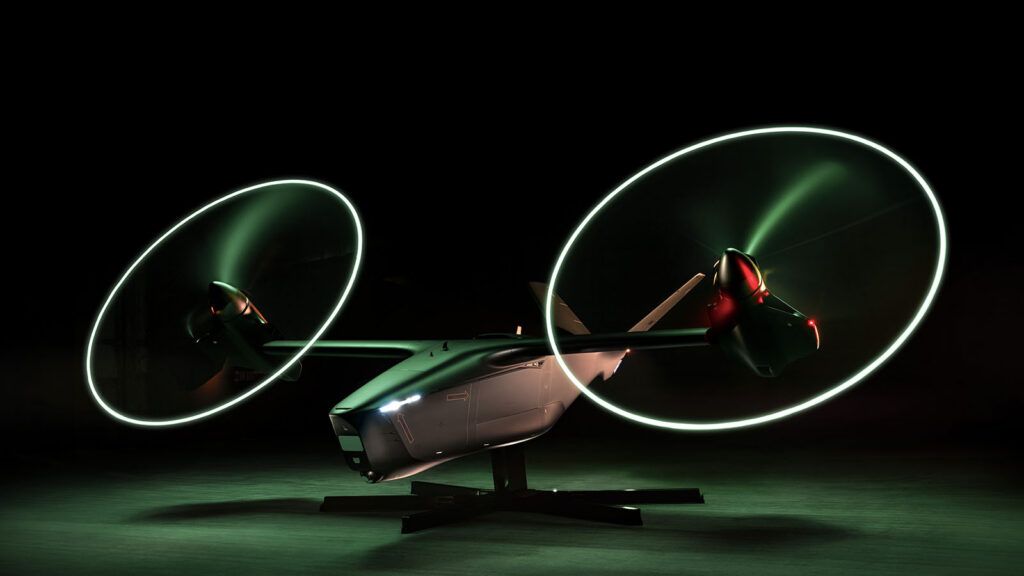
The Anduril Thunder is a Group 5 autonomous attack rotorcraft developed by Anduril Industries with Archer Aviation. It is intended to operate independently, in autonomous formations, or alongside current and future crewed attack and assault aircraft.
Thunder combines vertical takeoff and landing with wing-borne cruise through a tiltrotor configuration. Its planned roles include armed reconnaissance, precision strike, fire support, intelligence, surveillance and reconnaissance, maritime patrol, anti-submarine warfare, search and rescue, electronic warfare, and contested logistics.
The aircraft remains under development. Anduril has completed test flights with full-scale surrogate aircraft, while the first flight of Thunder itself is planned for 2027.
Development began several years before the aircraft's public presentation. Anduril applied experience from its YFQ-44A Fury collaborative combat aircraft program, while Archer contributed technology developed for commercial electric vertical takeoff and landing aircraft. The resulting defense-specific platform shares a dual-use technological baseline intended to support broader supply chains and future large-scale manufacturing.
Anduril publicly unveiled Thunder on 20 July 2026 during the Farnborough International Airshow. The company presented the aircraft as an autonomous teammate capable of carrying sensors, weapons, defensive effectors, or cargo into areas where crewed helicopters would face significant risks from air defenses, loitering munitions, electronic warfare, and persistent surveillance.
The operational concept places several Thunder aircraft alongside a crewed platform such as the AH-64 Apache. Anduril stated that pairing three Thunder aircraft with each Apache could provide three times the available munitions without adding more aircrews. This remains a proposed employment model rather than a demonstrated operational capability.
According to the official Thunder announcement, full-scale surrogate aircraft have already completed multiple test flights. Anduril also tested relevant autonomy software on surrogate aircraft before unveiling the design. The company plans the first flight of the actual Thunder aircraft for 2027. Production is targeted for approximately 2029–2030, depending on demand from the United States military and partner nations.
Design
Configuration
Thunder is an uncrewed tiltrotor aircraft designed for vertical takeoff and landing from austere sites. After takeoff, its rotors tilt for efficient wing-borne cruise. This arrangement is intended to combine runway independence with greater range and cruise efficiency than a conventional rotorcraft.
The aircraft uses a modular open architecture. Internal main and nose payload bays allow mission equipment to be changed without creating separate specialized airframes. The platform can also be disassembled and packed into a standard 40-foot ISO shipping container for transport by air, road, rail, or sea.
Powerplant
A series hybrid-electric powertrain supplies the propulsion system. The design uses Optimum-Speed Tiltrotors, which vary rotor speed according to the flight regime. Higher rotor speeds support vertical flight, while reduced rotor speed during cruise is intended to lower power demand, fuel consumption, and acoustic signature.
Autonomy and sensors
Thunder uses Anduril's Lattice for Mission Autonomy software. The system translates high-level operator intent into route, timing, tasking, formation, and deconfliction decisions. It is intended to remove the need for a pilot in a crewed aircraft to control Thunder continuously with conventional flight commands.
The planned perception system combines passive and selectively active sensors with computer vision, map data, and onboard edge computing. Visual navigation, inertial positioning, and terrain-feature mapping are intended to support low-altitude flight when satellite navigation, visibility, or communications are degraded or denied.
Lattice is also intended to combine sensor, threat, and mission information from connected aircraft into a common tactical picture. Thunder aircraft would use this information to maintain formation separation, share observations, coordinate tasks, and respond to the intent of crews in accompanying aircraft.
Payload and armament
The internal main payload module can be configured for different weapons or mission equipment. Publicly presented examples include ten air-to-ground missiles, sixteen air-launched effects, or seventy-six 70 mm rockets. These are alternative main-bay configurations rather than a single combined load.
Named missile options include the AGM-114 Hellfire, AGM-179 Joint Air-to-Ground Missile, and Anduril Barracuda-100M. The air-launched-effects configuration can accommodate systems such as the Altius-600. A separate nose module can carry up to twelve counter-unmanned-aircraft effectors in addition to the selected main payload.
The bays are also intended to accept electronic-warfare equipment, reconnaissance sensors, communications systems, maritime mission equipment, and cargo. The precise equipment would depend on the mission and any future customer requirements.
Program status
As of August 2026, Thunder is a development program rather than an operational military aircraft. No production contract, unit price, confirmed order, or operator has been announced.
Testing before the unveiling used full-scale surrogate aircraft and associated autonomy software. The planned 2027 first flight will be the first physical flight milestone publicly scheduled for Thunder itself. According to reporting by Breaking Defense, Anduril expects possible production during 2029–2030, but the schedule depends on military demand and successful development.
Specifications (Thunder)
General characteristics
- Type: Group 5 autonomous attack rotorcraft
- Manufacturer: Anduril Industries, in partnership with Archer Aviation
- Configuration: Tiltrotor vertical takeoff and landing aircraft
- Crew: Uncrewed autonomous operation
- Powerplant: Series hybrid-electric propulsion system
- Rotor system: Optimum-Speed Tiltrotors with variable rotor speed
- Payload accommodation: Modular internal main payload bay and nose payload module
- Transport: Configurable for carriage inside a standard 40-foot ISO shipping container
Mission systems
- Autonomy: Lattice for Mission Autonomy
- Navigation: Visual navigation, inertial positioning, terrain-feature mapping, and map-based navigation
- Perception: Passive and selectively active sensors, onboard computer vision, and edge computing
- Planned roles: Attack, armed reconnaissance, fire support, ISR, air-launched-effects deployment, electronic warfare, maritime patrol, anti-submarine warfare, counter-UAS protection, search and rescue, and contested logistics
Armament
- Air-to-ground missiles: Up to 10 Hellfire, JAGM, Barracuda-100M, or comparable weapons in a compatible configuration
- Air-launched effects: Up to 16 systems such as Altius-600 in an alternative main-bay configuration
- Rockets: Up to 76 70 mm rockets in an alternative main-bay configuration
- Counter-UAS effectors: Up to 12 in the nose payload module
 Argentina
 Armenia
 Australia
 Austria
 Austria-Hungary
 Belgium
 Brazil
 United Kingdom
 Brunei
 Bulgaria
 Canada
 Chile
Chile China
China Colonial America
 Colombia
 Confederate States
 Croatia
 Czech
Czech Denmark
 Egypt
Egypt Finland
 France
 Georgia
 Germany
 German Imperial
 Greece
 Holland
 Hungary
 India
India Indonesia
 Iran
Iran Iraq
Iraq Ireland
 Israel
 Italy
Italy Japan
Japan Japan (1940)
 Jordan
 Kingdom of Italy
 Malaysia
 Mexico
 Myanmar
 Nazi Germany
 Netherlands
 New Zealand
 North Korea
 Norway
 Pakistan
 Peru
Peru Philippines
 Poland
 Portugal
 Prussia
 Romania
 Russia
 Saudi Arabia
 Serbia
 Singapore
 Slovakia
 Slovenia
 South Africa
 South Korea
 Soviet Union
 Spain
Spain Sweden
 Switzerland
 Syria
Syria Taiwan
 Thailand
 Turkey
 UAE
UAE Ukraine
 Vietnam
 Yugoslavia