
History
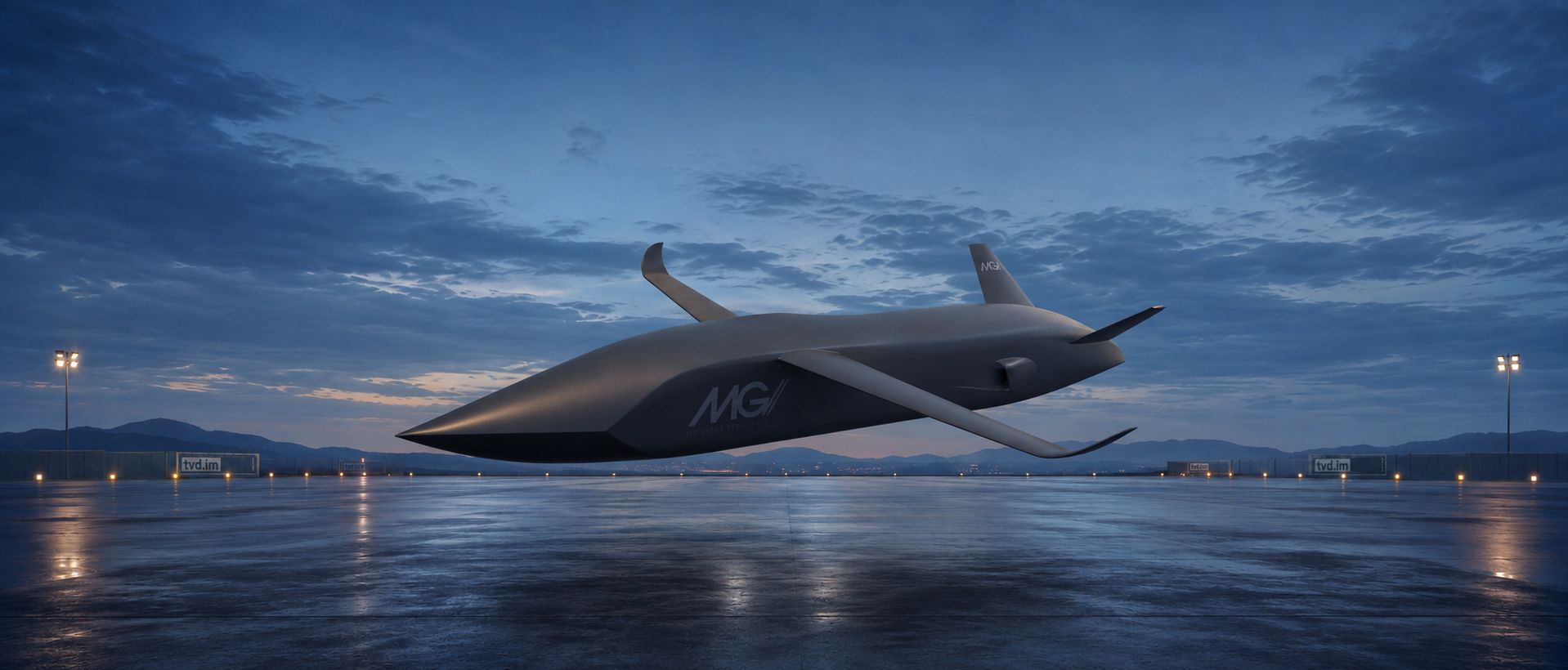
The MGI Engineering TigerShark is a British high-speed autonomous one-way strike drone intended for precision attacks against distant, high-value targets. It combines a modular payload bay with navigation designed for operation when satellite signals or communications are unavailable.
TigerShark is designed to provide performance similar to a cruise missile at a lower stated cost. The reusable elements of conventional aircraft are omitted because the vehicle is not intended to return after completing its mission.
MGI Engineering was founded in 2003 by former Formula 1 designer Mike Gascoyne. The Oxfordshire company applied experience in rapid prototyping, lightweight structures, composites, aerospace engineering, and Formula 1 development methods to its defence work.
MGI unveiled TigerShark at the DSEI exhibition in London in 2025. The company presented it as the larger member of a two-tier autonomous strike family following the introduction of the smaller SkyShark tactical drone. Contemporary reporting stated that TigerShark would become available to MGI partners from October 2025.
MGI and Auterion completed the initial TigerShark flight tests in the United Kingdom in 2026. Auterion supplied its autonomous flight-control technology, including Skynode hardware. The tests demonstrated a jet-powered Group 4 uncrewed aircraft able to operate without continuous control and in environments where Global Navigation Satellite System signals are denied.
In June 2026, MGI displayed TigerShark to the British Ministry of Defence during an event associated with Project Brakestop, a programme intended to accelerate a sovereign deep-strike capability. Phase 2 contracts had been awarded, and MGI was planning to expand production during the fourth quarter of 2026 and into 2027. These dates described planned production growth rather than confirmed operational service. Further information is available from the MGI TigerShark page and the published production-planning report.
Design
Airframe and launch
TigerShark is a jet-powered uncrewed aircraft with an empty mass of 170 kg and a maximum take-off weight of 800 kg. It can be launched from the ground with rocket-assisted take-off equipment or deployed from vehicle-based launch systems. The launch arrangement supports salvo firing, in which several vehicles can be dispatched in a short period.
Payload system
The modular payload bay accepts loads between 200 and 300 kg. Reported payload options include high-explosive warheads, electronic-warfare equipment, and decoys. Its open architecture is intended to support third-party payloads, sensors, software, and later upgrades without redesigning the complete vehicle.
Guidance and autonomy
The guidance system combines inertial navigation with terrain-mapping technology and onboard edge computing. It is designed to continue its mission in GNSS-denied or spoofed environments and without a real-time communications link. Auterion's software-defined architecture provides autonomous flight and mission execution.
Performance
MGI lists a cruise speed of 650 km/h and a maximum speed of 750 km/h. The manufacturer states a range of 550 km while carrying the maximum payload at maximum speed, increasing to 900 km with the maximum payload at cruise speed.
Other published accounts have given different range figures. The 2025 DSEI report described a range of more than 750 km, while reports following the initial flight tests stated that the vehicle could exceed 1,000 km. These figures may represent different flight profiles or development configurations, but the available sources do not explain the difference. The manufacturer's configuration-specific figures are therefore used in the specifications below. Details of the initial tests were reported in the first-flight test report.
Program status
By June 2026, TigerShark had completed initial flight testing and was undergoing production planning connected with Project Brakestop. MGI was targeting a production scale-up beginning in the fourth quarter of 2026 and continuing into 2027. The supplied sources do not identify an operational unit, confirmed production quantity, or formal service-entry date.
Specifications (TigerShark)
General characteristics
- Type: Autonomous one-way deep-strike drone
- Empty mass: 170 kg (375 lb)
- Maximum take-off weight: 800 kg (1,764 lb)
- Payload: 200–300 kg (441–661 lb)
- Launch methods: Ground launch using rocket-assisted take-off or launch from a vehicle platform
Performance
- Cruise speed: 650 km/h (404 mph)
- Maximum speed: 750 km/h (466 mph)
- Range at maximum payload and maximum speed: 550 km (342 mi)
- Range at maximum payload and cruise speed: 900 km (559 mi)
Mission equipment
- Navigation: Inertial navigation and GPS-free terrain mapping
- Mission control: Autonomous, software-defined flight-control architecture
- Payload options: Modular strike, electronic-warfare, and decoy payloads
Related equipment
- MGI SkyShark: A smaller tactical autonomous strike drone with a reported 20 kg payload, introduced before TigerShark as the short-to-medium-range member of MGI's strike-drone family.
 Argentina
 Armenia
 Australia
 Austria
 Austria-Hungary
 Belgium
 Brazil
 United States
 Brunei
 Bulgaria
 Canada
 Chile
Chile China
China Colonial America
 Colombia
 Confederate States
 Croatia
 Czech
Czech Denmark
 Egypt
Egypt Finland
 France
 Georgia
 Germany
 German Imperial
 Greece
 Holland
 Hungary
 India
India Indonesia
 Iran
Iran Iraq
Iraq Ireland
 Israel
 Italy
Italy Japan
Japan Japan (1940)
 Jordan
 Kingdom of Italy
 Malaysia
 Mexico
 Myanmar
 Nazi Germany
 Netherlands
 New Zealand
 North Korea
 Norway
 Pakistan
 Peru
Peru Philippines
 Poland
 Portugal
 Prussia
 Romania
 Russia
 Saudi Arabia
 Serbia
 Singapore
 Slovakia
 Slovenia
 South Africa
 South Korea
 Soviet Union
 Spain
Spain Sweden
 Switzerland
 Syria
Syria Taiwan
 Thailand
 Turkey
 UAE
UAE Ukraine
 Vietnam
 Yugoslavia