
History
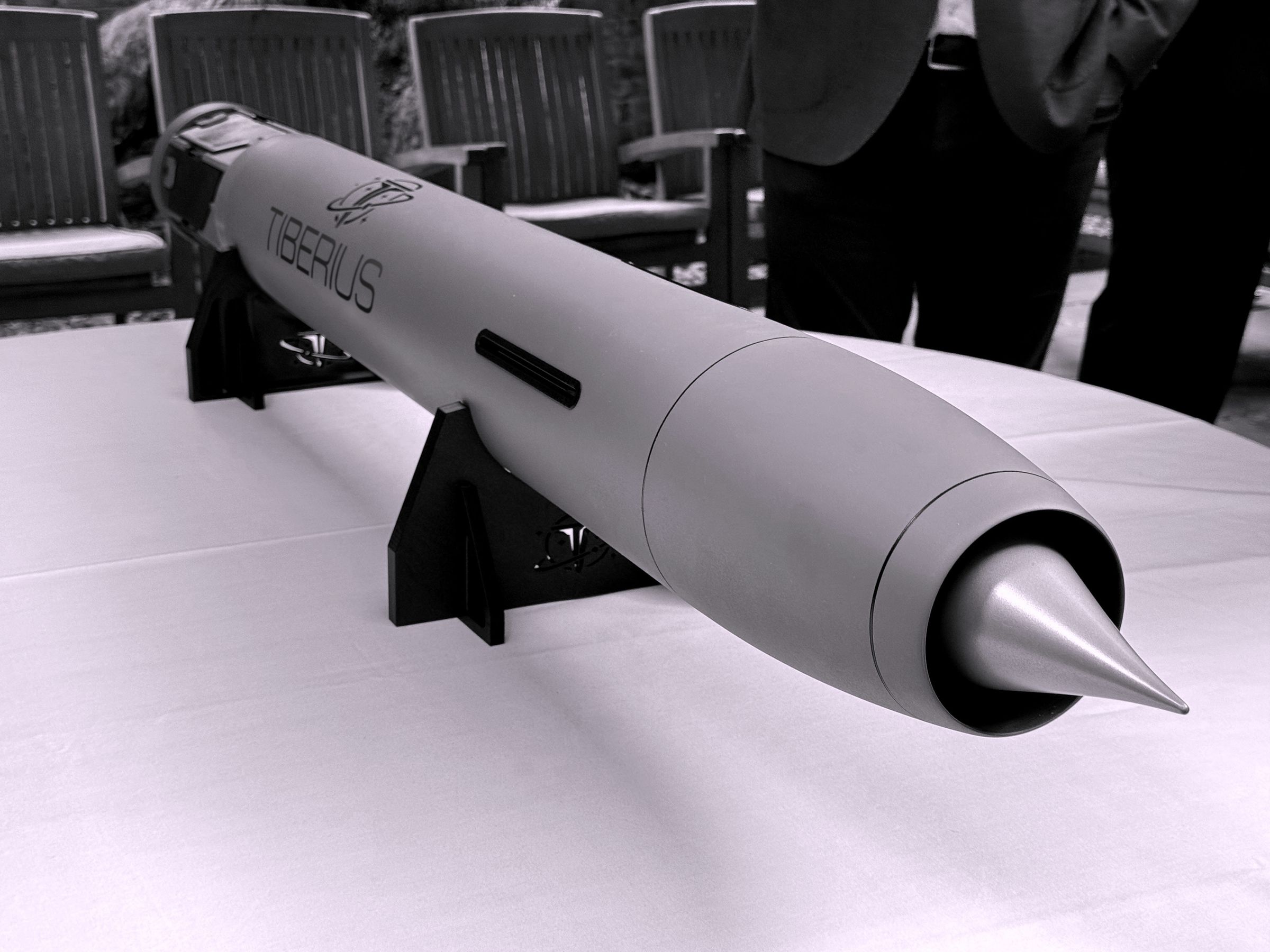
The Tiberius Aerospace Sceptre is a developmental 155 mm precision-guided artillery projectile powered by a liquid-fueled ramjet. It is intended to give NATO-standard howitzers a precision-strike range of up to 150 km without requiring a dedicated missile launcher.
Tiberius describes Sceptre as a lower-cost weapon for hardened and other high-value targets. Its planned capabilities include a speed of approximately Mach 3.5, flight above 19,800 m (65,000 ft), and accuracy within 5 m in environments where satellite navigation is degraded or unavailable.
The projectile remained under development in August 2026. Its ramjet had been ignited successfully after launch from a howitzer, but full-range guided performance, accuracy, repeatable manufacture, and operational integration had not yet been demonstrated publicly.
Development and unveiling
Tiberius Aerospace was founded in 2022 and developed Sceptre as its first publicly announced product. The company unveiled the projectile in May 2025. At that time, test firings using an M777 155 mm howitzer were already under way in the United States. The initial program examined obturation, stabilization, and survival of the projectile and its electronics under the acceleration produced by gun launch.
The company initially targeted production deployment by the end of 2025. Available sources do not confirm that this target was achieved. A detailed contemporary description of the initial configuration and development plans was published by Calibre Defence.
In September 2025, the British Ministry of Defence awarded Tiberius a contract for development and rapid trials. The company identified the ministry as the intended launch customer and stated that the United States Defense Innovation Unit would facilitate independent verification and validation.
Ramjet testing
In April 2026, Sceptre was fired from a NATO-standard 155 mm howitzer at a test site in New Mexico. The liquid-fueled ramjet ignited after launch, while the projectile deployed its fins and maintained stable aerodynamic flight. Reports placed the launch acceleration between approximately 16,000 and 18,000 g. This was an important engineering demonstration because the propulsion, guidance electronics, fuel system, and structural components must survive the severe acceleration and vibration of artillery launch.
The April firing did not constitute a complete demonstration of the claimed 150 km range or terminal accuracy. Tiberius stated that subsequent work would require a substantially larger test range. Conventional artillery ranges generally cannot accommodate the missile-like distance and altitude planned for Sceptre. Further details of the ignition test were reported by Calibre Defence and Army Recognition.
United States Army cooperation
In August 2026, Tiberius entered a Cooperative Research and Development Agreement with the United States Army Combat Capabilities Development Command Armaments Center. The agreement created a framework for joint research and technical work on the projectile. It was not a procurement contract and did not establish Sceptre as an Army program of record.
The agreement supported continued maturation of the propulsion, guidance, and software technologies. Contemporary accounts from Military.com and Army Technology emphasized that decisive full-range and accuracy trials still remained ahead.
Design
Projectile configuration
Sceptre is a 155 mm gun-launched projectile designed for existing NATO-standard artillery systems. It has a reported launch mass of 47.5 kg and a length of 1.55 m. A standard artillery propelling charge accelerates it to the speed required for the ramjet to begin operating. The design uses limited contact points inside the barrel, which Tiberius says reduces barrel wear.
The projectile has forward control surfaces and deployable stabilization surfaces for controlled flight. Its modular, open architecture is intended to permit changes to the payload, guidance hardware, and software. Tiberius has also proposed adding a seeker for moving targets, but this has not been presented as a demonstrated capability.
Liquid-fueled ramjet
A ramjet has no compressor driven by a turbine. Instead, the projectile's forward speed compresses incoming air before fuel is mixed with it and burned. The artillery charge therefore provides the initial acceleration, while the ramjet supplies continuing thrust after launch.
Sceptre carries approximately 7 liters of liquid fuel in an internal bladder. Pressurized air squeezes fuel from the bladder, avoiding a mechanical pump that would have to withstand the shock of launch. The engine is designed to use diesel, Jet A, JP-4, JP-8, and other commonly available aviation fuels. The projectile is intended to be fueled in the field shortly before firing.
Separating the liquid fuel from the stored projectile is claimed to support a shelf life of up to 20 years. It also permits the ammunition to use fuels already present in military supply systems. These storage and service-life claims remain subject to qualification.
Guidance and control
The planned guidance system combines satellite navigation with an inertial measurement unit. Tiberius states that onboard software uses position-error correction to maintain accuracy when satellite signals are degraded or denied. The fire-control interface is intended to support integration with third-party systems through an open application programming interface.
The company has also described an optional ability for multiple projectiles to exchange information during flight and refine their navigation solution. Public sources do not establish that this feature has been demonstrated. The reported accuracy objective is a circular error probable of approximately 3.5 to 5 m.
Payload and target set
Sceptre can carry a payload of up to 5.2 kg, depending on the range configuration. Published descriptions mention conventional TNT, fragmentation sleeves, and a tungsten core intended to improve penetration. The projectile can use existing 155 mm fuzes.
The relatively small payload reflects the space required for propulsion, fuel, guidance, and control equipment. Tiberius therefore positions Sceptre for precision attacks against tanks, radar and air-defense equipment, command vehicles, fuel depots, rail infrastructure, and other high-value targets rather than for conventional area bombardment.
Manufacturing concept
Tiberius plans to retain and update the design while licensing approved governments or companies to manufacture Sceptre domestically. Initial test articles were produced through a network of more than 20 suppliers using processes that included additive manufacturing and standard computer-controlled machining.
In May 2025, the company quoted an all-up projectile cost of $52,000 excluding payload and fuel, with a volume-production target of $42,000. These figures were company estimates rather than confirmed procurement prices. Tiberius also stated that it would place manufacturing, quality-control, and testing engineers at licensed facilities and periodically test production rounds.
Program status
As of August 2026, Sceptre was a developmental munition rather than an operational weapon. The United Kingdom was identified as the intended launch customer, while the United States Army relationship was limited to research and development under the CRADA framework. No confirmed production quantity, service-entry date, or operational unit had been announced.
Tiberius reported conducting live-fire tests approximately every 30 days while integrating the guidance system. Major outstanding milestones included a full-range guided flight, independent verification of accuracy and navigation in a GPS-denied environment, certification, and proof that multiple licensed manufacturers could produce consistent projectiles at the planned cost and volume.
Specifications (Sceptre developmental configuration)
General characteristics
- Type: Ramjet-powered 155 mm precision-guided artillery projectile
- Developer: Tiberius Aerospace
- Caliber: 155 mm
- Length: 1.55 m
- Launch mass: 47.5 kg
- Maximum payload: 5.2 kg, depending on range configuration
- Fuel capacity: Approximately 7 liters
- Compatible fuels: Diesel, Jet A, JP-4, JP-8, and other specified aviation fuels
- Launch platform: NATO-standard 155 mm howitzer
- Reported shelf life: Up to 20 years
Performance
- Planned maximum range: Up to 150 km (93 mi), depending on payload
- Reported speed: Approximately Mach 3.5 within six seconds of launch
- Planned flight altitude: More than 19,800 m (65,000 ft)
- Accuracy objective: Approximately 3.5 to 5 m circular error probable
- Reported peak thrust: More than 8 kN
- Demonstrated launch tolerance: Approximately 16,000 to 18,000 g
Guidance and payload
- Guidance: Satellite navigation and inertial measurement unit with software-based error correction
- Control: Forward control surfaces and deployable stabilization surfaces
- Payload options: Conventional explosive charge, fragmentation sleeves, and tungsten penetrator core
- Fuzes: Compatible with standard existing 155 mm projectile fuzes
Related equipment
- Boeing-Nammo ramjet projectile: A separately developed 155 mm extended-range projectile using a solid-fueled ramjet.
- General Atomics Long-Range Maneuvering Projectile: A guided, unpowered gliding 155 mm projectile described with a planned range of 120 km from conventional guns.
- ER GMLRS: A rocket-system munition with a range broadly comparable to Sceptre's planned 150 km reach, but launched from M270 or M142 platforms rather than a howitzer.
 Argentina
 Armenia
 Australia
 Austria
 Austria-Hungary
 Belgium
 Brazil
 United Kingdom
 Brunei
 Bulgaria
 Canada
 Chile
Chile China
China Colonial America
 Colombia
 Confederate States
 Croatia
 Czech
Czech Denmark
 Egypt
Egypt Finland
 France
 Georgia
 Germany
 German Imperial
 Greece
 Holland
 Hungary
 India
India Indonesia
 Iran
Iran Iraq
Iraq Ireland
 Israel
 Italy
Italy Japan
Japan Japan (1940)
 Jordan
 Kingdom of Italy
 Malaysia
 Mexico
 Myanmar
 Nazi Germany
 Netherlands
 New Zealand
 North Korea
 Norway
 Pakistan
 Peru
Peru Philippines
 Poland
 Portugal
 Prussia
 Romania
 Russia
 Saudi Arabia
 Serbia
 Singapore
 Slovakia
 Slovenia
 South Africa
 South Korea
 Soviet Union
 Spain
Spain Sweden
 Switzerland
 Syria
Syria Taiwan
 Thailand
 Turkey
 UAE
UAE Ukraine
 Vietnam
 Yugoslavia