
History
The Boeing GBU-75 Joint Direct Attack Munition Long Range, or JDAM LR, is a powered precision-guided weapon developed to carry a 500-pound-class payload over more than 300 nautical miles. Its BSU-111/B Payload Delivery Unit combines extended standoff range with interfaces derived from the established JDAM system.
The program is intended to give United States naval aviation a less costly complement to advanced long-range missiles. It remains in qualification and aircraft integration and has not been announced as an operational fleet weapon.
Boeing funded nearly $100 million of development work before receiving its first production authorization. The design uses modular propulsion and can accept optional mission equipment while retaining compatibility with aircraft already integrated for JDAM.
Flight testing
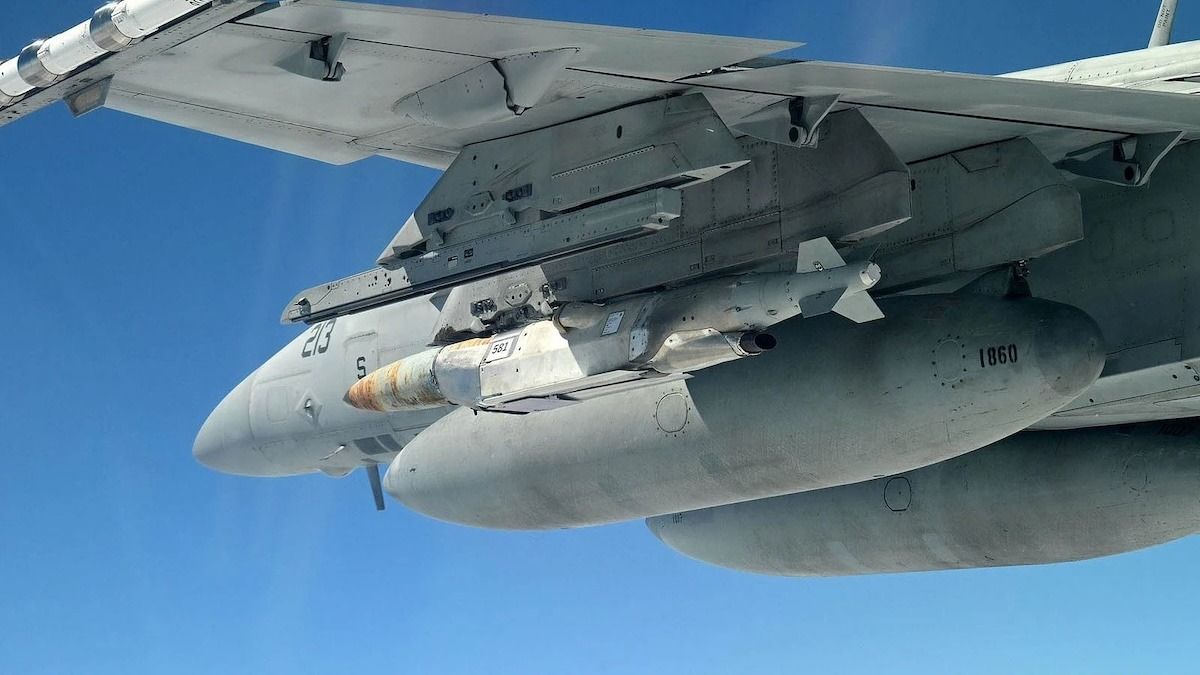
The first flight test took place off California on 1 April 2026, followed by a second test on 3 April. An F/A-18 carried the test weapon, which separated safely and completed controlled powered flight while following a predefined profile. The demonstrations used military M-code GPS navigation and covered approximately 200 nautical miles. They verified important flight functions but did not publicly demonstrate the advertised range of more than 300 nautical miles. Further details were reported by Air & Space Forces Magazine.
Initial production
On 5 August 2026, the United States Air Force awarded Boeing a $75 million Undefinitized Contract Action for BSU-111/B Payload Delivery Units. The action cleared initial production for the United States Navy. It did not represent full-rate production or completion of weapon qualification. Boeing published the award through its official news release.
Boeing began establishing manufacturing space at its St. Charles, Missouri, facility while continuing qualification and aircraft-integration work for initial fielding. The company summarized the tests and production preparations in its program announcement.
Design
The BSU-111/B is the Payload Delivery Unit used to create the GBU-75 JDAM LR. It combines JDAM-related guidance and aircraft interfaces with aerodynamic lifting surfaces and compact air-breathing propulsion. The powered configuration is designed to extend the weapon's reach well beyond that of an unpowered JDAM.
The system accommodates payloads conforming to the Mk 82 form factor and weighing up to 500 pounds. Boeing states that the armed configuration can travel more than 300 nautical miles while preserving JDAM precision and control over impact conditions. A separate account of the system's configuration is available from Mezha.
Aircraft integration
JDAM LR uses the existing JDAM aircraft interface and the In-Weapon Launch Acceptability Region function. Boeing presents it as compatible with aircraft already integrated for JDAM, although publicly available material does not identify every aircraft approved for the initial production configuration.
The April 2026 demonstrations used an F/A-18. Qualification work and shipboard-integration testing are continuing for naval service. Compatibility with an interface does not by itself establish that the weapon is cleared for operational use on every JDAM-capable aircraft.
Propulsion and mission equipment
Boeing describes the propulsion system as compact, modular, and air breathing. Its product material depicts a TDI J85 engine with wind-tunnel-tested concepts, while secondary reporting identifies a Kratos TDI-J85 turbojet. Public Boeing documentation does not establish that this engine will equip every production BSU-111/B.
An onboard 1.5-kilowatt generator can support optional seekers, a data link, and other mission avionics through open-system interfaces. Boeing has not disclosed which of these optional systems will be fitted to the initial Navy configuration. The manufacturer's technical claims appear in the JDAM LR product card.
Program status
As of August 2026, Payload Delivery Units were entering initial production for the United States Navy under an Air Force contracting action. Boeing was simultaneously preparing its production area and conducting qualification and aircraft integration. No source in the available record confirms operational deployment or combat use.
The weapon is intended for precision attacks against land and maritime targets from outside heavily defended areas. Its practical effectiveness and launch envelope will depend on aircraft integration, release conditions, mission planning, and the final selection of guidance and communication equipment.
Configurations
- GBU-75 JDAM LR: Armed configuration based on the BSU-111/B Payload Delivery Unit and designed to carry a 500-pound-class payload more than 300 nautical miles.
- Baseline JDAM LR: Configuration shown by Boeing in high-fidelity wind-tunnel testing material. The published material does not identify it as a separately fielded operational variant.
- Quickstrike Long Range: Mine-related configuration depicted in Boeing wind-tunnel material. Its inclusion in the initial production award has not been confirmed.
- Maritime Strike: Maritime mission configuration depicted during wind-tunnel testing. Its operational status and initial-production equipment have not been disclosed.
- Low-cost decoy fuel-tank configuration: Unarmed or alternative-payload concept advertised with a range exceeding 700 nautical miles. This figure does not apply to the armed 500-pound configuration.
Specifications (GBU-75 JDAM LR with 500-pound-class payload)
General characteristics
- Manufacturer: Boeing
- Payload Delivery Unit: BSU-111/B
- Payload: Up to 226 kg (500 lb)
- Payload form factor: Mk 82
- Propulsion: Compact modular air-breathing propulsion system
- Onboard electrical generation: 1.5 kW for optional mission equipment
Performance
- Advertised range: More than 555 km (300 nautical miles) with a 500-pound-class payload
- Demonstrated test distance: Approximately 370 km (200 nautical miles) during each April 2026 demonstration
Guidance and integration
- Test navigation: M-code GPS during the April 2026 demonstrations
- Aircraft interface: Existing JDAM interface
- Launch planning: In-Weapon Launch Acceptability Region function
- Optional equipment: Seekers, data link, and other mission avionics
 Argentina
 Armenia
 Australia
 Austria
 Austria-Hungary
 Belgium
 Brazil
 United Kingdom
 Brunei
 Bulgaria
 Canada
 Chile
Chile China
China Colonial America
 Colombia
 Confederate States
 Croatia
 Czech
Czech Denmark
 Egypt
Egypt Finland
 France
 Georgia
 Germany
 German Imperial
 Greece
 Holland
 Hungary
 India
India Indonesia
 Iran
Iran Iraq
Iraq Ireland
 Israel
 Italy
Italy Japan
Japan Japan (1940)
 Jordan
 Kingdom of Italy
 Malaysia
 Mexico
 Myanmar
 Nazi Germany
 Netherlands
 New Zealand
 North Korea
 Norway
 Pakistan
 Peru
Peru Philippines
 Poland
 Portugal
 Prussia
 Romania
 Russia
 Saudi Arabia
 Serbia
 Singapore
 Slovakia
 Slovenia
 South Africa
 South Korea
 Soviet Union
 Spain
Spain Sweden
 Switzerland
 Syria
Syria Taiwan
 Thailand
 Turkey
 UAE
UAE Ukraine
 Vietnam
 Yugoslavia