
History
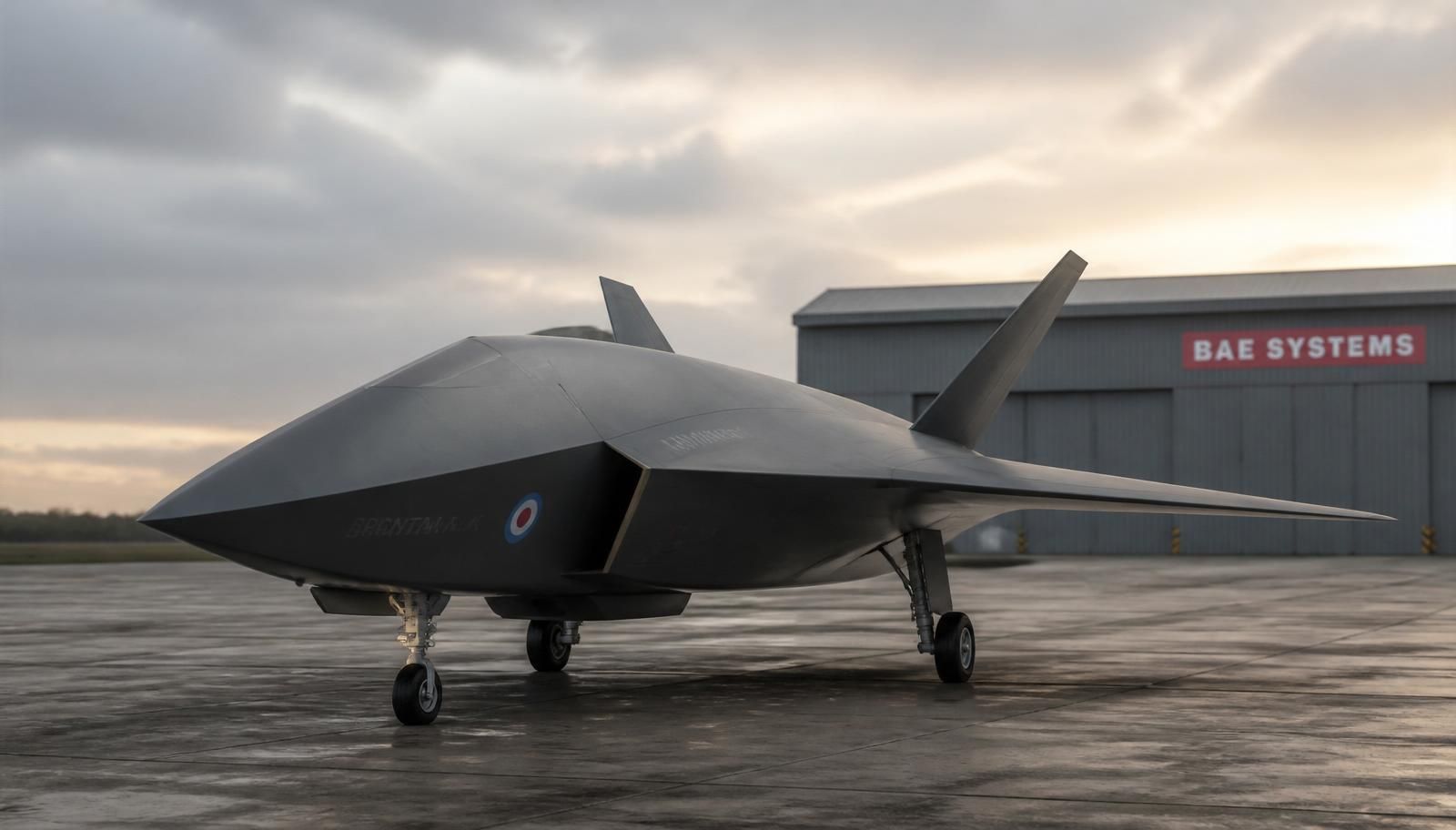
BAE Systems Brontanax is a British uncrewed collaborative combat aircraft developed to operate alongside crewed combat aircraft. It is intended to increase combat mass at lower cost while keeping pilots away from some high-risk missions.
The aircraft is designed for electronic warfare and precision strikes against airborne and ground targets. BAE Systems unveiled the completed prototype at the Farnborough International Airshow on 22 July 2026.
BAE Systems began developing Brontanax with the Royal Air Force in 2022. The work was led by the company's FalconWorks organization at Warton in Lancashire. More than 500 BAE Systems employees and approximately 75 British companies participated in the program.
The company funded the initial development through its own research and development investment. By July 2026, BAE Systems had reportedly committed more than £400 million to the project. The separate British Storm Fighter program received an initial government commitment of £300 million for sovereign collaborative combat aircraft development.
Brontanax was presented as a pre-series, pre-production prototype rather than an operational aircraft. Its name combines ancient Greek words associated with thunder and king. The aircraft was described as the United Kingdom's first autonomous uncrewed Collaborative Combat Aircraft at its public unveiling. Contemporary reports and program details were published by Defense News and Naval News.
Design
Airframe
Brontanax is similar in size to the BAE Systems Hawk jet trainer and has a maximum take-off weight exceeding 5 metric tons. BAE Systems claims that its low-observable design provides greater stealth than competing collaborative combat aircraft, although detailed signature data have not been released.
GKN Aerospace engineered, manufactured, and integrated the prototype's wings, fins, and control surfaces. These flight-ready composite structures were produced at the company's Cowes facility on the Isle of Wight. Details of this industrial work were reported by AeroTime.
Architecture and control
The aircraft uses an open architecture and modular design intended to simplify software upgrades and changes to mission equipment. BAE Systems has also considered using suppliers outside the traditional defense sector during production.
Brontanax is intended to operate with current and future crewed combat aircraft. A Typhoon pilot or a remote mission commander is expected to direct the aircraft as part of a crewed-uncrewed team. The company aims to provide approximately 70 to 80 percent of the capability of a conventional fighter for less than 25 percent of its cost. Contemporary reporting estimated a possible unit price of approximately $25 million, but no production contract or final price has been announced.
Powerplant
The prototype is fitted with a Williams International engine. BAE Systems plans to transition the design to a powerplant from the Rolls-Royce Orpheus family. Detailed thrust, speed, range, endurance, and fuel-capacity figures have not been disclosed.
Mission systems and armament
The planned missions include electronic warfare and precision strikes against airborne and ground targets. The modular architecture is intended to support changes to software and payloads as requirements evolve. BAE Systems has not disclosed specific sensors, electronic warfare equipment, weapons, internal payload capacity, or external stations.
Program status
Following its July 2026 unveiling, the prototype was being prepared for ground testing at Warton. Power-on was scheduled for the end of the third quarter of 2026, followed by ground trials during the first half of 2027. The first flight was planned for later in 2027 within United Kingdom airspace.
The British government selected Brontanax as an operational concept demonstrator associated with the Storm Fighter program. BAE Systems stated that the aircraft could become available for service before the end of 2030. This remains a planned objective rather than an achieved operational milestone. No production order, fleet quantity, or confirmed operator had been announced at the time of the unveiling.
The program faces competition from other collaborative combat aircraft projects. An assessment of its development and affordability objectives was published by Defence Matters.
Specifications (Brontanax prototype)
General characteristics
- Type: Uncrewed collaborative combat aircraft prototype
- Manufacturer: BAE Systems
- Development organization: BAE Systems FalconWorks
- Crew: None aboard
- Size: Similar in scale to the BAE Systems Hawk jet trainer
- Maximum take-off weight: More than 5 metric tons
- Prototype powerplant: One Williams International engine
- Planned powerplant: An engine from the Rolls-Royce Orpheus family
Planned mission capabilities
- Control: Direction by a crewed-aircraft pilot or remote mission commander
- Primary missions: Electronic warfare and precision strike
- Targets: Airborne and ground targets
- Configuration: Open architecture with modular software and mission equipment
Related equipment
- BAE Systems Hawk: Jet trainer used as a public reference for the approximate size of Brontanax.
- Eurofighter Typhoon: Crewed combat aircraft identified for collaborative operation with Brontanax.
- Boeing MQ-28 Ghost Bat: Australian collaborative combat aircraft cited as a competing program with a more advanced flight-test schedule.
 Argentina
 Armenia
 Australia
 Austria
 Austria-Hungary
 Belgium
 Brazil
 United States
 Brunei
 Bulgaria
 Canada
 Chile
Chile China
China Colonial America
 Colombia
 Confederate States
 Croatia
 Czech
Czech Denmark
 Egypt
Egypt Finland
 France
 Georgia
 Germany
 German Imperial
 Greece
 Holland
 Hungary
 India
India Indonesia
 Iran
Iran Iraq
Iraq Ireland
 Israel
 Italy
Italy Japan
Japan Japan (1940)
 Jordan
 Kingdom of Italy
 Malaysia
 Mexico
 Myanmar
 Nazi Germany
 Netherlands
 New Zealand
 North Korea
 Norway
 Pakistan
 Peru
Peru Philippines
 Poland
 Portugal
 Prussia
 Romania
 Russia
 Saudi Arabia
 Serbia
 Singapore
 Slovakia
 Slovenia
 South Africa
 South Korea
 Soviet Union
 Spain
Spain Sweden
 Switzerland
 Syria
Syria Taiwan
 Thailand
 Turkey
 UAE
UAE Ukraine
 Vietnam
 Yugoslavia