
History
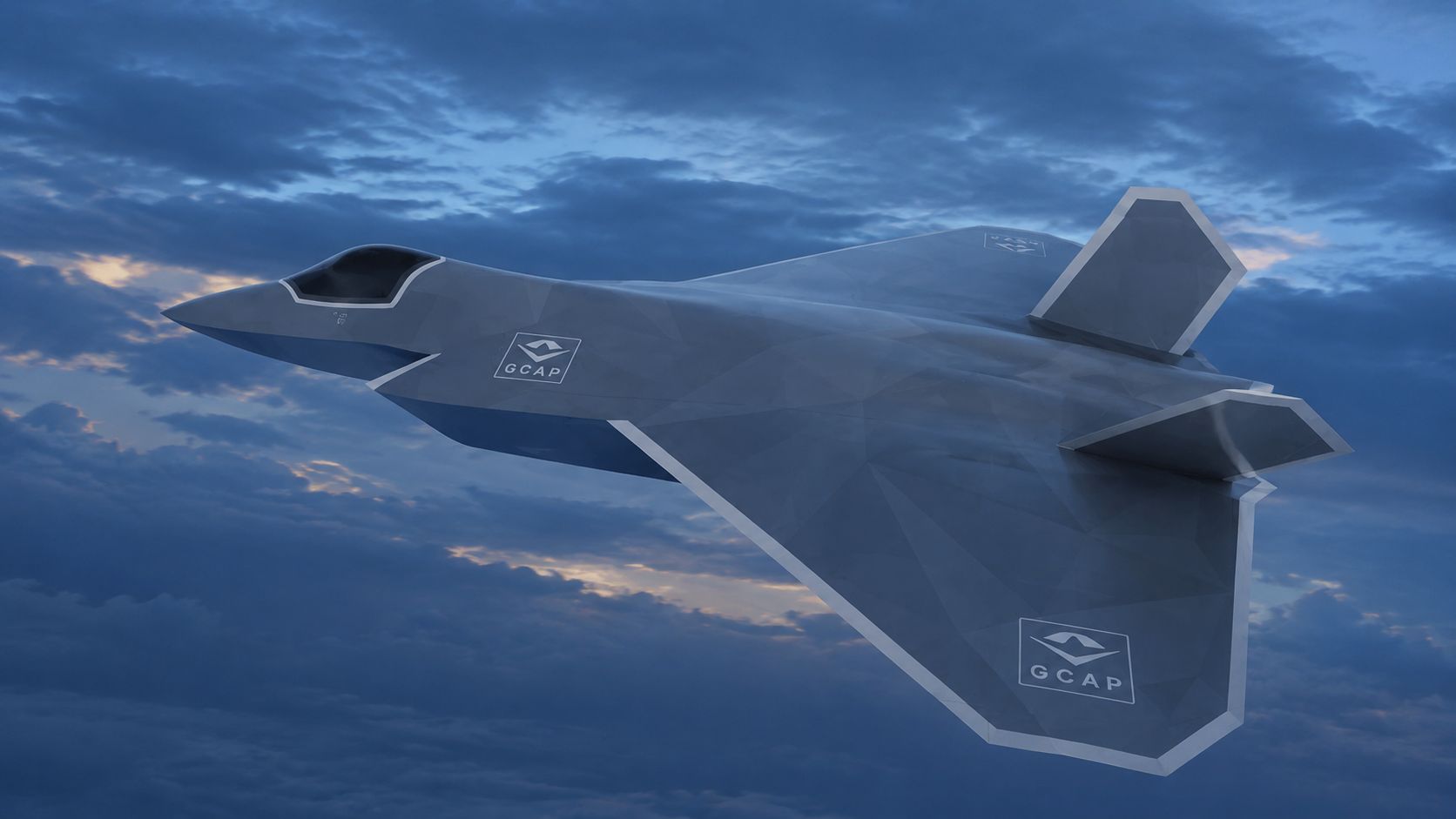
The Global Combat Air Programme (GCAP) is a joint British, Italian and Japanese project to develop a next-generation combat-air system. Its central element is a planned crewed, low-observable fighter, but the programme also covers propulsion, sensors, electronic warfare, weapons, communications, software and cooperation with uncrewed aircraft.
GCAP is intended to replace the Eurofighter Typhoon in British and Italian service and the Mitsubishi F-2 in Japanese service. The three governments target entry into service from 2035. The new aircraft is expected to operate alongside the F-35 and other existing platforms rather than replace every current fighter immediately.
The programme remains in development. Its final configuration, dimensions, performance and armament have not been publicly confirmed. A British combat-air demonstrator associated with technology development for GCAP is planned to make its first flight in 2028.
Formation of the programme
Before GCAP, the United Kingdom and Italy participated in the Tempest project within the British Future Combat Air System initiative. Japan separately pursued the F-X project as a successor to the Mitsubishi F-2. The countries combined these efforts because their replacement schedules and many operational requirements were compatible.
GCAP was formally announced on 9 December 2022. The partnership allowed the countries to share development costs, engineering resources and technical risk while retaining national influence over the aircraft, its weapons and future modifications. A detailed account of the programme's origins is available in the GCAP programme guide.
On 14 December 2023, the three governments signed an international treaty in Tokyo. The treaty created the GCAP International Government Organisation, commonly abbreviated GIGO, to direct and manage the joint programme. The organisation is headquartered in the United Kingdom.
Cooperation accelerated during 2024 with the establishment of the international government structure and an agreement to create a joint industrial organisation. An Istituto Affari Internazionali study describes the partnership as based on equal rights, investment, freedom of action and freedom to modify national systems.
Industrial organization
Edgewing is the programme's principal industrial organization and design authority. It is an equally owned joint venture of BAE Systems in the United Kingdom, Leonardo in Italy and the Japan Aircraft Industrial Enhancement Company. The Japanese organization represents industrial participation that includes Mitsubishi Heavy Industries.
Edgewing is responsible for aircraft design, system integration, engineering, airworthiness, certification and configuration management. It is organized as a trinational company with engineering activity in all three partner countries. Each founding shareholder holds an equal interest, and no single country is formally designated as the industrial leader.
Development contracts
In April 2026, a £686 million bridge contract maintained engineering work while the partners prepared the next international agreement. On 3 July 2026, the GCAP Agency awarded Edgewing an approximately £4.6 billion contract covering about 18 months of advanced concept work, detailed design, technology integration, supply-chain activity and preparation for later development phases. The agreement moved GCAP from coordinated national research toward an integrated international design programme. The contract and its industrial context are examined in an aviation analysis of GCAP.
The United Kingdom subsequently identified £8.6 billion of planned GCAP investment over four years. Italy increased its stated commitment to €18.6 billion, while Japan included ¥206.6 billion for GCAP in its fiscal year 2026 defence budget request. These figures represent national commitments or requests rather than a confirmed total development cost or unit price.
Design
System-of-systems concept
GCAP is designed as a connected combat-air system rather than an isolated fighter. The crewed aircraft is intended to exchange information with satellites, naval forces, ground units, other aircraft and long-range weapons. It is also planned to coordinate collaborative uncrewed aircraft performing reconnaissance, electronic warfare, communications relay, decoy and strike tasks.
The pilot is expected to retain authority over mission execution while onboard systems combine information from multiple sources. This approach is intended to reduce pilot workload and allow the aircraft to operate as a command and information-distribution node in contested environments. The architecture is also intended to support operations when satellite communications or conventional tactical data links are degraded.
Airframe
Public models show a tailless delta-wing aircraft with two engines, diverterless supersonic inlets and a broad blended fuselage. These features indicate an emphasis on low observability and substantial internal volume. The shape and details remain subject to change during detailed design.
Estimates based on the full-scale model displayed in 2026 place the aircraft in the 19–20 m length class, approximately 3–4 m longer than the Eurofighter Typhoon. The additional internal volume is intended for fuel, sensors, electronic systems and internally carried weapons. Early programme objectives described an internal payload roughly twice that of an F-35A, but no final payload figure has been confirmed.
Propulsion and electrical systems
Rolls-Royce, Avio Aero and IHI are jointly developing propulsion technologies for GCAP. The work covers thrust and fuel efficiency as well as electrical generation and heat management. These functions are important because the planned radar, electronic-warfare equipment, communications systems and onboard processors will require substantial electrical power and cooling.
The British combat-air demonstrator will use two modified EJ200 engines rather than the planned production propulsion system. Rolls-Royce is also developing a next-generation engine demonstrator, using experience from the smaller Orpheus technology programme to reduce propulsion risk before the final engine is available.
Sensors, avionics and software
The planned mission system will combine information from an active electronically scanned array radar, passive infrared sensors, electronic-support equipment and external platforms. Secure communications and high-capacity onboard processing are intended to create a shared representation of the battlespace for the pilot and cooperating forces.
An open software architecture is planned to simplify the integration of future sensors, weapons and mission applications. Artificial intelligence and machine-learning methods are also being studied for data processing, mission support and analysis of test results. The exact degree of onboard automation and the final human-machine interface have not been disclosed.
The Excalibur Flight Test Aircraft, a modified Boeing 757 developed by Leonardo and 2Excel, serves as an airborne laboratory for radar and integrated mission-system testing. It allows equipment to be evaluated in flight before installation in the new fighter. A 2026 GCAP development report stated that Excalibur had completed its modifications and entered a further stage of flight trials.
Armament integration
GCAP is intended to carry air-to-air and air-to-surface weapons internally to preserve its low-observable characteristics. Final weapons and bay dimensions remain unconfirmed. MBDA UK, MBDA Italy, Mitsubishi Electric and Mitsubishi Heavy Industries are coordinating national approaches to weapons integration without combining all sovereign weapons work into a single development effort.
The partners plan to use digital modelling, virtualized mission-system interfaces and automated analysis to shorten weapons-integration work. Supersonic release trials from the British demonstrator are planned to compare these methods with conventional testing and provide evidence for the production aircraft.
Program status
GCAP was in detailed design in 2026 and had not produced an operational aircraft. Work on the British crewed demonstrator was progressing, with about half of its main structure reported to be in final assembly and more than 11,500 parts designed. Its planned 2028 first flight is intended to test technologies and engineering methods relevant to GCAP, although the demonstrator is smaller than the proposed service aircraft.
The partners continue to target service entry from 2035. Meeting that date depends on completing the detailed design, integrating the propulsion and mission systems, conducting flight tests, establishing production and training personnel. Final production quantities, unit costs and national order sizes have not been announced.
Canada became the programme's first observer in July 2026. Observer status provides insight into programme governance, capability planning and industrial requirements without voting rights, design authority or a guaranteed industrial share.
Singapore also began exploratory discussions concerning possible involvement. No participation or procurement decision had been made. The talks therefore did not make Singapore an operator or programme member. The preliminary nature of the discussions was reported by Janes.
Specifications (planned GCAP crewed combat aircraft)
General characteristics
- Type: Planned next-generation crewed combat aircraft and central platform of an integrated combat-air system
- Crew: One pilot in the publicly described configuration
- Configuration: Tailless delta wing with a broad blended fuselage
- Estimated length class: 19–20 m, based on the displayed development model
- Powerplant: Two jointly developed next-generation engines
- Intakes: Two diverterless supersonic inlets in the public design
- Planned service entry: From 2035
Mission systems
- Radar: Planned active electronically scanned array radar
- Passive sensing: Planned infrared sensors and electronic-support systems
- Communications: Secure, networked data exchange with air, space, naval and land platforms
- Architecture: Open digital architecture intended to support continuing upgrades
- Uncrewed teaming: Planned control and coordination of collaborative uncrewed aircraft
Armament
- Carriage: Internal weapon bays are planned to support low-observable operations
- Weapon roles: Planned integration of air-to-air and air-to-surface weapons
- Non-kinetic effects: Electronic attack is included in the wider combat-system concept
Related equipment
- Eurofighter Typhoon: Aircraft that GCAP is intended to replace in British and Italian service.
- Mitsubishi F-2: Aircraft that GCAP is intended to replace in Japanese service.
- F-35 Lightning II: Fifth-generation aircraft expected to operate alongside GCAP rather than be immediately replaced by it.
- British combat-air demonstrator: Planned flight demonstrator intended to reduce technical risk before the GCAP service aircraft enters testing.
- Excalibur: Modified Boeing 757 used as a flying laboratory for next-generation sensors and integrated systems.
 Argentina
 Armenia
 Australia
 Austria
 Austria-Hungary
 Belgium
 Brazil
 United States
 Brunei
 Bulgaria
 Canada
 Chile
Chile China
China Colonial America
 Colombia
 Confederate States
 Croatia
 Czech
Czech Denmark
 Egypt
Egypt Finland
 France
 Georgia
 Germany
 German Imperial
 Greece
 Holland
 Hungary
 India
India Indonesia
 Iran
Iran Iraq
Iraq Ireland
 Israel
 Italy
Italy Japan
Japan Japan (1940)
 Jordan
 Kingdom of Italy
 Malaysia
 Mexico
 Myanmar
 Nazi Germany
 Netherlands
 New Zealand
 North Korea
 Norway
 Pakistan
 Peru
Peru Philippines
 Poland
 Portugal
 Prussia
 Romania
 Russia
 Saudi Arabia
 Serbia
 Singapore
 Slovakia
 Slovenia
 South Africa
 South Korea
 Soviet Union
 Spain
Spain Sweden
 Switzerland
 Syria
Syria Taiwan
 Thailand
 Turkey
 UAE
UAE Ukraine
 Vietnam
 Yugoslavia