
History
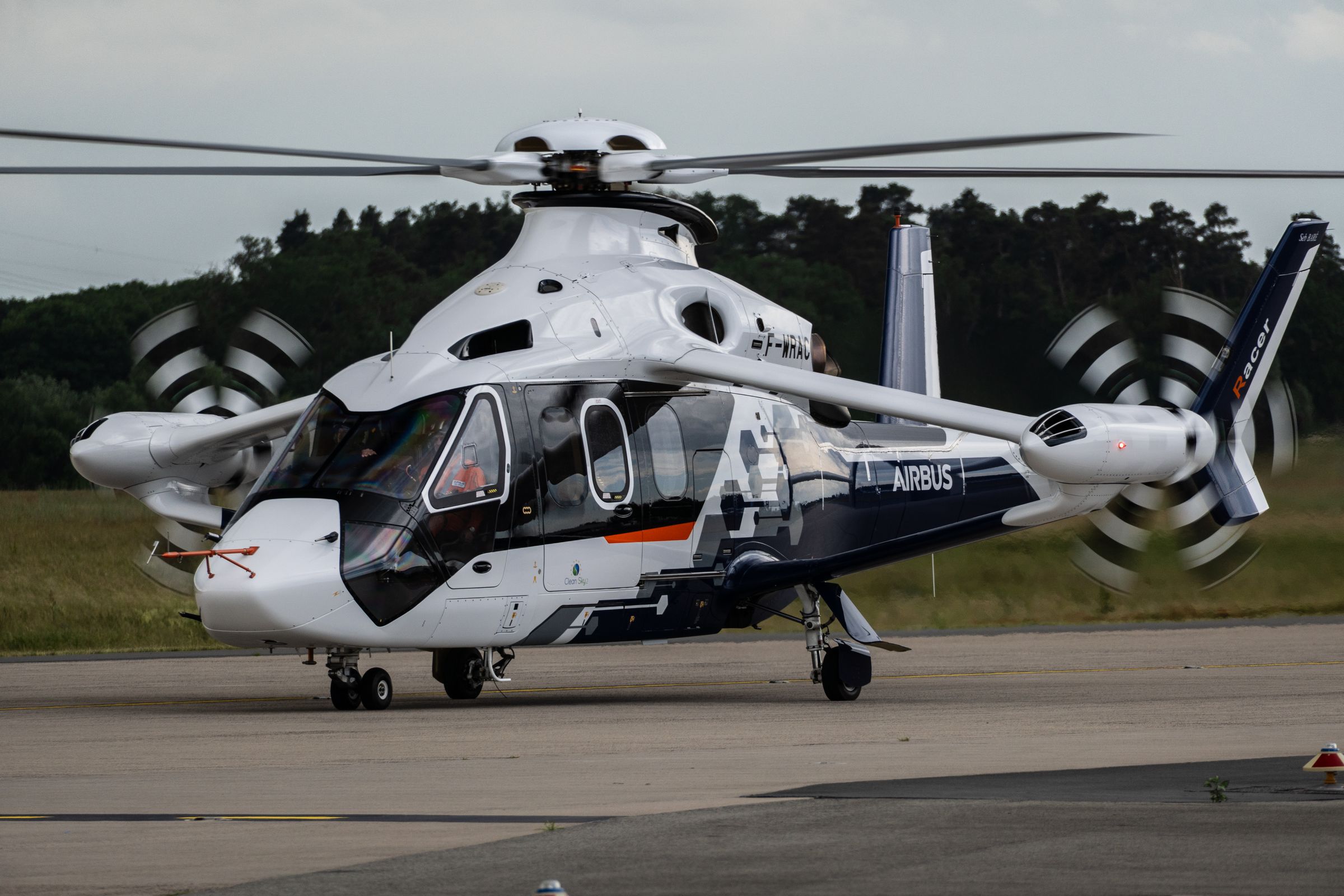
The Airbus Helicopters Racer (Rapid and Cost-Effective Rotorcraft) is an experimental high-speed compound helicopter developed by Airbus Helicopters as a technology demonstrator under the European Clean Sky 2 research programme. It evolved from the earlier Eurocopter X3 compound helicopter. A small-scale model of the Racer configuration was revealed at the June 2017 Paris Air Show. In February 2018, the 1,900 kW (2,500 hp) Safran Helicopter Engines Aneto-1X turboshaft was selected as the powerplant, replacing the originally considered RTM322. Design of key subsystems was completed by October 2018, followed by long-lead component manufacturing involving industrial partners across Europe. The programme brought together more than 40 partners from 13 countries, with Airbus Helicopters serving as the technical and administrative coordinator.
Production and assembly were significantly delayed by the COVID-19 pandemic. Final assembly began in mid-2021 at the Airbus Helicopters facility in Marignane, southern France. Powered systems testing and taxi trials commenced in December 2022. The Racer made its first flight on 25 April 2024 at Marignane. By the third test flight in May 2024, the aircraft had reached 165 kn (306 km/h). In June 2024, after seven flights, it exceeded its original 220-knot speed target. During a descent in the summer of 2024, the Racer recorded 260 kn (480 km/h). On 28 April 2025, after 25 flight hours since its first flight, the Racer achieved 240 kn (444 km/h) in level flight. The aircraft performed five public flight demonstrations at the 2025 Paris Air Show, marking its full public debut eight years after its initial unveiling.
In March 2026, as part of the first phase of the EDF-funded ENGRT programme, guest military pilots from France, Germany, and Finland flew the demonstrator in tactical evaluation sorties. In October 2026, the Racer completed a series of nap-of-the-earth flight trials from the Cazaux test centre in southern France, with military pilots participating. In the same mission profile, a conventional helicopter averaged 60 kt (111 km/h), while the Racer averaged 150 kt (278 km/h), with the capacity to accelerate to 200 kt (370 km/h) in some sections. By the time of these tests, the Racer had accumulated approximately 70 flight hours. Military pilots provided positive feedback on the aircraft's responsiveness and controllability, noting that its acceleration is approximately twice that of a conventional rotorcraft.
Design
Airframe and lifting system
The Racer employs a compound propulsion layout combining a conventional main rotor with two lateral pusher propellers mounted on a V-shaped box wing. The box wing generates aerodynamic lift during cruise, contributing approximately half of the total lift and permitting the main rotor to be slowed by up to 15 percent as airspeed increases. This prevents the retreating rotor blade from breaking the sound barrier, eliminating the associated performance degradation and vibration. The main rotor is a standard unit from the Airbus H175 super-medium twin helicopter. The pusher propellers are six-bladed and gear-driven from the main engines through lateral gearboxes. The airframe is a hybrid of metallic and composite structures designed for low weight and low maintenance. The tail is rotorless, a novel feature of this compound configuration. The overall aerodynamic drag is 2.5 times lower than that of a conventional helicopter of the same weight class.
Powerplant and eco-mode
Two Safran Helicopter Engines Aneto-1X turboshaft engines provide 1,900 kW (2,500 hp) each. The lateral gearboxes are rated at 1 MW of power output per unit. A key planned feature is the eco-mode system, developed in collaboration with Safran Helicopter Engines, which allows one engine to shut down during cruise to reduce fuel consumption while maintaining a speed of 180 kt (333 km/h). A 100-kW onboard battery system supports rapid restart of the shut-down engine; the target restart time to full power is approximately 5 to 7 seconds depending on the test phase. The electrical architecture follows a more-electric design philosophy, reducing mechanical power off-takes from the propulsion system and employing high-voltage direct current electrical generation.
Flight control and mission capability
The flight control system employs smart control laws that exploit the additional degrees of freedom provided by the compound configuration for aerodynamic trimming and power management. This architecture enables the aircraft to change speed while maintaining a constant altitude, a capability not available to conventional helicopters that must pitch to accelerate or decelerate. The lateral rotors provide independent attitude control, enabling the Racer to land on slopes of up to 14 degrees by keeping the main rotor level while angling the fuselage with the side propellers. This same control authority supports the development of optimised low-noise departure and arrival trajectories, with a target ground-noise reduction of at least 30 percent.
Program status
The Racer remains a single-aircraft technology demonstrator and is not a production or operational type. As of late 2026, the programme is in an active flight-test phase with approximately 70 flight hours accumulated. The next planned test activities include full integration and flight demonstration of the eco-mode system and validation of optimised low-noise trajectories. The ENGRT programme, funded by EDF, will continue to assess the relevance of the Racer's compound architecture for specific military performance requirements. Airbus Helicopters has stated that hundreds of additional flight hours remain in the demonstrator's test budget for further mission demonstrations and performance evaluation.
Specifications
The following data applies to the Racer technology demonstrator in its flight-test configuration.
General characteristics
- Crew: 2
- Passenger capacity: approximately 10
- Max takeoff weight: 8,000–9,000 kg (17,637–19,842 lb)
- Powerplant: 2 × Safran Helicopter Engines Aneto-1X turboshaft, 1,900 kW (2,500 hp) each
- Propellers: 2 × 6-bladed pusher propellers, gear-driven from main engines
Performance
- Maximum demonstrated level-flight speed: 444 km/h (240 kn)
- Maximum demonstrated speed in descent: 480 km/h (260 kn)
- Target cruise speed with one engine (eco-mode): 333 km/h (180 kn)
- Range: 740 km (460 mi, 400 nmi)
- Demonstrated climb rate: 1,100 m/min (3,600 ft/min)
- Demonstrated 2g turn speed: 350 km/h (190 kn)
Related equipment
- Eurocopter X3 — Predecessor compound helicopter; holds the world speed record for helicopters at a speed the Racer now approaches within 15 kn.
- Sikorsky X2 — Earlier U.S. compound helicopter demonstrator with a comparable pusher-rotor concept.
- Piasecki X-49 — U.S. tilt-rotor research aircraft exploring similar high-speed rotorcraft performance goals.
 Argentina
 Armenia
 Australia
 Austria
 Austria-Hungary
 Belgium
 Brazil
 United Kingdom
 United States
 Brunei
 Bulgaria
 Canada
 Chile
Chile China
China Colonial America
 Colombia
 Confederate States
 Croatia
 Czech
Czech Denmark
 Egypt
Egypt Finland
 Georgia
 Germany
 German Imperial
 Greece
 Holland
 Hungary
 India
India Indonesia
 Iran
Iran Iraq
Iraq Ireland
 Israel
 Italy
Italy Japan
Japan Japan (1940)
 Jordan
 Kingdom of Italy
 Malaysia
 Mexico
 Myanmar
 Nazi Germany
 Netherlands
 New Zealand
 North Korea
 Norway
 Pakistan
 Peru
Peru Philippines
 Poland
 Portugal
 Prussia
 Romania
 Russia
 Saudi Arabia
 Serbia
 Singapore
 Slovakia
 Slovenia
 South Africa
 South Korea
 Soviet Union
 Spain
Spain Sweden
 Switzerland
 Syria
Syria Taiwan
 Thailand
 Turkey
 UAE
UAE Ukraine
 Vietnam
 Yugoslavia