
History
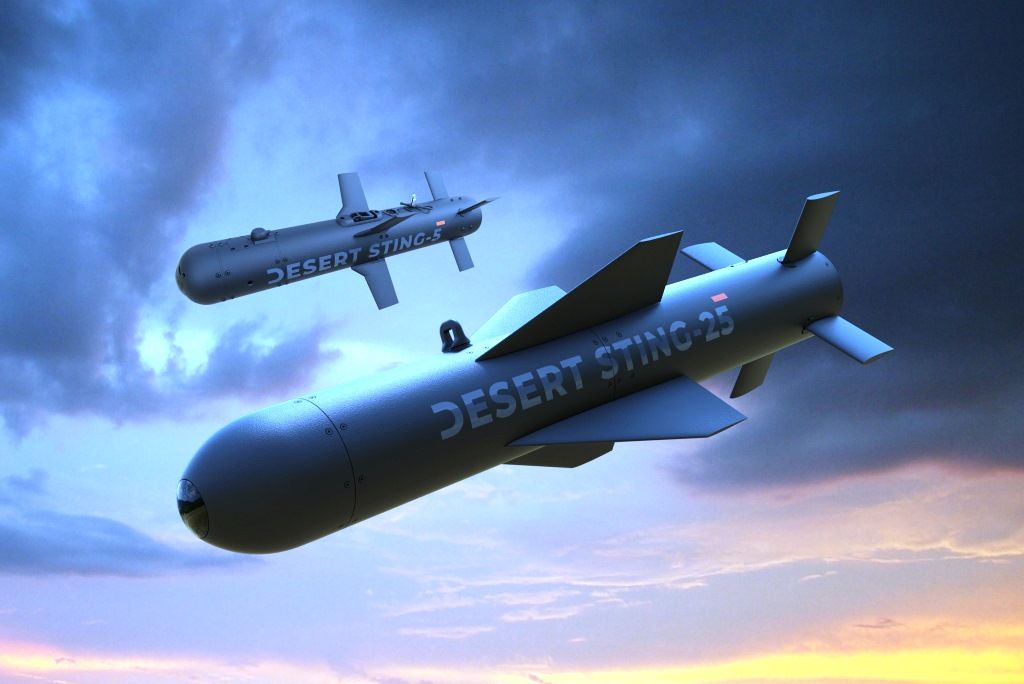
The Desert Sting 16 (DS-16) is a precision-guided glide weapon developed and manufactured in the United Arab Emirates by Halcon, a subsidiary of EDGE Group. On January 17, 2024, EDGE and Baykar agreed to integrate the DS-16 onto the Bayraktar TB2; the weapon has since been integrated for UAE-operated drones. On October 9, 2026, Morocco's Administration of National Defence signed a contract with EDGE at the Marrakech Air Show to procure the DS-16 for integration across the Royal Moroccan Air Force's unmanned combat aerial vehicle fleet. The agreement covers ammunition deliveries, aircraft modifications, weapon control software, integration, and long-term support. The contract value, ammunition quantities, specific recipient aircraft, and delivery schedule remain undisclosed.
Specifications
The DS-16 measures 1,000 mm in length, 129 mm in diameter, and 323 mm across its widest section. Its gross weight is 23 kg, of which the 12 kg warhead represents 52.2% of total mass. Guidance employs GNSS-assisted inertial navigation (GAINS), with an optional semi-active laser (SAL) seeker improving accuracy from a 10 m circular error probable (CEP) with GAINS alone to 3 m with GAINS plus SAL. The maximum range of 15 km is achieved from a release at 30,000 ft (9,144 m) altitude at 220 knots calibrated airspeed. The weapon supports impact and height-of-burst detonation.
Halcon's Quad Rack carries four DS-16 weapons and weighs 45 kg, producing a 137 kg assembly measuring 1,880 × 435 × 200 mm with MIL-STD-1760 electrical connections. The four-weapon loadout of 92 kg represents 61.3% of the Bayraktar TB2's 150 kg payload capacity, rising to 137 kg (91.3%) with the rack.
Operators
United Arab Emirates — Operates the DS-16 on its drone fleet following integration completed after the January 2024 EDGE–Baykar agreement.
Morocco — The Royal Moroccan Air Force contracted EDGE on October 9, 2026, to integrate the DS-16 across its UCAV fleet, which includes at least 19 Bayraktar TB2s, Chinese Wing Loongs, and Bayraktar Akincis. Aircraft-specific carriage, separation, and release certification will determine which configurations are operationally deployed.
 Argentina
 Armenia
 Australia
 Austria
 Austria-Hungary
 Belgium
 Brazil
 United Kingdom
 United States
 Brunei
 Bulgaria
 Canada
 Chile
Chile China
China Colonial America
 Colombia
 Confederate States
 Croatia
 Czech
Czech Denmark
 Egypt
Egypt Finland
 France
 Georgia
 Germany
 German Imperial
 Greece
 Holland
 Hungary
 India
India Indonesia
 Iran
Iran Iraq
Iraq Ireland
 Israel
 Italy
Italy Japan
Japan Japan (1940)
 Jordan
 Kingdom of Italy
 Malaysia
 Mexico
 Myanmar
 Nazi Germany
 Netherlands
 New Zealand
 North Korea
 Norway
 Pakistan
 Peru
Peru Philippines
 Poland
 Portugal
 Prussia
 Romania
 Russia
 Saudi Arabia
 Serbia
 Singapore
 Slovakia
 Slovenia
 South Africa
 South Korea
 Soviet Union
 Spain
Spain Sweden
 Switzerland
 Syria
Syria Taiwan
 Thailand
 Turkey
 Ukraine
 Vietnam
 Yugoslavia