
History
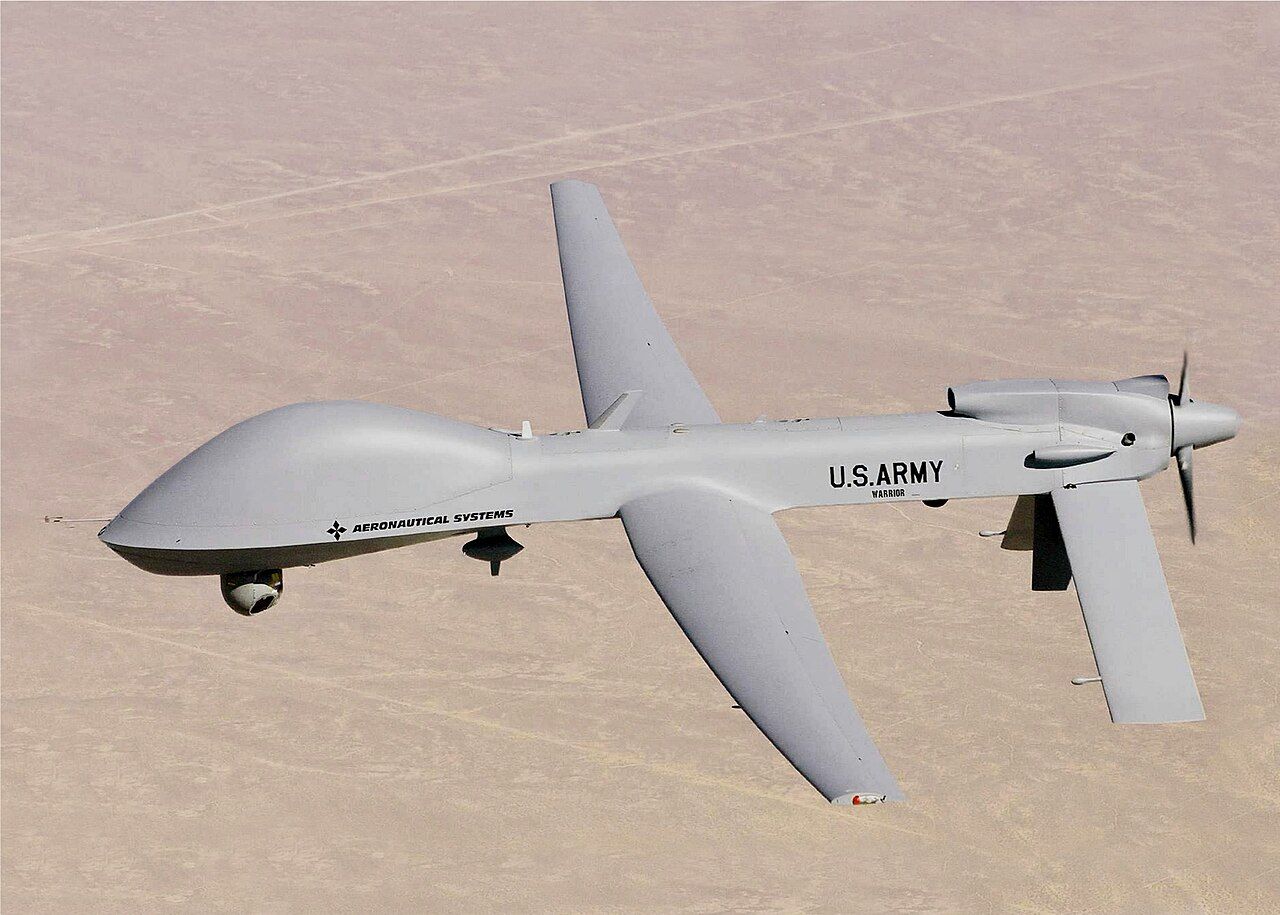
The Gray Eagle Extended Range (GE-ER) first flew in July 2013 as an advanced derivative of the Gray Eagle Unmanned Aircraft System. The aircraft was developed to provide the U.S. Army with significantly increased endurance, improved reliability and maintainability, and greater payload and weapons capacity compared to the standard Gray Eagle.
Modernization of the platform continued through 2025 and 2026. In October 2025, the U.S. Army awarded General Atomics Aeronautical Systems (GA-ASI) a contract to integrate a C5ISR Modular Open Suite of Standards–compliant electronic warfare capability onto Gray Eagle, building on prior integration of Electronic Attack, communications relay, Counter-UAS, and Signals Intelligence functions. In April 2026, GA-ASI announced a further Army contract to enhance Gray Eagle ER's Electronic Intelligence capability, including advanced radar detection and signal-collection technology integrated with Sierra Nevada Corporation (SNC). The platform has also demonstrated Communications Intelligence, Synthetic Aperture Radar/Moving Target Indicator, and Mobile Ad Hoc Network radio capabilities. During Project Convergence Capstone 5, Gray Eagle ER conducted persistent Detect, Identify, Locate and Report missions in an electronically contested environment while supporting tactical networking and cross-cueing between multiple intelligence capabilities.
On 15 October 2026, GA-ASI announced completion of flight testing of the SNC Electronic Support Measures (ESM) system aboard the MQ-1C Gray Eagle ER.
Design
GE-ER incorporates a deep belly design with a centerline hard point, enabling significantly increased internal fuel capacity over the standard Gray Eagle, with the option of an external fuel pod for additional range. The aircraft uses an upgraded diesel engine compared to the standard Gray Eagle. Its automatic takeoff and landing system allows launch and recovery without operator interaction, and is based on the Gray Eagle ATLS, which has a proven operational track record. The aircraft features triple-redundant avionics and flight controls with redundant flight control surfaces. GA-ASI's Modular Open Systems Architecture supports integration of multiple payloads simultaneously, with capacity for growth as operational requirements evolve.
Specifications
- Wingspan: 17 m (58 ft)
- Length: 9 m (28 ft)
- Power Plant: 180-hp Heavy Fuel Engine
- Max Gross Takeoff Weight: 1,905 kg (4,200 lb)
- Fuel Capacity: 408 kg (900 lb) internal; additional external pod capacity
- Payload: 181 kg (400 lb) internal; 227 kg (500 lb) centerline
- Weapons: 4 Hellfire missiles
- Max Altitude: 8,839 m (29,000 ft)
- Max Endurance: 42 hr
- Max Airspeed: 167 KTAS
- Electrical Power: 28 Vdc / 9 kW (redundant 4.5 kW alternators)
Program Status
As of October 2026, GA-ASI has completed flight testing of the SNC ESM system on Gray Eagle ER. The ESM is a small form-factor detection and collection system that allows the aircraft to detect and track hostile Integrated Air Defense System emitters while remaining outside enemy Weapon Engagement Zones, supporting the Army's sensor-to-shooter concept and advanced Crewed-Uncrewed Teaming. The U.S. Army is evaluating numerous approaches to modernize Gray Eagle for long-range sensing in contested environments.
 Argentina
 Armenia
 Australia
 Austria
 Austria-Hungary
 Belgium
 Brazil
 United Kingdom
 Brunei
 Bulgaria
 Canada
 Chile
 China
 Colonial America
 Colombia
 Confederate States
 Croatia
 Czech
 Denmark
 Egypt
 Finland
 France
 Georgia
 Germany
 German Imperial
 Greece
 Holland
 Hungary
 India
 Indonesia
 Iran
 Iraq
 Ireland
 Israel
 Italy
 Japan
 Japan (1940)
 Jordan
 Kingdom of Italy
 Malaysia
 Mexico
 Myanmar
 Nazi Germany
 Netherlands
 New Zealand
 North Korea
 Norway
 Pakistan
 Peru
 Philippines
 Poland
 Portugal
 Prussia
 Romania

 Russia
 Saudi Arabia
 Serbia
 Singapore
 Slovakia
 Slovenia
 South Africa
 South Korea
 Soviet Union
 Spain
 Sweden
 Switzerland
 Syria
 Taiwan
 Thailand
 Turkey
 UAE
 Ukraine
 Vietnam
 Yugoslavia