
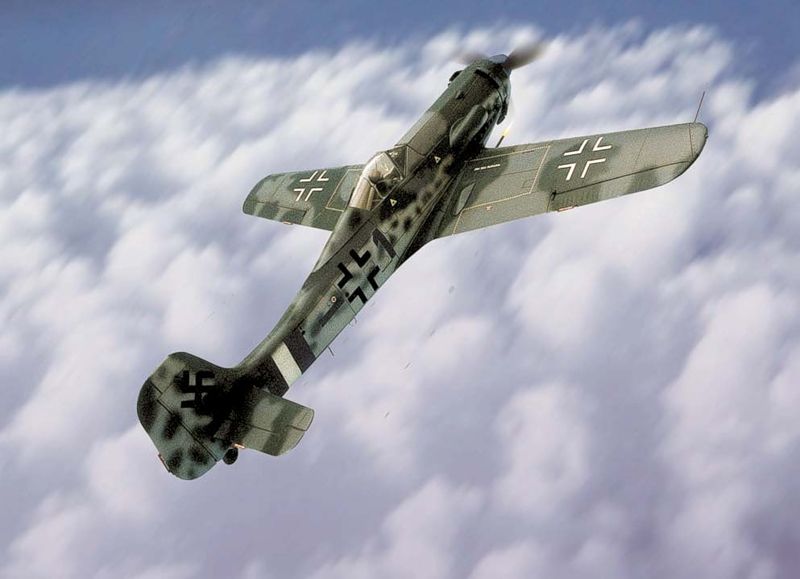


History
The Focke-Wulf Ta 152 was a short-lived advanced interceptor used by the Luftwaffe at the end of World War II. Lengthened fuselage, high altitude/high performance capability using a nitrous oxide powered booster system (one of the first known uses of such a system) and powerful artillery armament to counter the growing presence of Allied bombers , wreaking havoc on German interests across Europe. Unfortunately for the Luftwaffe, the Ta 152 entered service in January 1945, when all its development problems had not been resolved.
This action, combined with the deteriorating situation throughout Germany, ensured that only about 43 production prototypes (sources differing from exact numbers) were delivered since the Imperial War ended in June 1945.
Stop blood loss
Until 1944, hundreds or even thousands of American bombers by day and British bombers by night destroyed German infrastructure and manufacturing capabilities. In addition, news of the new high-altitude long-range Boeing B-29 superfortress quickly spread throughout the German establishment, and the pressing issue of defending their military industry quickly became critical.
As a result, the Air Ministry (RLM) sought new requirements for high-altitude interceptors and turned to the proven Messerschmitt and Focke-Wulf companies for a viable solution. By this point, Messerschmitt had proven their mastery of the skies with their Bf 109 single-seat fighter (one of the most produced military aircraft at the time) and later the Schwalbe Me 262 jet fighter.
Likewise, the Focke-Wulf office provided a potential winner of the war for the development and subsequent production of the excellent Fw 190 single-seat fighter.
Fork Wolf Fw 190D-9
Starting with the Fw 190D-9, Focke-Wulf and the famous German aircraft engineer Kurt Tank started work. The Fw 190D ("Dora") was a long nose production fighter of the base Fw 190, improved overall and clearly distinguished from earlier Fw 190 forms by its streamlined design and annular fairing. The Fw 190D-9 became the final Fw 190 production fighter for the Luftwaffe in the fall of 1944 and was highly regarded by both parties as Germany's best entry-level piston engine in the postwar years, hitting 426 mph and armed with a pair of guns , and was further supported by a pair of machine guns.
Water-methanol is used to boost the engine power of the Junkers Jumo 213A to an impressive 2,240 hp for heavy duty work at heights.
Fork Wolf Ta 152
The Fw 190D-9 was modified by Focke-Wulf to meet the new RLM requirements in three different prototypes - Fighter, High Altitude Fighter and Ground Attack Platform. Only the high-altitude prototype survived further evaluation, evolving into the Ta 152C prototype.
The fighter and ground attack versions were completely abandoned, the Messerschmitt template - the Bf 109H (based on the Bf 109G with pressurized cockpit and extended wings) - was not accepted by the RLM and was released on 18 July 1944 Dropped from testing, the Ta 152 and the upcoming Me 262 proved better options at high altitudes.
The "Ta" name of the Ta 152 comes from the first two letters of the designer Kurt Tank's surname, in honor of his early contributions to the Focke-Wulf Company (the "152" part of the name is more generally designated by the RLM). Ta The 152 series itself had three different production variants from the start - the Ta 152C low-altitude fighter, the Ta 152E fighter reconnaissance platform and the Ta 152H high-altitude fighter.
The heart of the Ta 152 is nothing more than a heavily modified Fw 190. The fuselage remained largely intact, but was significantly lengthened to accommodate the new center of gravity of the fuselage. The wings have also undergone significant changes, lengthening the original Fw 190 by 35 feet 5 inches (the H model is 48 feet 6 inches, and the C model is 36 feet 1 inches).
All tail surfaces have been increased, and the flaps and landing gear are now hydraulically controlled (as opposed to electric). Other features include a pressurized cockpit (model H), upgraded radios, a navigation system, autopilot and a heated front armored windshield (the latter for combating freezing temperatures at high altitudes).
On the wings are fuel tanks, MW 50 methanol in water (for low altitude operations - rated below 32,800 feet) and GM-1 nitrous oxide (required for high performance high altitude flight).
Ta 152 power
Kurt Tank originally wanted the Ta 152 to be powered by a Daimler-Benz DB 603 production engine, but that engine's earlier mating with the Fw 190C was deemed too moody by the Luftwaffe, forcing Tank to do his The design effort uses a liquid-cooled, inverted V12 engine from the Junkers Jumo 213E series, which delivers up to 1,750 horsepower. The Junkers Jumo 213E series is a high-altitude version of the Jumo 213A/C series already used on the Fw 190D models.
The engine uses a three-speed, two-stage supercharger and relies on a 50 MW methanol-water mixture to boost the engine's overall performance, especially at high altitudes where the air gets thinner. The Ta 152 reportedly had a top speed of 472 mph, a substantial increase from the 426 demonstrated by the similar Fw 190D-9 - making it on par or higher than anything the Allies could deploy at the time. The range of 1,240 miles is equally impressive, and with the onboard GM-1 booster, the Ta 152 could have a service ceiling of over 48,550 feet. The rate of climb is approximately 3,445 feet per minute, allowing the aircraft to rapidly accelerate to high altitudes to fight oncoming bombers and fighter jets.
Ultimately, the Ta 152 design proved to be one of the fastest piston-powered aircraft of the entire war.
Focke-Wulf Ta 152 Weapon
Since the Ta 152 was designed to kill enemy bombers, it required a heavy "hit" against the armored sector. Thus, the armament was concentrated on 30mm Mk 108 series guns mounted in the hub of the propeller and firing through the center of the rotating propeller. This was further aided by a pair of 20mm MG 151/20 cannons, one mounted on the leading edge of each wing and at the root of the wing.
This addition to armament ensures that Ta 152 pilots only need to fire a quick salvo against an enemy bomber's critical components, such as the cockpit or engine, to knock out or completely destroy a target.
Operating Services Focke-Wulf Ta 152
With the deteriorating war effort of the German Empire, the Ta 152 was put into production and service as quickly as possible. Of course, this was bad for the entire Ta 152 program, as their design quickly developed a number of critical issues - complex engine layouts and cooling systems often proved unreliable, pressurized cockpits that couldn't stand due to leaking gaskets is under pressure. Nonetheless, in November 1944, the desperate Luftwaffe received at least 20 pre-production models from Erprobungskommando for operational evaluation.
3. / Jagdgeschwader 301 converted to Ta 152 in January 1945 (the only Luftwaffe squadron to deploy Ta 152), but operated them only in limited numbers and with limited success, usually responsible for protecting developing jet fighters air force base. The JG 301 proved to be one of the last high-altitude combat squadrons of the Luftwaffe, consisting of the advanced Ta 152 and a series of fighters including Walter Luce, Joseph "Jup" Kiel and Willie Reschke Ace composition.
A number of factors ended up adversely affecting the Ta 152 and its pilots, and combat proved elusive at one point. In this case, the Ta 152 piloted by Reschke had to abandon the pursuit of the twin-engine RAF de Havilland DH. 98 Mosquito engine failure caused Ta 152 to withdraw from combat.
However, further action resulted in at least one fast New Zealand Hawker Tempest fighter later being used on Reschke, and the Ta 152 was used against invading Soviet forces in the crucial Battle of Berlin, in which Reschke shot down two Soviet Yaks - 9 fighters in processing. Keil is thought to have shot down a North American P-51 Mustang and a Republic P-47 Thunderbolt while flying the Ta 152, as well as at least three other deaths - although some sources limit Keil's record to just four flying Ta 152s s plane. /p]
The Ta 152 pilots are credited with only getting a fairly small number of total air victories (sources vary, but ranged from 7 to 10 enemy aircraft), but lost four of their own. At the time of the official surrender of Germany, only two Ta 152 prototypes were known to be operational. Spare parts, trained pilots, and fuel/oil supplies proved to be difficult commodities as the Allies captured the ground, seized airfields, covered important bridges and had vital supply routes.
Ta 152 pilots are said to have barely 20 minutes of flying time on the Ta 152 before being put into active duty with their new mounts - not a recipe for success, but that was the case with the Luftwaffe.
Focke-Wulf Ta 152 variant
There are many notable versions of the Ta 152 - including prototypes. This started with the pre-production model Ta 152 C-0, of which only one example was built. The model is equipped with a 2,100 hp Daimler-Benz DB503LA engine. The Ta 152 C-1 followed with an engine-mounted 30mm gun and 4 x 20mm guns - one pair on the front cowl and the other on the wing roots. The Ta 152 C-2 received improved radio equipment.
Ta 152 C-3 is similar to C-1. The Ta 152 E-1 is a professional photographic reconnaissance platform based on the Ta 152C production fighter model. The Ta 152 E-2 is a high-altitude variant equipped with Junkers Jumo 213E series engines and a longer wingspan for high-altitude operations. In the end only one product was completed.
The Ta 152 H-0 model appeared in 20 pre-production forms with long wings for high altitudes. The Ta 152 H-1 remains the only official production model of the Ta 152 series. This model also has tall and long wings, and the armament consists of a centralized 30mm gun and only 2 x 20mm guns.
Japanese Ta 152
Like other German creations during the war, Allied Japan was eager for the latest and greatest military weapons the Germans had to offer to improve their deteriorating situation in the Pacific. In April 1945, the Empire received a production license for the deployment of new Kurt tank destroyers on Japanese soil.
However, no known production of the Japanese Ta 152 is believed to have occurred, as the war in Germany ended in May 1945 and Japan soon followed in August. As a result, Germany remained the only truly active operator of the Ta 152 throughout the life of the aircraft.
Today's Focke-Wulf Ta 152
Surprisingly, a Ta 152 that survived a military purge in postwar Germany is currently awaiting restoration in the back room of the National Air and Space Museum in Washington, DC. This particular Fang is believed to be the Ta 152 H-0 model.
Specification
Basic
Production
Roles
- Fighter
- Intercept
Dimensions
35.50 ft (10.82 m)
14.44m
3.36m
Weight
8,887 lbs (4,031 kg)
11,502 lb (5,217 kg)
Performance
Performance
472 mph (759 km/h; 410 knots)
48,556 ft (14,800 m; 9.2 mi)
1,243 miles (2,000 km; 1,080 nautical miles)
1,050 m/min
Armor
Default:
1 x 30mm MK108 cannon mounted on the engine and fired through the propeller hub.
2 x 20mm MG151/20 cannons mounted on the leading edge of the wing root.
Changes
Ta 152C-0 - Pre-production example; making a single prototype; powered by a Daimler-Benz DB603LA engine, 2100 hp; lengthened fuselage and increased stern area; increased wingspan.
Ta 152C-1 - 1 x 30mm gun on nose, 2 x 20mm gun on hood, 2 x 20mm gun on wing; winglet version.
Ta 152C-2 - Improved radio; winglet version.
Ta 152C-3 - 1 x 30mm gun in nose, 2 x 20mm gun in nose, 2 x 20mm in wing; winglet version.
Ta 152E-1 - Dedicated photographic reconnaissance aircraft based on the Ta 152C production fighter model.
Ta 152E-2 - High-altitude interceptor; equipped with Junkers Jumo 213E engines; long-wing version; single prototype example completed.
Ta 152H-0 - Pre-production variant; Longwing version; 20 copies made.
Ta 152H-1 - Main production model; 1 x 30mm gun in nose and 2 x 20mm guns in wing; long-wing variant.
 Argentina
 Armenia
 Australia
 Austria
 Austria-Hungary
 Belgium
 Brazil
 United Kingdom
 United States
 Brunei
 Bulgaria
 Canada
 Chile
Chile China
China Colonial America
 Colombia
 Confederate States
 Croatia
 Czech
Czech Denmark
 Egypt
Egypt Finland
 France
 Georgia
 Germany
 German Imperial
 Greece
 Holland
 Hungary
 India
India Indonesia
 Iran
Iran Iraq
Iraq Ireland
 Israel
 Italy
Italy Japan
Japan Japan (1940)
 Jordan
 Kingdom of Italy
 Malaysia
 Mexico
 Myanmar
 Netherlands
 New Zealand
 North Korea
 Norway
 Pakistan
 Peru
Peru Philippines
 Poland
 Portugal
 Prussia
 Romania
 Russia
 Saudi Arabia
 Serbia
 Singapore
 Slovakia
 Slovenia
 South Africa
 South Korea
 Soviet Union
 Spain
Spain Sweden
 Switzerland
 Syria
Syria Taiwan
 Thailand
 Turkey
 UAE
UAE Ukraine
 Vietnam
 Yugoslavia